Aromatics Unit Wastewater Treatment
BTX-grade wastewater treatment with benzene compliance
What this application solves
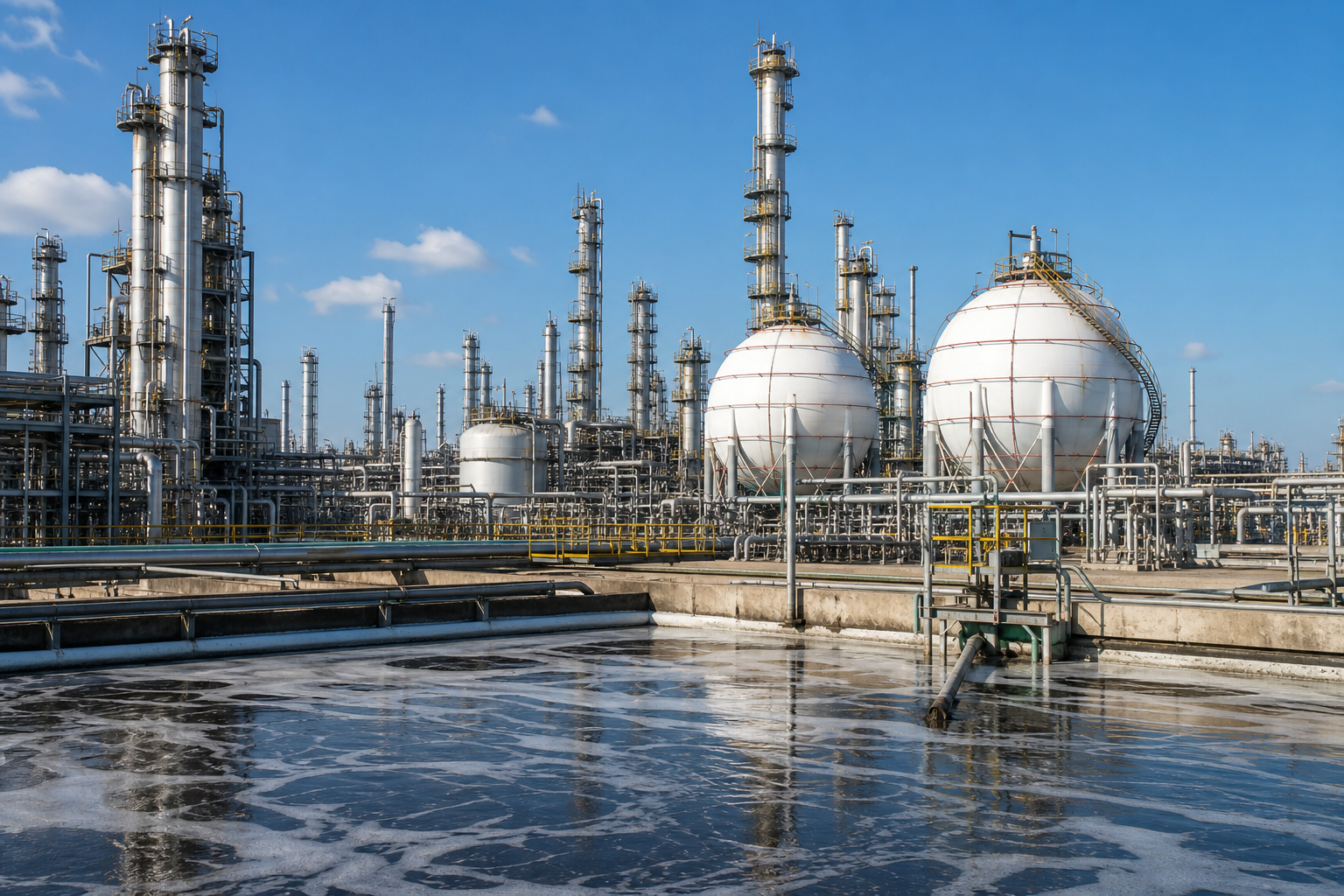
Aromatics (BTX) complexes — reforming, extraction, fractionation and isomerization — produce wastewater containing dissolved and free aromatics, extraction solvents (sulfolane, NMP), and oily condensate. Benzene in particular is strictly regulated in both water and air.
WFS combines oil removal, VOC stripping with vapor capture, and biological/adsorption polishing so that treated water meets benzene and COD limits while volatile emissions are controlled.
Typical influent characteristics
| Parameter | Typical range |
|---|---|
| Benzene | 1 – 200 mg/L |
| BTEX | 10 – 1,000 mg/L |
| COD | 500 – 10,000 mg/L |
| Oil & Grease | 50 – 2,000 mg/L |
| Solvents | variable mg/L |
These ranges frame the design basis. WFS confirms the exact values for your site through laboratory characterization and 24-hour composite sampling, capturing variability across normal, upset and turnaround operation before any equipment is sized.
The problems — and how WFS solves them
- Strict benzene limits in water and air
- Dissolved aromatics & solvents resistant to gravity separation
- Volatile emissions requiring vapor capture
- Solvent (sulfolane) degradation products
- High COD with toxicity to biology
- Oil-water separation & flotation
- Air / steam stripping with vapor-phase carbon
- Biological treatment acclimated to aromatics
- Activated carbon polishing for dissolved aromatics
- Advanced oxidation for refractory solvents
Targets the system is designed to meet
| Performance parameter | Design target |
|---|---|
| Benzene | < 0.05 – 0.5 mg/L |
| BTEX removal | > 99% |
| COD removal | > 90% |
| Oil & Grease | < 10 mg/L |
Guaranteed, tested performance
Every WFS system is commissioned against a documented performance test. We design to the discharge consent, reuse specification or zero-liquid-discharge target — and verify it on site before handover, then sustain it through O&M.
Filtration approach & system required
Free oil is removed first, then volatile aromatics are stripped and captured, then residual dissolved organics are biologically oxidized and carbon-polished. Benzene drives the stripper sizing and the air-emission design.
Where extraction solvents persist, advanced oxidation is added to break down refractory compounds before final polishing.
- Oil-water separators & flotation
- VOC stripping tower with off-gas carbon
- Biological reactor
- Advanced oxidation unit
- Activated carbon polishing vessels
Modular process-train schematic
- 1Oil RemovalCPI separator + DAF
Remove free & emulsified oil
- 2VOC StrippingStripper + vapor-phase GAC
Remove & capture benzene/BTEX
- 3BiologicalAcclimated MBBR / activated sludge
Oxidize dissolved aromatics
- 4Advanced OxidationAOP (UV / peroxide / ozone)
Break refractory solvents
- 5PolishingLiquid-phase GAC
Final dissolved-aromatic removal
Indicative system specification
Layout & general arrangement
Inlet oil removal at grade, the stripping tower and its off-gas carbon block set in a classified area, then biological and polishing units arranged downstream. The AOP unit is placed ahead of final carbon.
Continuous benzene / VOC monitoring is positioned at the stripper and the final outfall.
- 01Oil Removal
- 02VOC Stripping
- 03Biological
- 04Advanced Oxidation
- 05Polishing
What WFS delivers
- 1Aromatics wastewater characterization & design basis
- 2Benzene compliance & air-emission strategy
- 3Stripping, biological & AOP system design
- 4Fabrication, delivery & installation
- 5E&I, area classification & monitoring
- 6Commissioning & benzene/COD performance test
- 7O&M, carbon management & training
From study to continuous O&M
- 01Study & Assess
- 02Characterize Water
- 03Custom Design
- 04Pilot & Trial
- 05Detailed Engineering
- 06Equipment Design
- 07Fabricate
- 08Deliver to Site
- 09Construct
- 10Electrical & Automation
- 11Continuous O&M
Discuss your aromatics unit wastewater treatment project
Share your stream data and target specification — WFS will characterize the water and propose a custom train.