Boiler Feed Water Treatment
Ultrapure, scale-free feed water to protect steam generation
What this application solves
Boilers and steam generators demand feed water that is virtually free of hardness, silica, dissolved oxygen and organics; otherwise scale, corrosion and carryover damage tubes and turbines. WFS designs feed-water trains to the boiler's pressure class and the relevant standards.
Treatment combines clarification, demineralization (RO + EDI or ion exchange) and mechanical/chemical deaeration, plus condensate polishing where recovered condensate is reused.
Typical influent characteristics
| Parameter | Typical range |
|---|---|
| Total Hardness | 50 – 500 mg/L CaCO₃ |
| Silica | 5 – 50 mg/L |
| TDS | 200 – 3,000 mg/L |
| Dissolved O₂ | up to 8 mg/L |
| Conductivity | 300 – 4,000 µS/cm |
These ranges frame the design basis. WFS confirms the exact values for your site through laboratory characterization and 24-hour composite sampling, capturing variability across normal, upset and turnaround operation before any equipment is sized.
The problems — and how WFS solves them
- Scale (hardness, silica) and corrosion control
- Very low silica & conductivity targets for HP boilers
- Dissolved-oxygen removal to prevent pitting
- Condensate contamination (oil / iron) on return
- Reliability — boilers cannot tolerate off-spec water
- Clarification & multimedia filtration
- Softening or two-pass RO for bulk demineralization
- EDI or mixed-bed polishing to ultrapure
- Mechanical deaeration + oxygen scavenger dosing
- Condensate polishing (filtration / ion exchange)
Targets the system is designed to meet
| Performance parameter | Design target |
|---|---|
| Total Hardness | ~ 0 (< 0.02) mg/L |
| Silica | < 0.02 mg/L |
| Conductivity | < 0.1 – 0.2 µS/cm |
| Dissolved O₂ | < 7 ppb |
Guaranteed, tested performance
Every WFS system is commissioned against a documented performance test. We design to the discharge consent, reuse specification or zero-liquid-discharge target — and verify it on site before handover, then sustain it through O&M.
Filtration approach & system required
Purity targets scale with boiler pressure — the higher the pressure, the lower the allowable silica and conductivity, which dictates whether EDI/mixed-bed polishing is needed after RO. Deaeration and scavenger dosing protect against oxygen pitting.
Condensate is polished and reused wherever possible to cut make-up demand and energy.
- Clarification & multimedia filtration
- Two-pass reverse osmosis trains
- EDI / mixed-bed ion exchange
- Deaerator & chemical dosing skids
- Condensate polishing unit
Modular process-train schematic
- 1PretreatmentClarifier + multimedia filter
Remove turbidity & solids
- 2DemineralizationTwo-pass RO
Bulk salt & silica removal
- 3PolishingEDI / mixed-bed IX
Ultrapure, ultra-low silica
- 4DeaerationDeaerator + scavenger
Remove dissolved O₂ / CO₂
- 5Condensate PolishingFilter / IX
Clean returned condensate
Indicative system specification
Layout & general arrangement
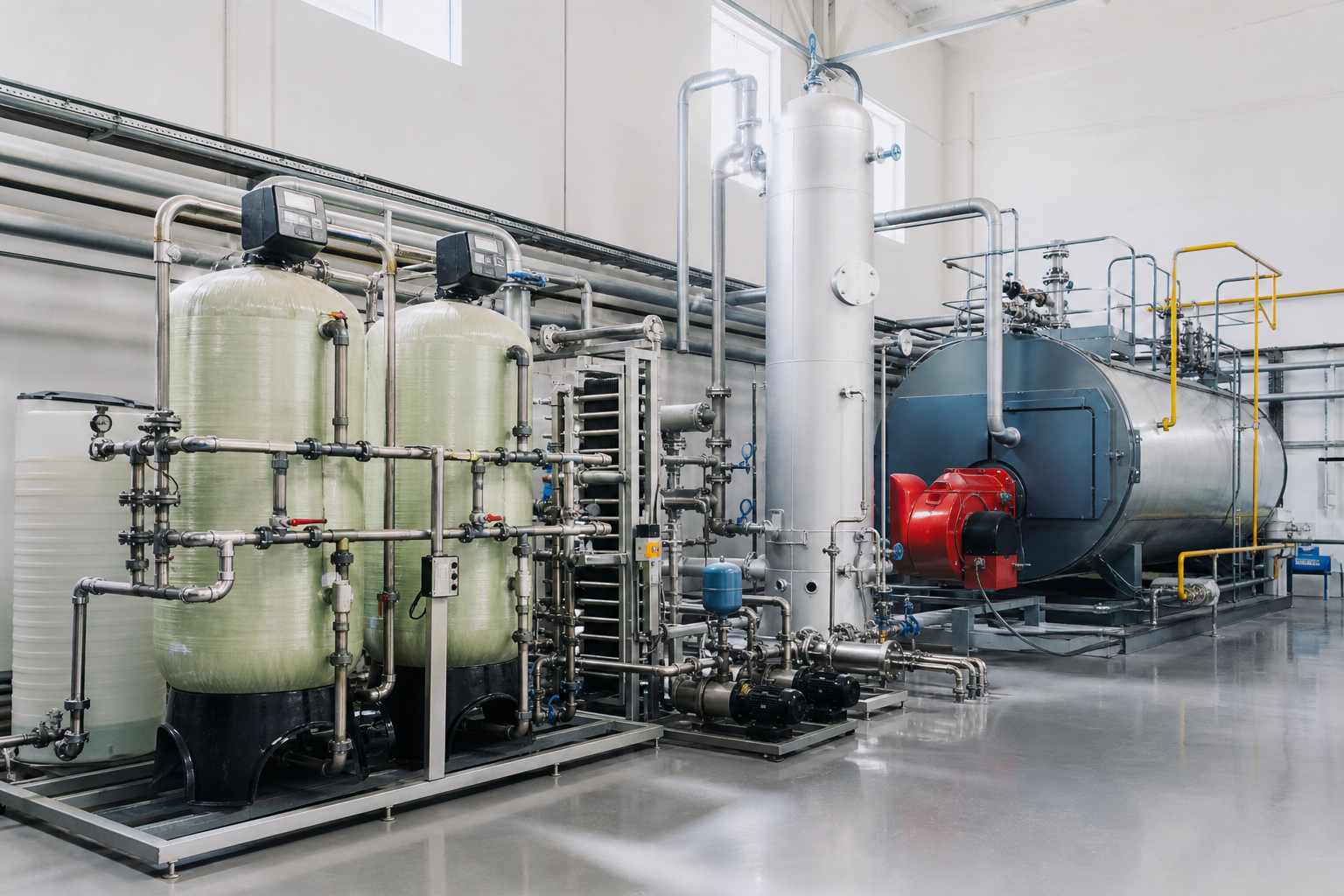
A clean, indoor utility-building layout: pretreatment and RO skids in line, EDI/polishing adjacent, deaerator elevated above the feed pumps for NPSH. Chemical dosing and the control panel are centralized.
Condensate polishing sits near the condensate return header. Full access is provided to membranes, resin vessels and the deaerator.
- 01Pretreatment
- 02Demineralization
- 03Polishing
- 04Deaeration
- 05Condensate Polishing
What WFS delivers
- 1Boiler water spec review & design basis
- 2Make-up & condensate balance
- 3RO / EDI / deaeration system design
- 4Fabricated, factory-tested skids
- 5Installation, tie-ins & commissioning
- 6Automation, dosing control & training
- 7O&M, membrane & resin management
From study to continuous O&M
- 01Study & Assess
- 02Characterize Water
- 03Custom Design
- 04Pilot & Trial
- 05Detailed Engineering
- 06Equipment Design
- 07Fabricate
- 08Deliver to Site
- 09Construct
- 10Electrical & Automation
- 11Continuous O&M
Discuss your boiler feed water treatment project
Share your stream data and target specification — WFS will characterize the water and propose a custom train.