
The full spectrum of water-treatment technology
for oil, gas & petrochemicals
From bulk gravity separation to membrane desalination and advanced oxidation, WFS engineers, builds and operates every unit operation in the modern treatment train — custom-designed to your water and your target specification.
One treatment train, engineered from the right unit operations
No single technology treats every contaminant. Oil appears as free, dispersed and emulsified fractions; water also carries suspended solids, dissolved salts, organics (COD), dissolved gases such as H₂S and ammonia, and micro-organisms — each demanding a different separation or destruction mechanism.
WFS approaches each application as an engineering problem: characterize the water, select the right unit operations, and assemble them into a custom train that reliably meets the discharge, reuse or zero-liquid-discharge objective. The technologies below are the building blocks — organised by the treatment stage at which they act.
Bulk phase separation — free oil, gross solids, grit.
Emulsified oil, fine solids and stabilised colloids.
Dissolved salts, organics, gases — membrane, ion & stripping.
Refractory organics, micro-pollutants, disinfection, biology.
3 Primary · 7 Secondary · 7 Tertiary · 6 Polishing technologies
23 technologies — each with its own engineering page
Select any technology for the underlying science, working mechanism, efficiency, operating parameters, a system schematic, typical specifications and target applications.
 PRIMARY
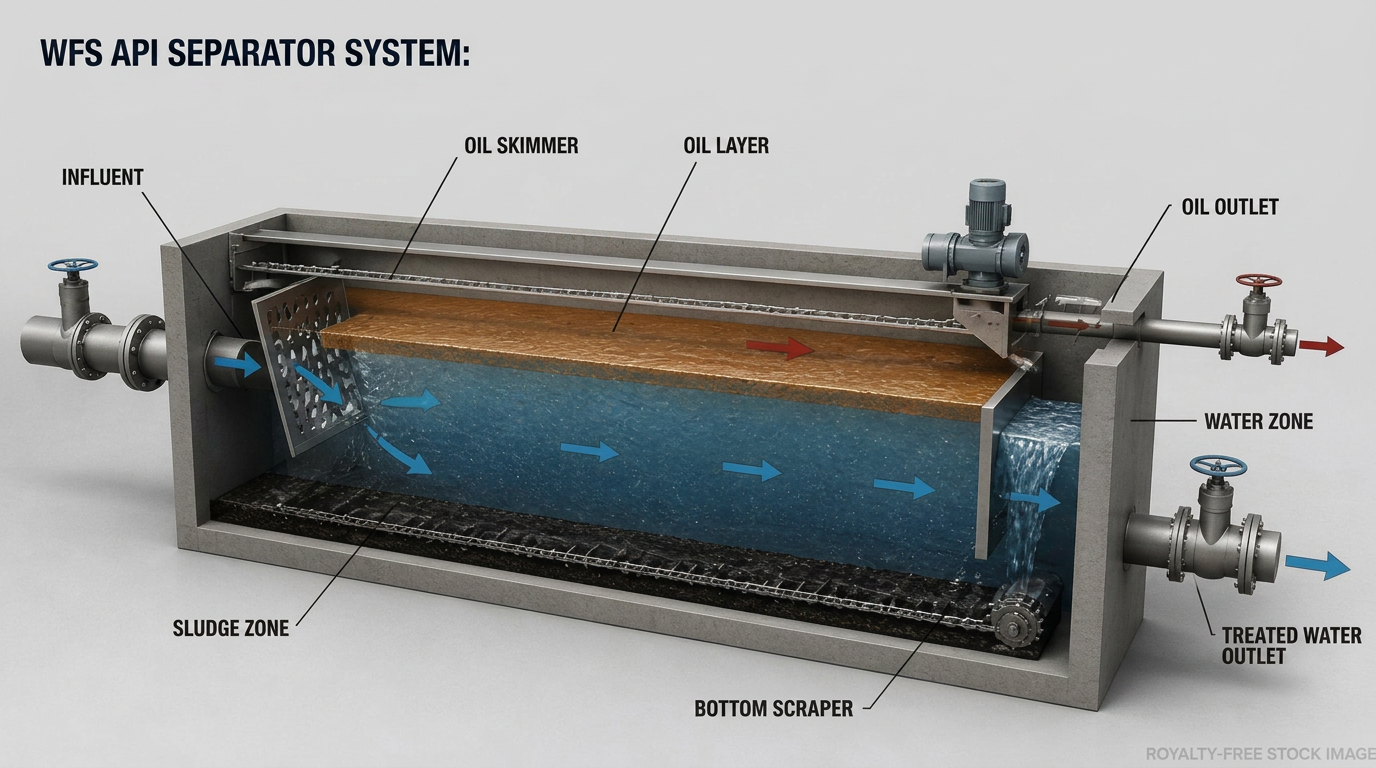
API Separator
APIGravity-based rectangular basin that separates bulk free oil, settleable solids and water by density difference — the robust first stage of nearly every oily-water train.
Explore technology →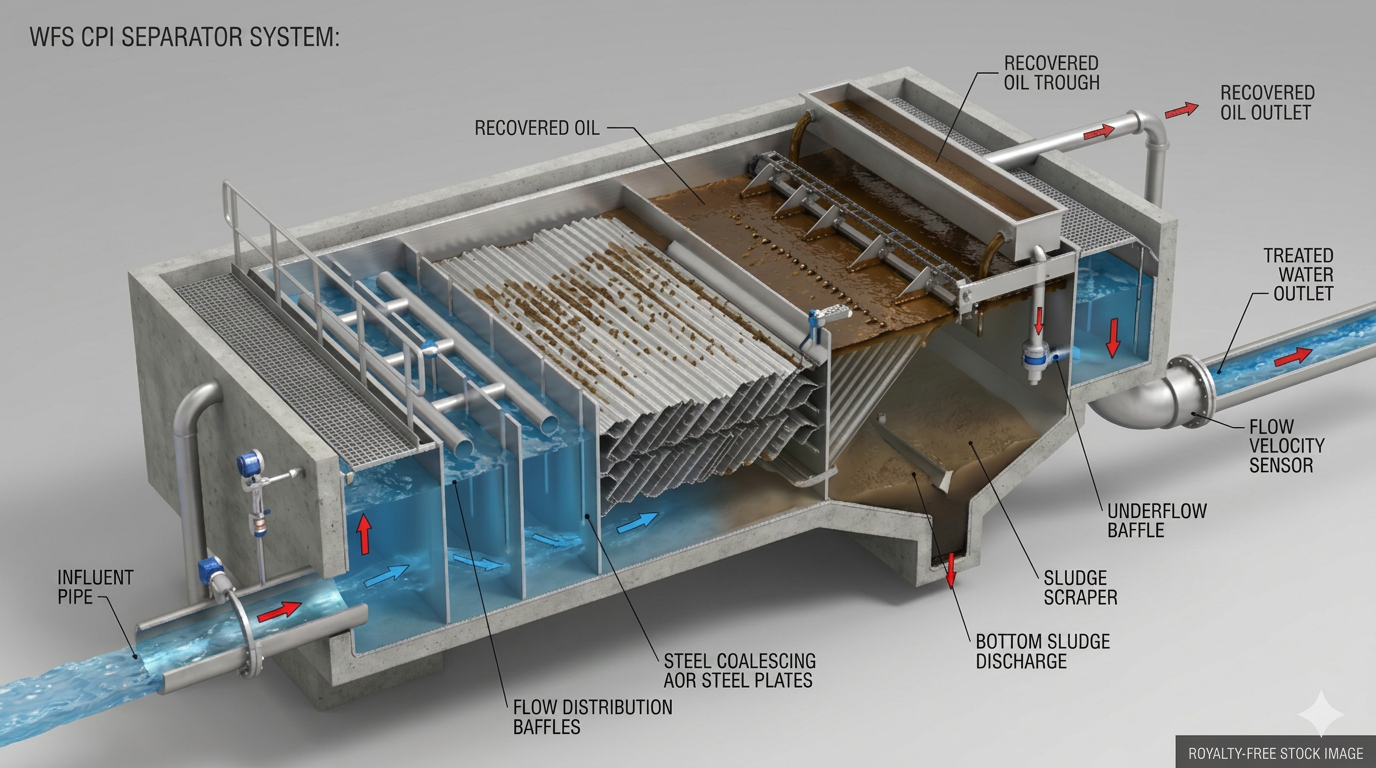 PRIMARY
Corrugated Plate Interceptor
CPIInclined corrugated-plate pack that shortens the distance an oil droplet must rise — delivering API-class separation in a fraction of the footprint.
Explore technology →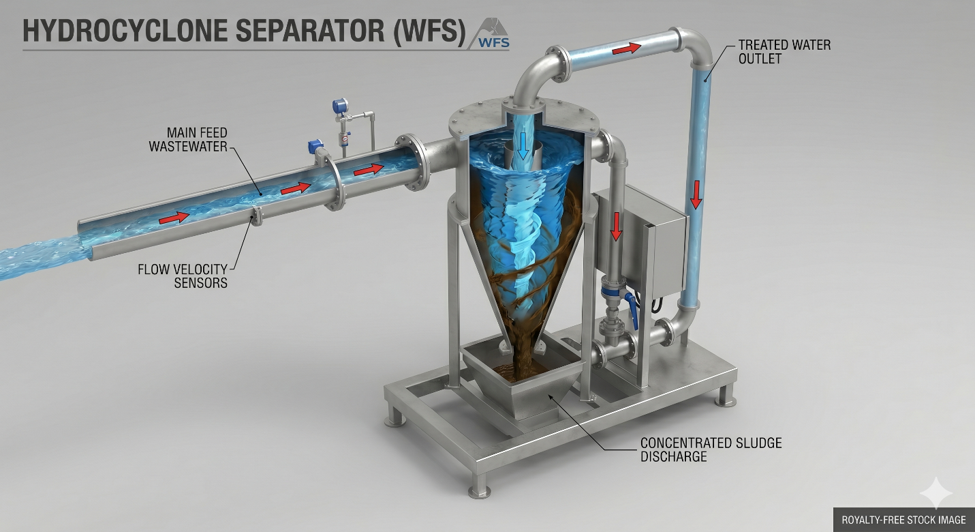 PRIMARY
Hydrocyclones
HCStatic centrifugal de-oilers that spin produced water at thousands of g — separating dispersed oil with no moving parts in a compact, deck-friendly package.
Explore technology →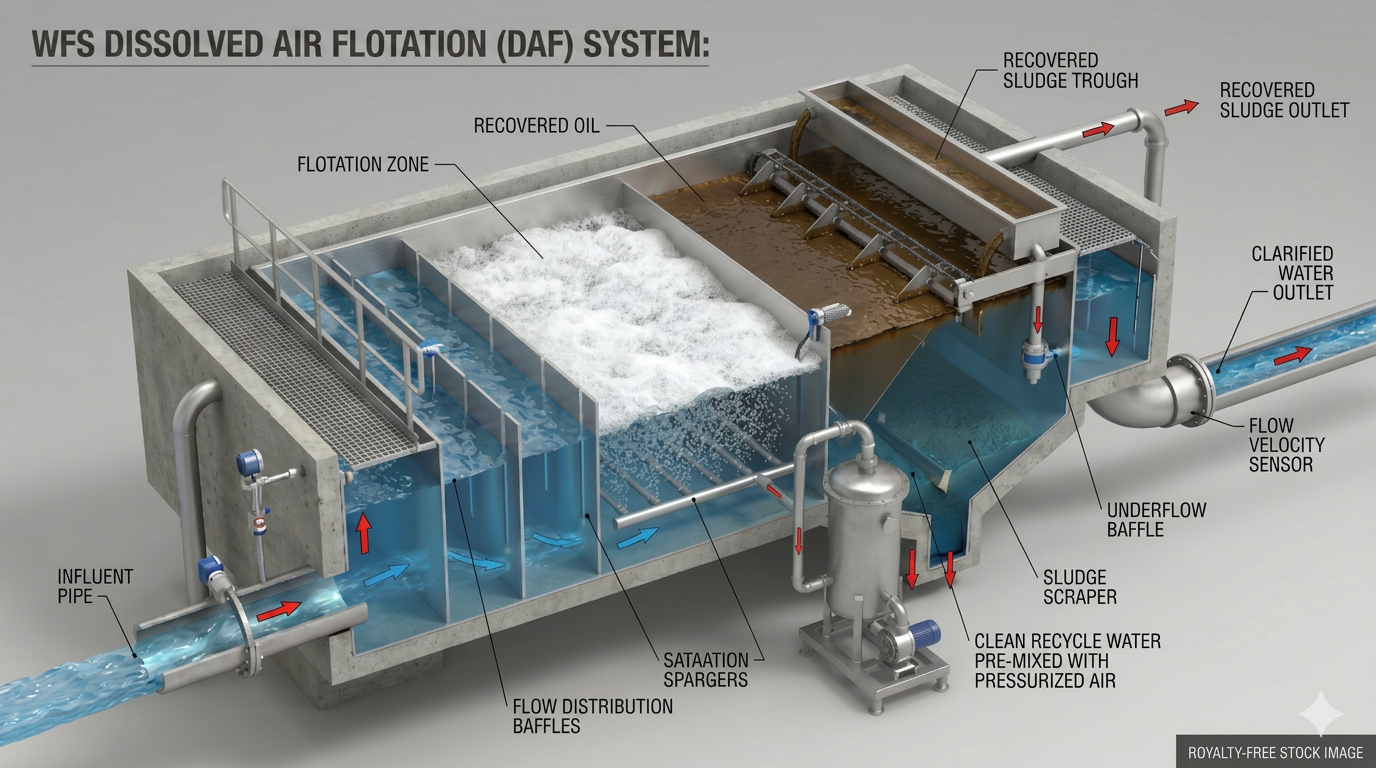 SECONDARY
Dissolved Air Flotation
DAFMicro-bubble flotation that lifts emulsified oil, light solids and chemical floc to the surface — the workhorse secondary de-oiler for emulsified streams.
Explore technology →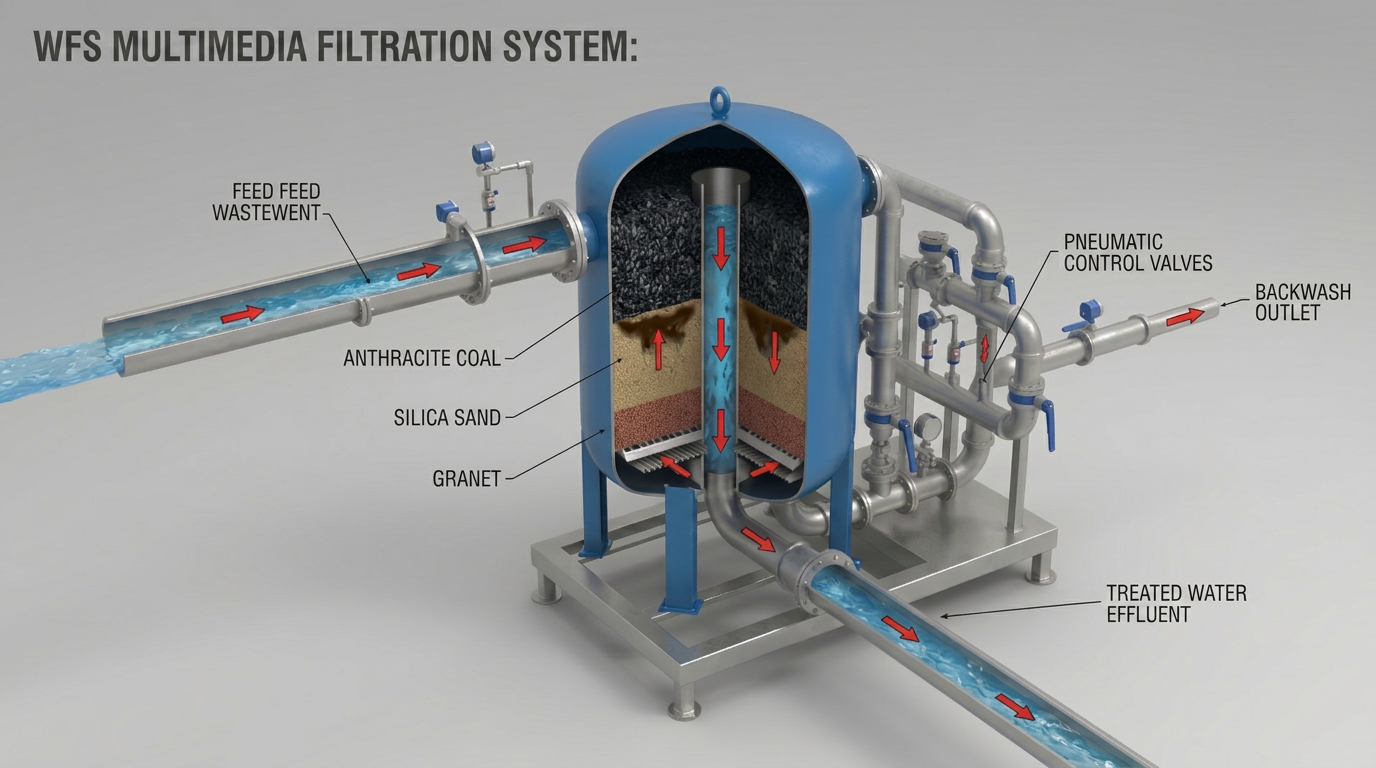 SECONDARY
Multimedia Filtration
MMFLayered anthracite–sand–garnet beds that strain residual suspended solids and oil to protect membranes and ion exchange downstream.
Explore technology →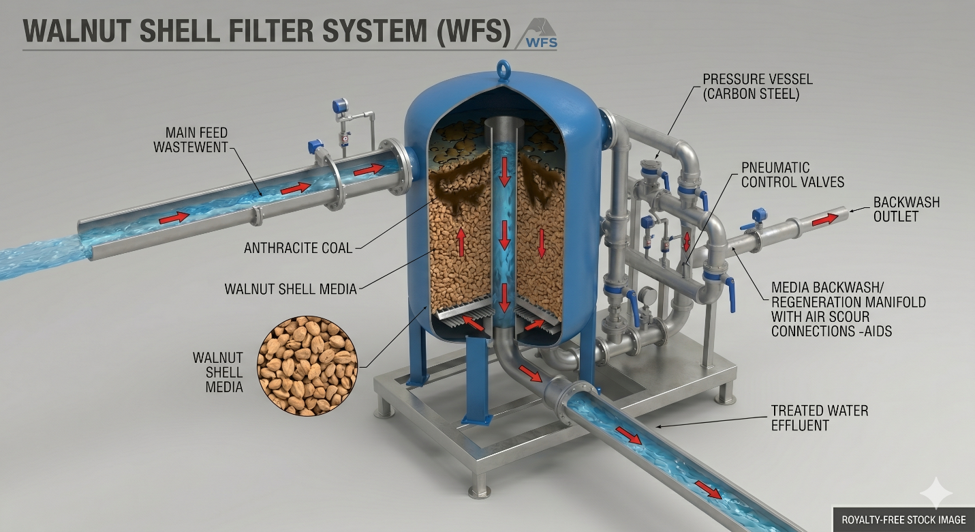 SECONDARY
Walnut Shell Filters
WSFDeep-bed crushed-walnut-shell media with a natural affinity for oil — the produced-water polishing filter that scrubs clean and recovers full capacity.
Explore technology →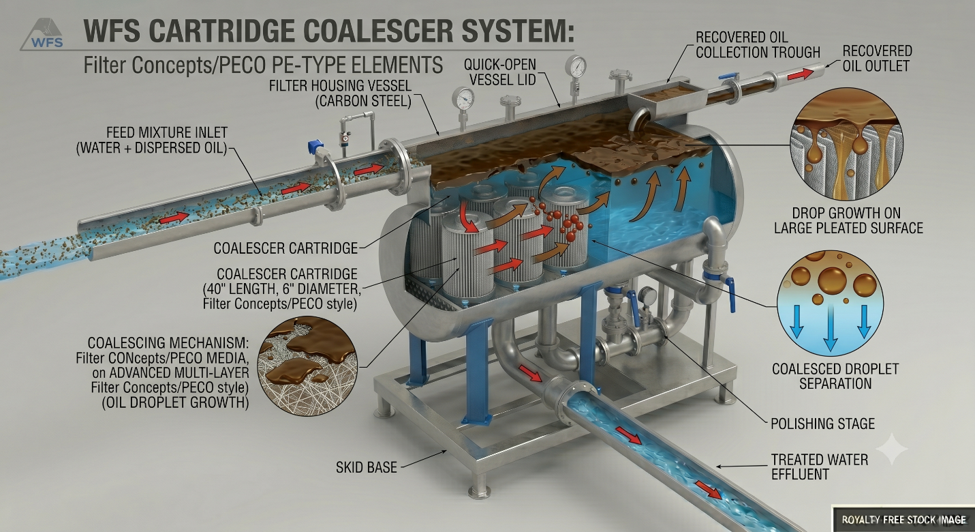 SECONDARY
Coalescers
COALHigh-surface-area media that merge fine dispersed oil droplets into large, easily separated drops — a low-pressure-drop enhancer for gravity de-oiling.
Explore technology →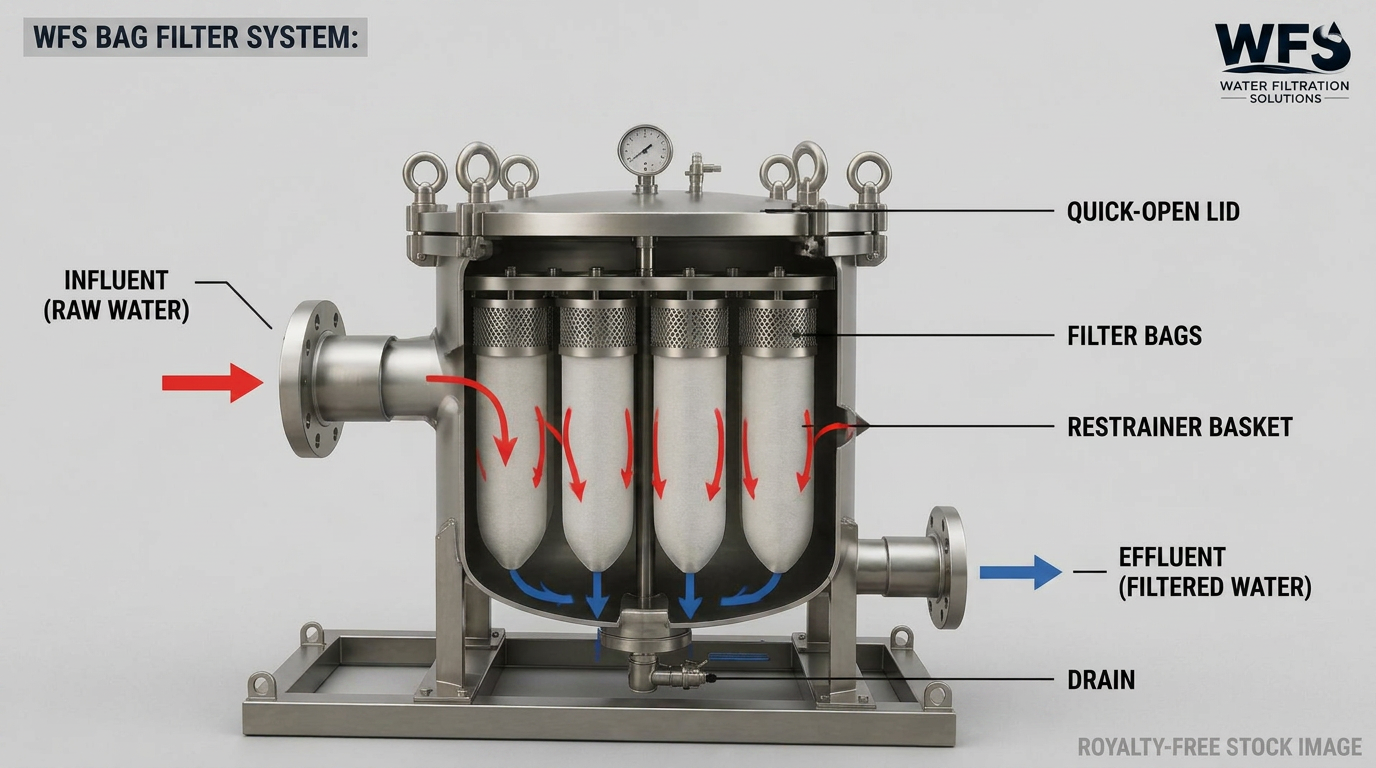 SECONDARY
Bag Filters
BAGReplaceable fabric bags in pressure housings for low-cost, high-flow removal of coarse suspended solids — simple frontline particulate protection.
Explore technology →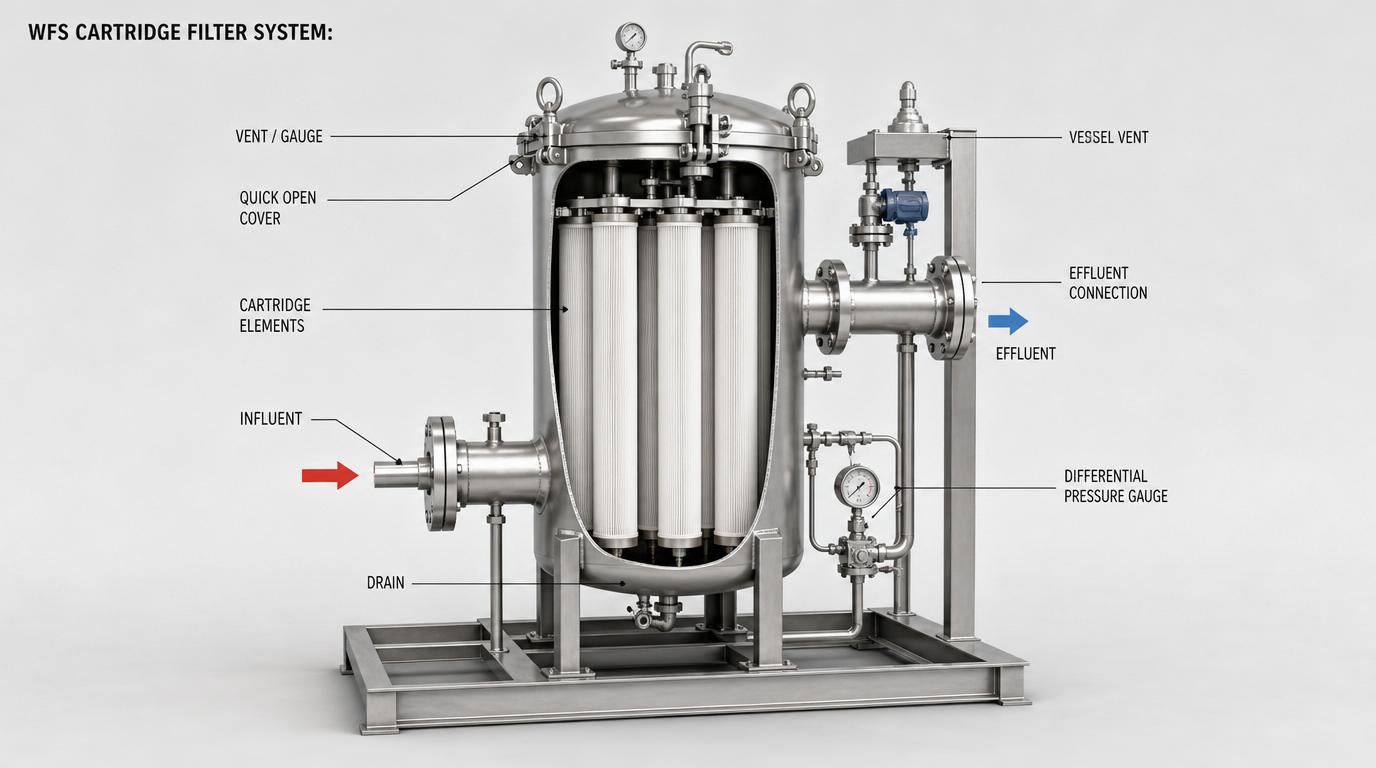 SECONDARY
Cartridge Filters
CARTPleated or wound elements with absolute micron ratings — the final guard filter that protects RO membranes and high-purity systems.
Explore technology →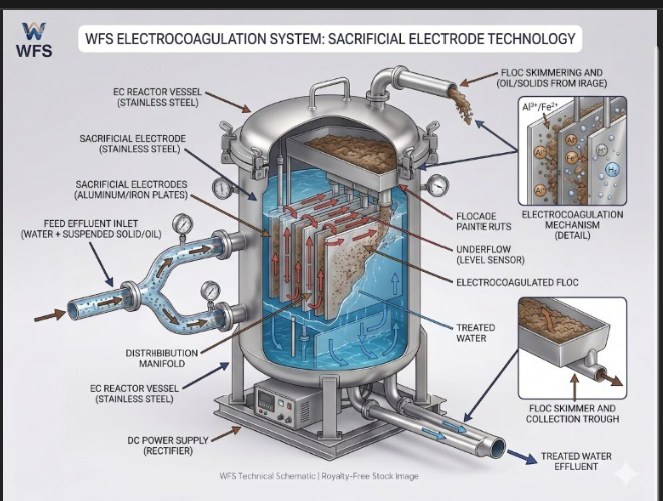 SECONDARY
Electrocoagulation
ECElectrically dosed coagulation that breaks the toughest stable emulsions and precipitates heavy metals — without bulk chemical addition.
Explore technology →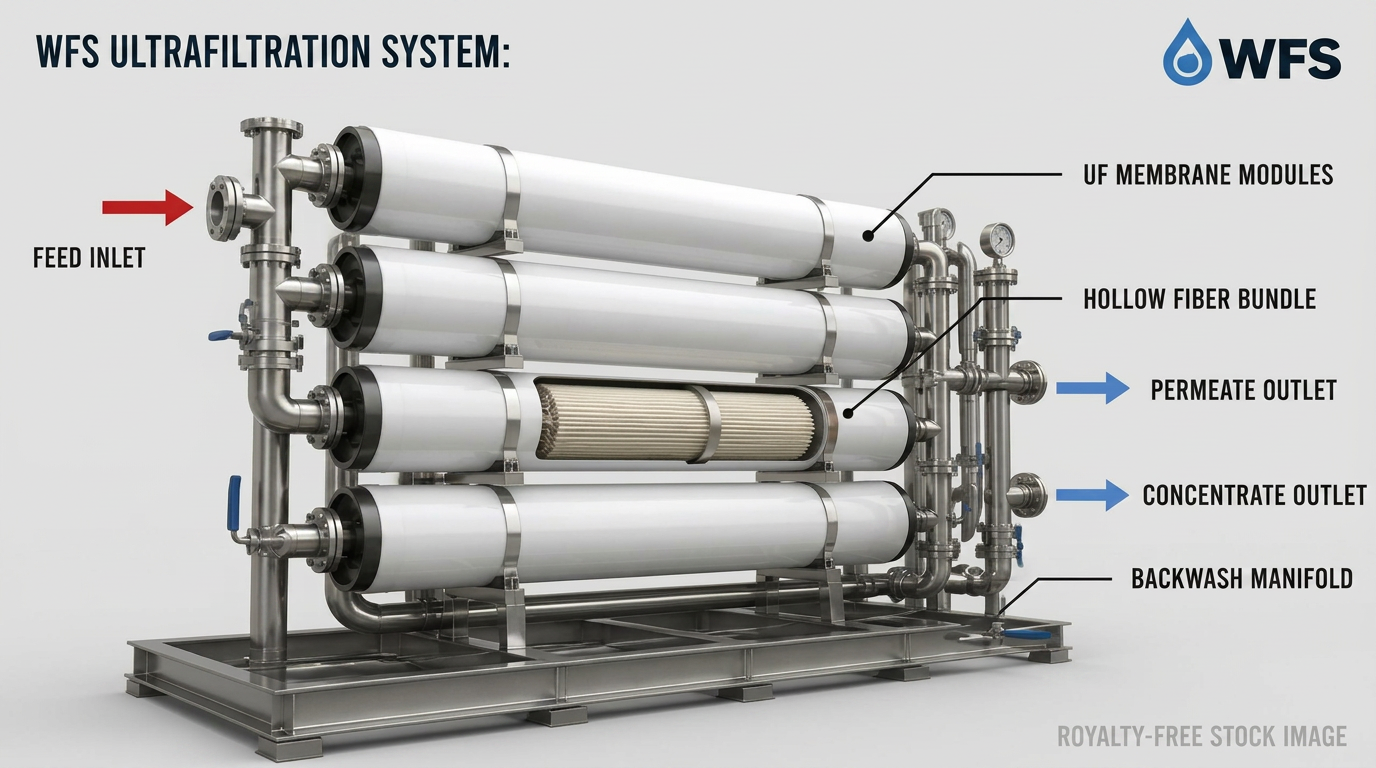 TERTIARY
Ultrafiltration
UFPressure-driven membranes (0.01–0.1 µm) that deliver an absolute barrier to suspended solids, oil, bacteria and viruses — the modern RO pre-treatment standard.
Explore technology →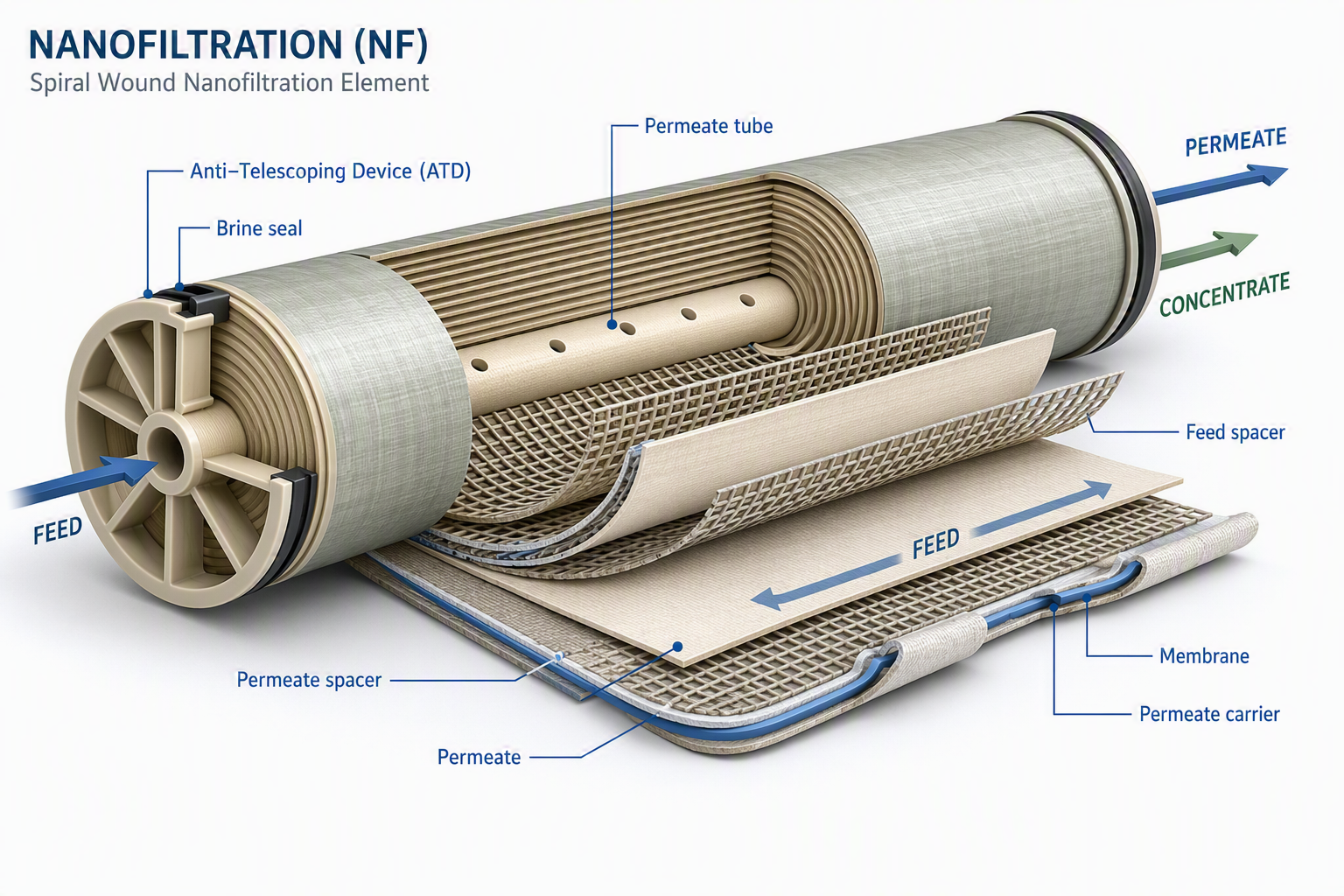 TERTIARY
Nanofiltration
NFLoose membranes (0.001–0.01 µm) that selectively reject divalent ions, hardness, colour and micro-pollutants while passing much of the monovalent salt.
Explore technology →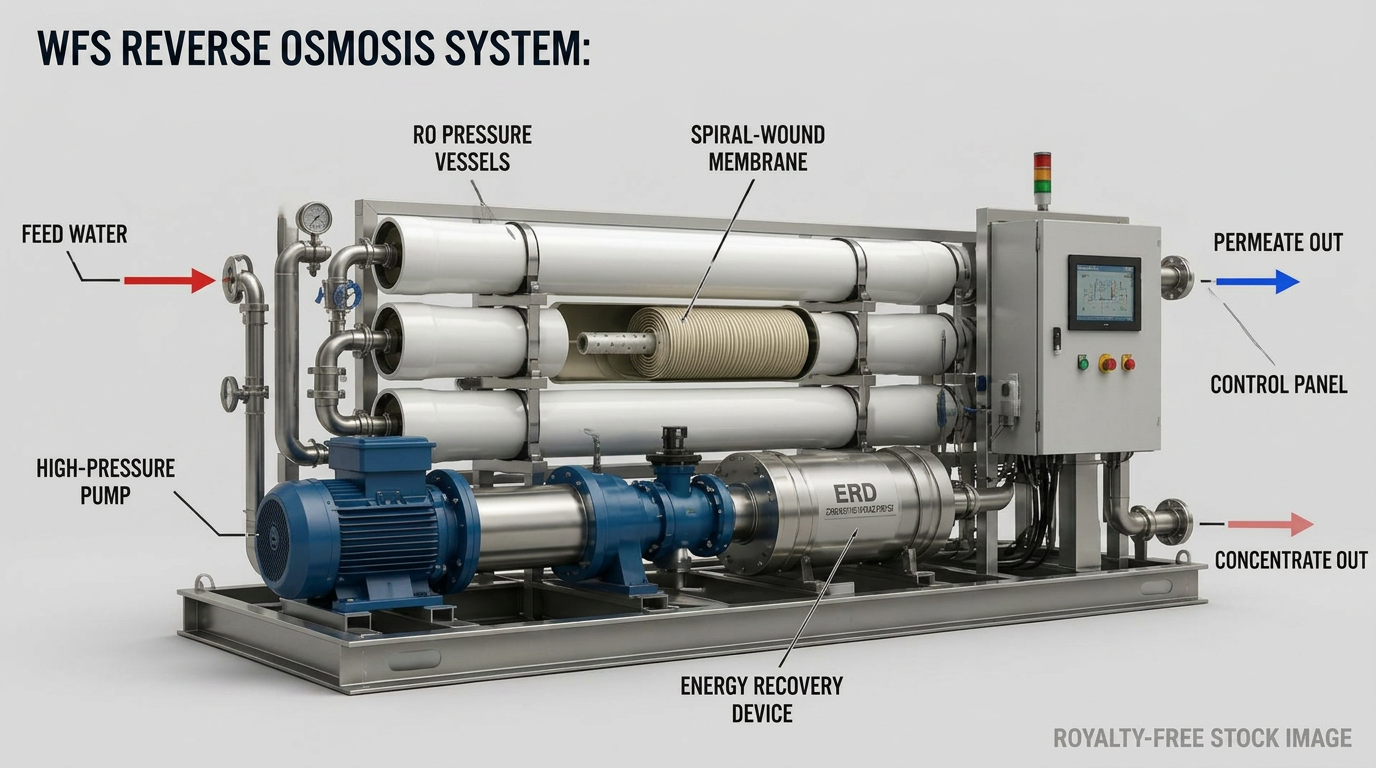 TERTIARY
Reverse Osmosis
ROHigh-pressure semi-permeable membranes that reject dissolved salts and organics to produce near-pure permeate — the backbone of desalination, reuse and ZLD.
Explore technology →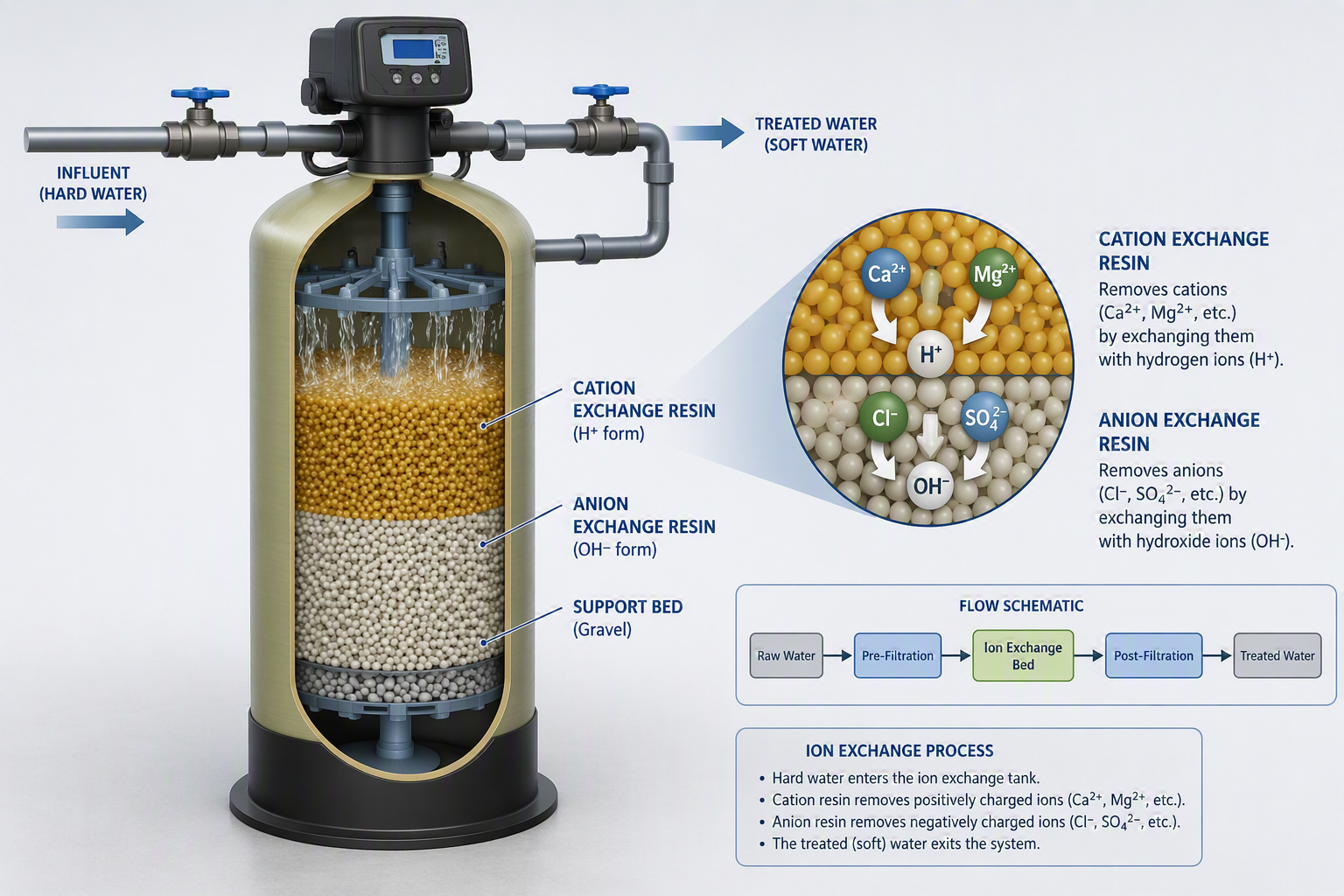 TERTIARY
Ion Exchange
IXSelective resin beds that swap unwanted ions for benign ones — delivering softening, demineralisation and trace heavy-metal capture to ultra-low levels.
Explore technology →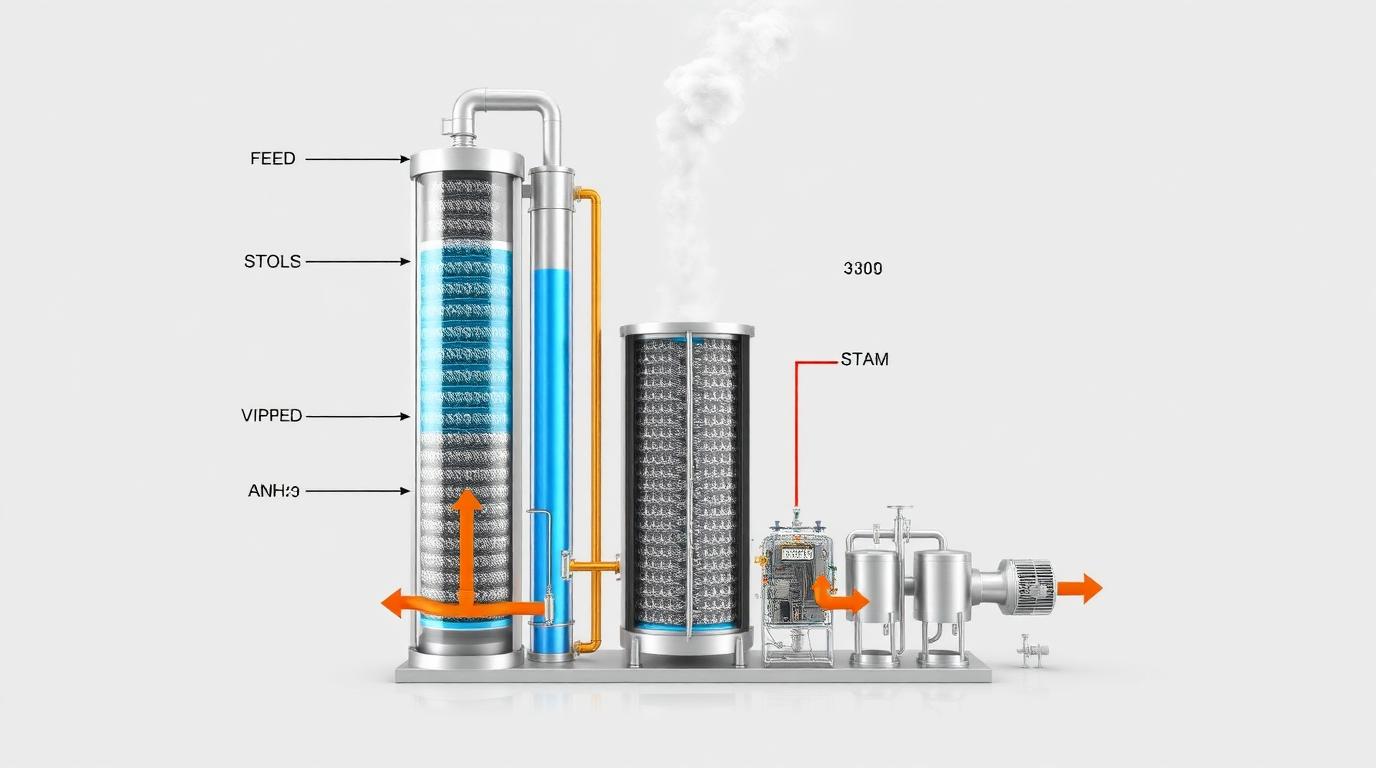 TERTIARY
Sour Water Strippers
SWSSteam-stripping columns that drive dissolved H₂S and ammonia out of refinery sour water — recovering acid gas for the sulphur plant and protecting downstream treatment.
Explore technology →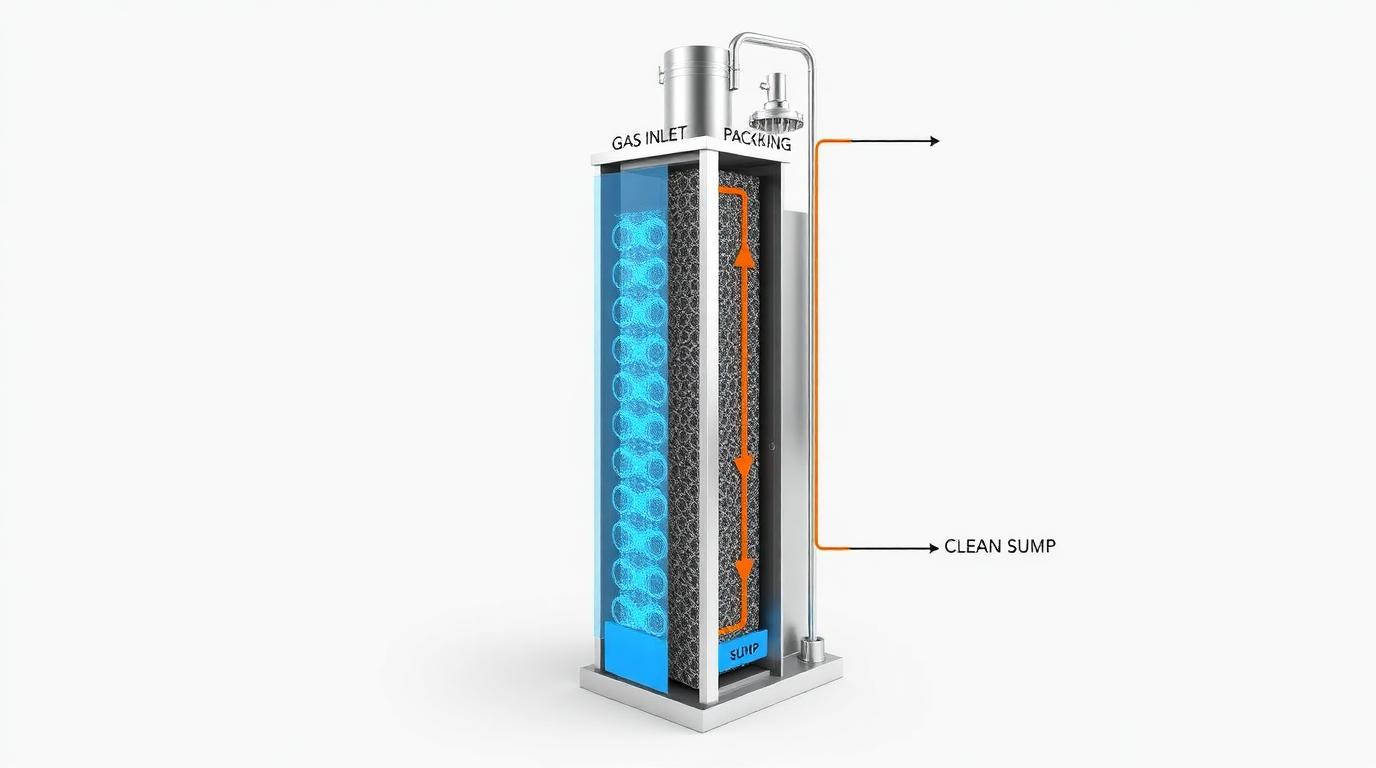 TERTIARY
Wet Scrubbers
WSGas–liquid contact towers that neutralise sour and acid gases and capture particulate — bridging water treatment and emissions control for stripped-gas and vent streams.
Explore technology →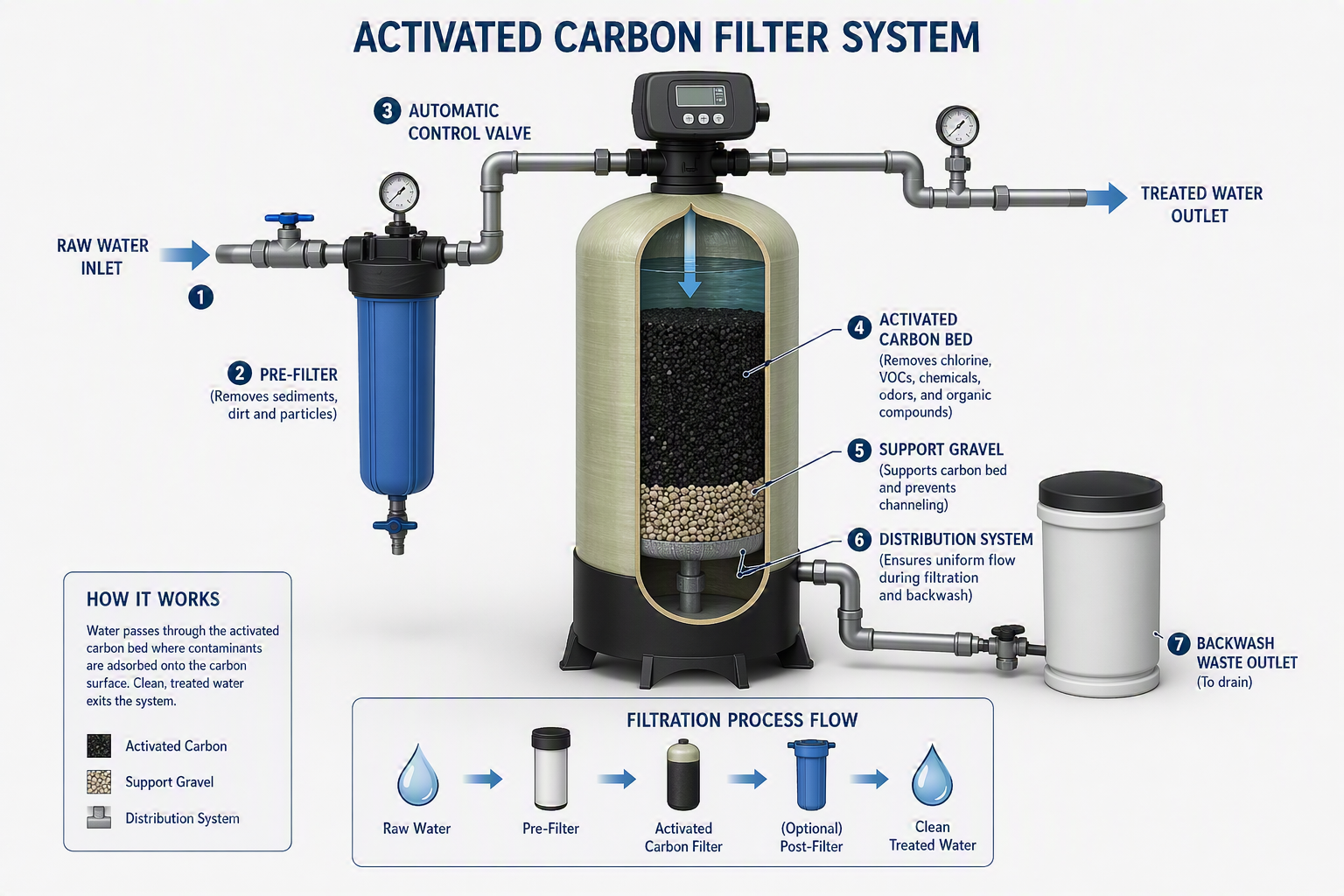 TERTIARY
Activated Carbon Adsorption
GACHigh-surface-area carbon that adsorbs trace hydrocarbons, BTEX, colour and refractory organics — the broad-spectrum organic polishing stage.
Explore technology →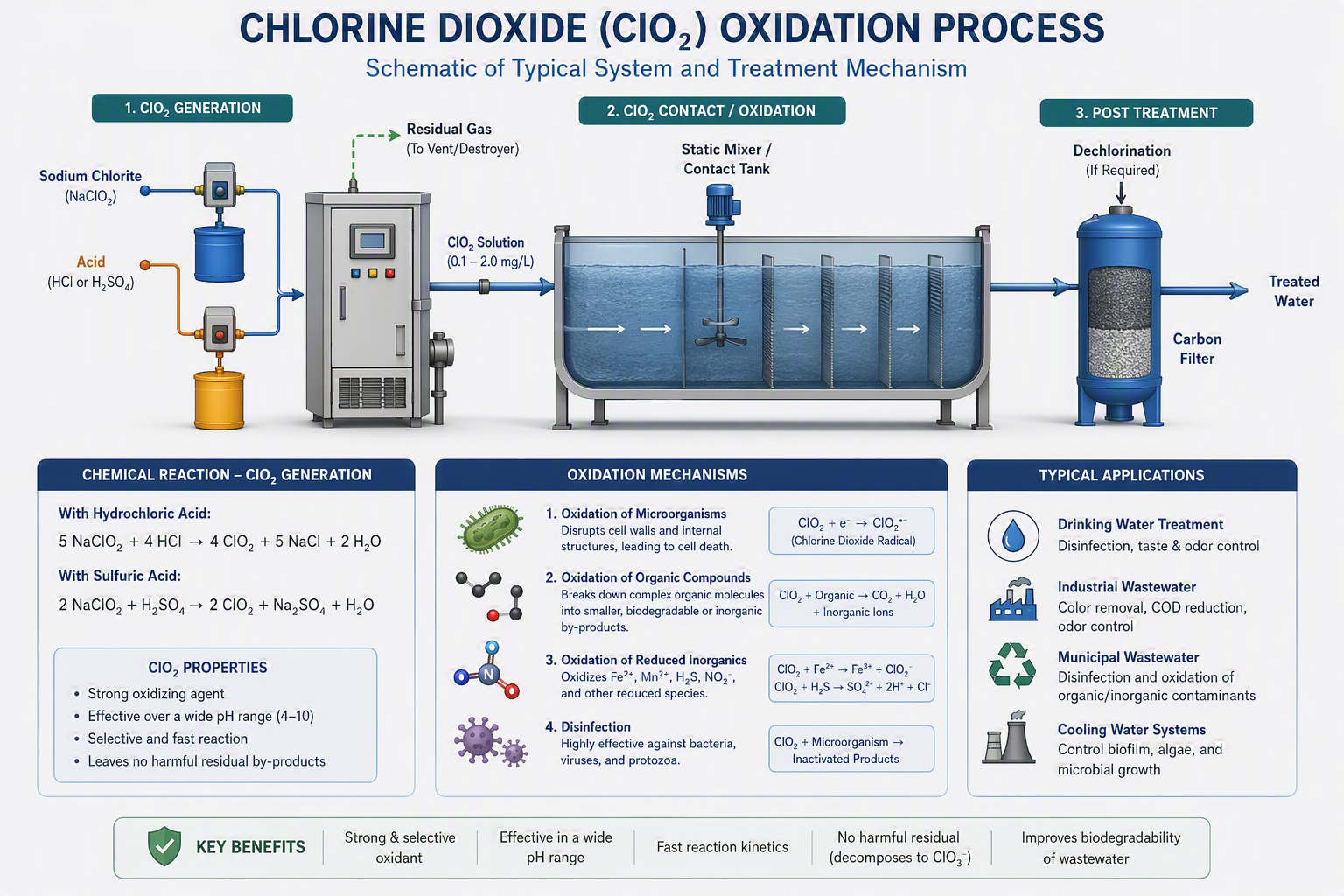 POLISHING
Chlorine Dioxide (ClO₂) Treatment
ClO₂A powerful selective oxidant and biocide dosed on-site — controls biofouling and oxidises sulphides without forming chlorinated by-products.
Explore technology →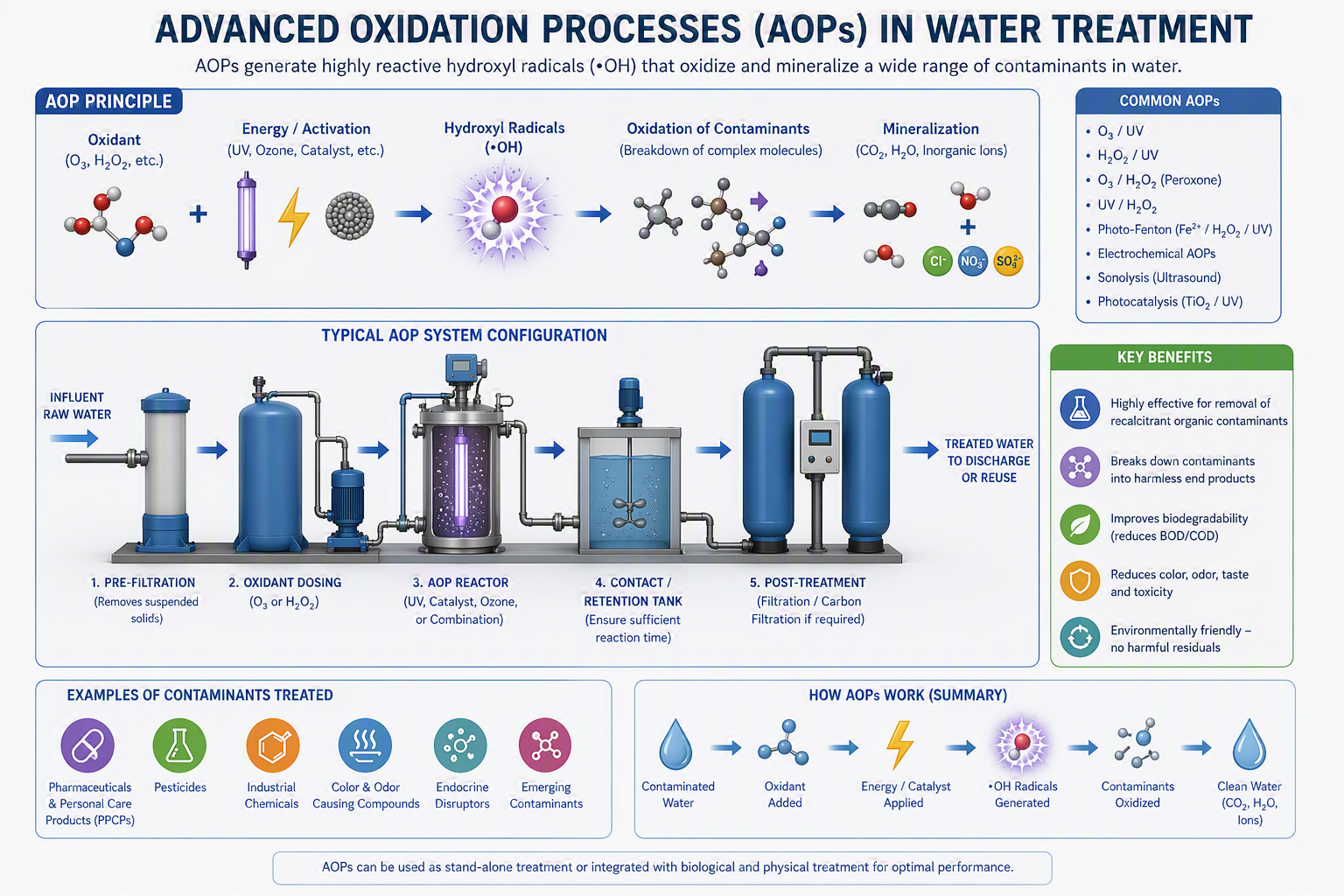 POLISHING
Advanced Oxidation Processes
AOPHydroxyl-radical generation (UV/ozone/peroxide/Fenton) that destroys the most persistent organics outright — mineralising what other processes only transfer.
Explore technology →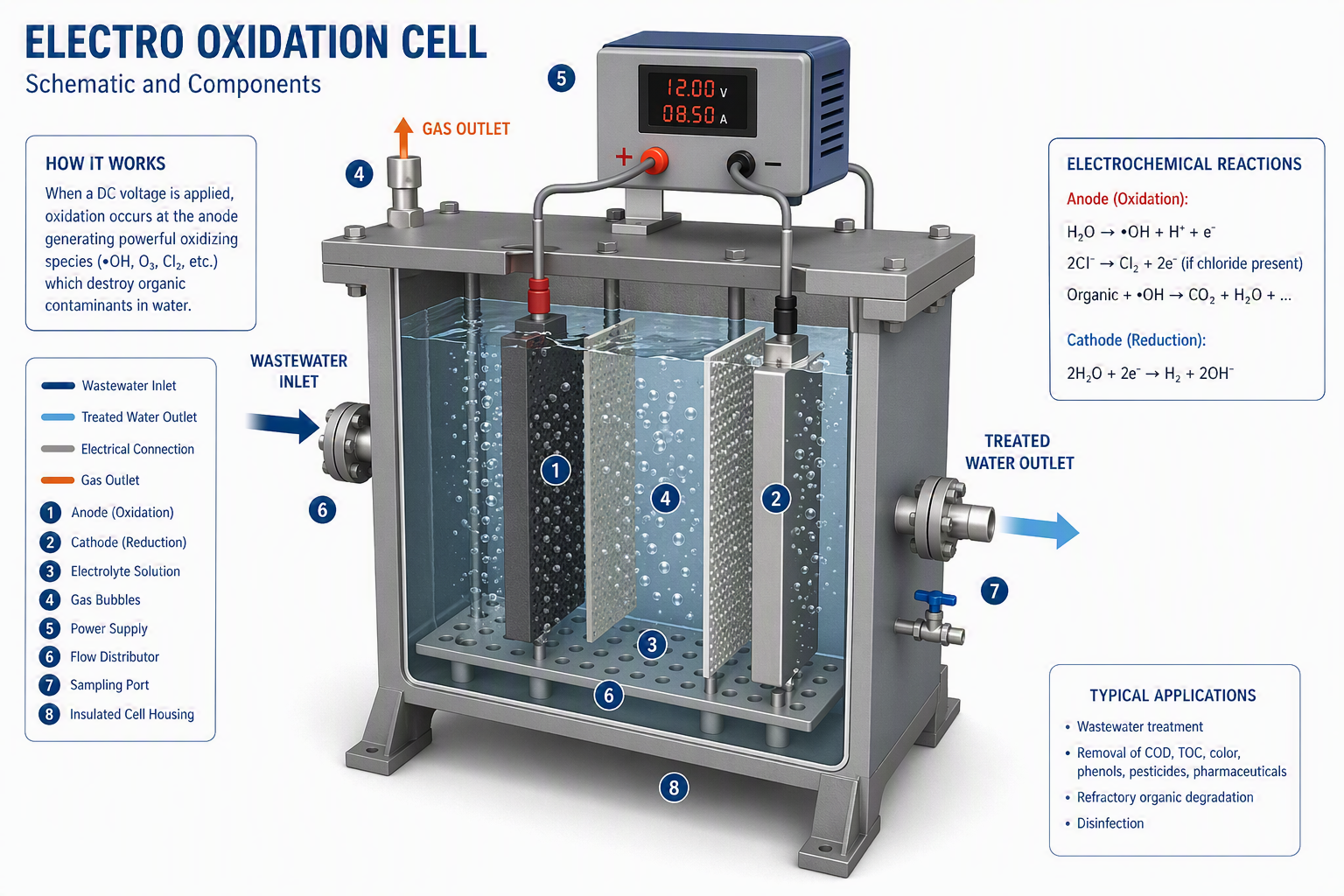 POLISHING
Electro-oxidation
EODirect anodic oxidation at dimensionally stable electrodes that destroys refractory organics and ammonia in high-salinity brines — chemical-free advanced oxidation.
Explore technology →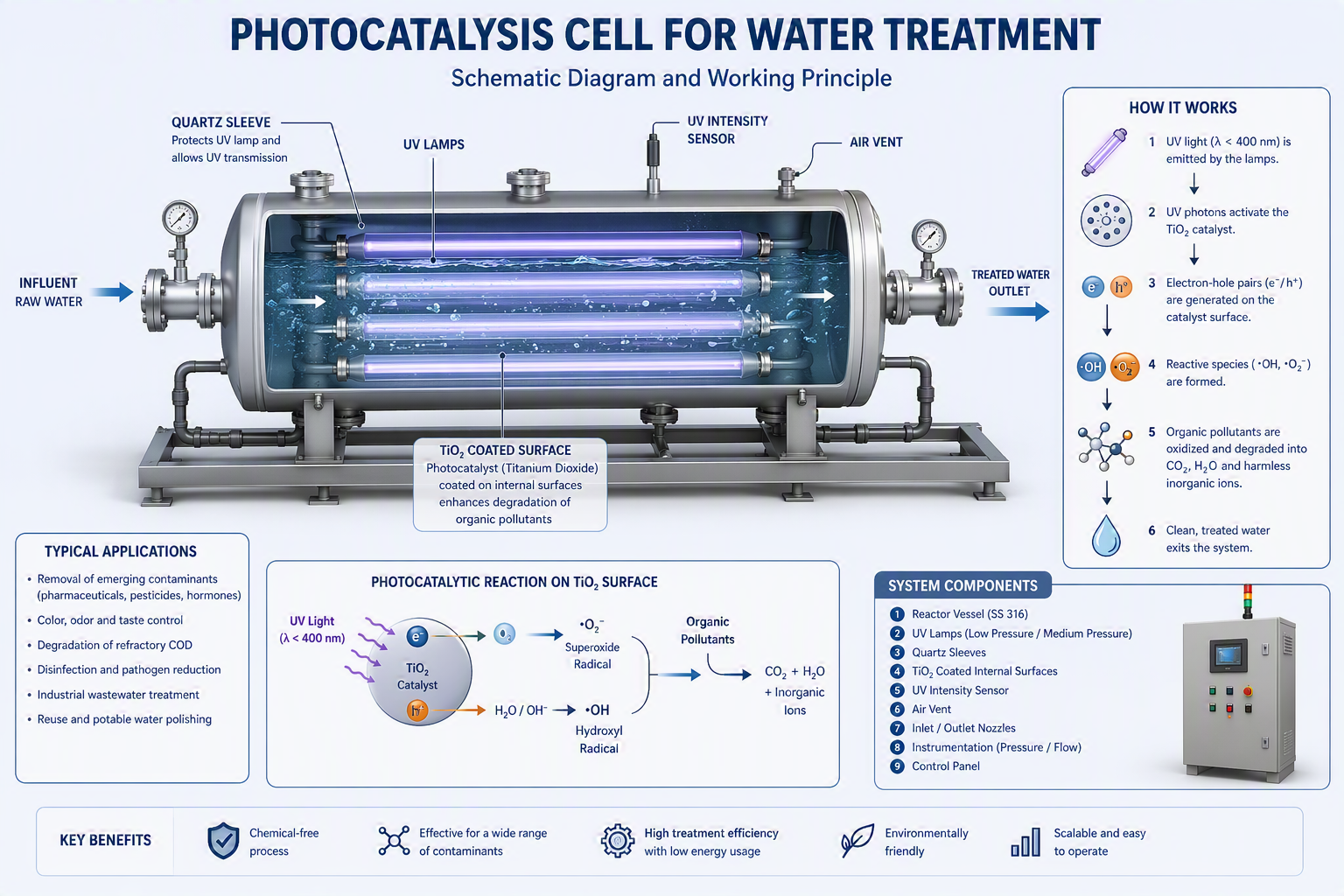 POLISHING
Photocatalysis
PCUV-activated semiconductor catalysts (TiO₂) that generate reactive radicals from light — a green advanced-oxidation route that breaks down complex organics.
Explore technology →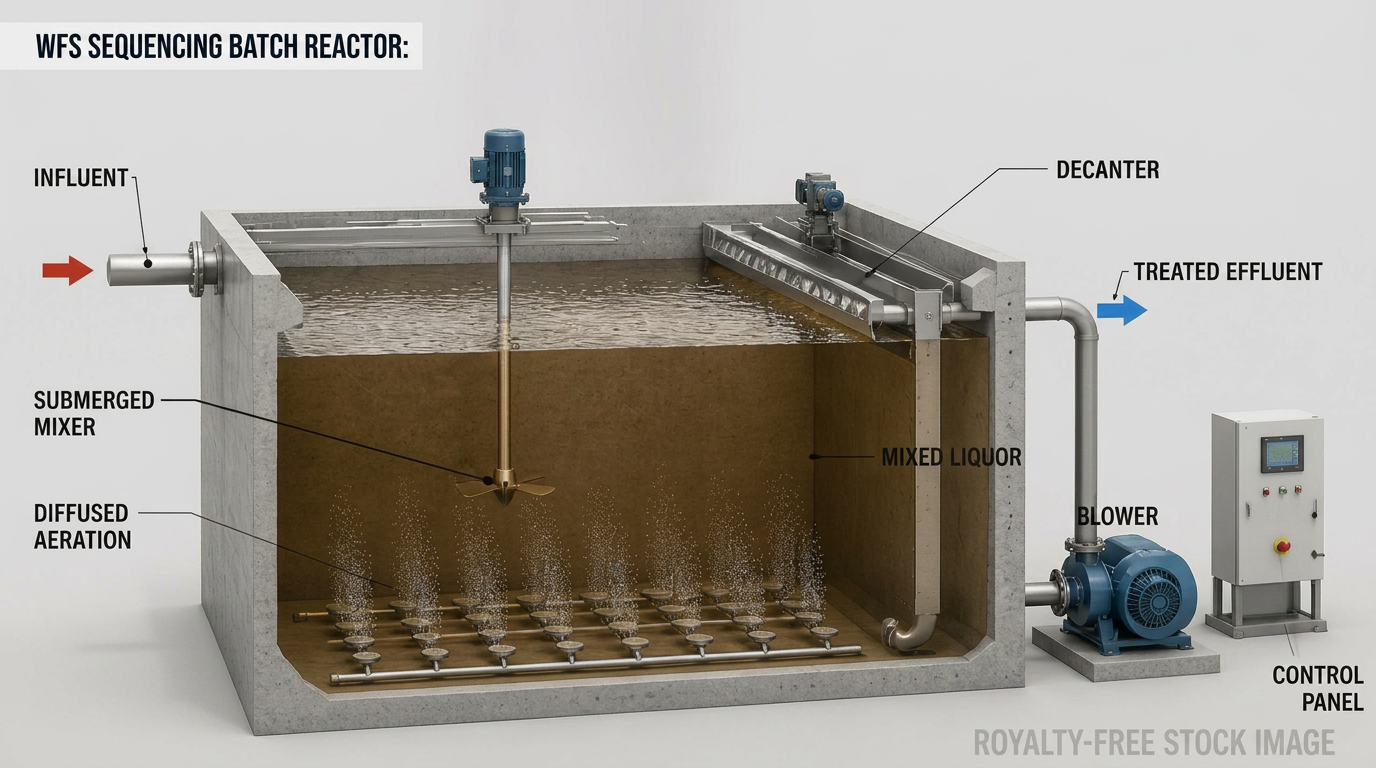 POLISHING
Sequencing Batch Reactor
SBRA fill-and-draw activated-sludge process that performs equalisation, biological oxidation and clarification in one tank — compact, flexible biological polishing.
Explore technology →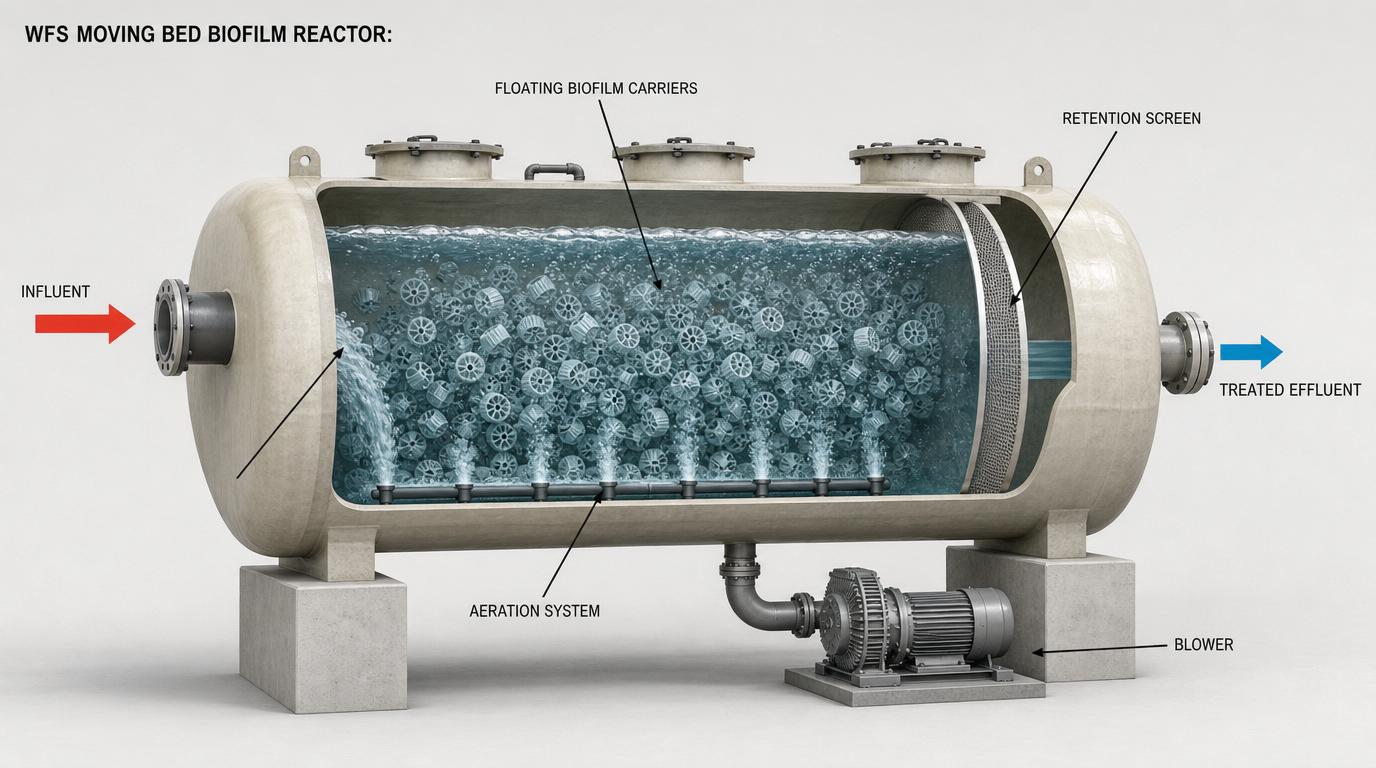 POLISHING
Moving Bed Biofilm Reactor
MBBRContinuous biofilm process on floating plastic carriers — high biomass, small footprint and strong resilience to toxic and load shocks.
Explore technology →Classification, specifications, advantages & limitations
How each technology is classified, what it does, and where it excels or falls short — the engineer's shortlist at a glance.
| Technology | Class | Specifications | Advantages | Limitations |
|---|---|---|---|---|
| API Separator | PRIMARY | Gravity-based, rectangular basins for bulk phase separation. | Low cost, robust, handles massive flow rates and slugs. | Large footprint; ineffective on emulsified oil fractions. |
| Corrugated Plate Interceptor | PRIMARY | Gravity-based with inclined plates to reduce settling distance. | Small footprint; significantly higher efficiency than API. | Susceptible to clogging from heavy solids; plates require chemical washing. |
| Hydrocyclones | PRIMARY | Centrifugal force, high pressure-drop liquid–liquid / solid separation. | Extremely compact, no moving parts, efficient on concentrated streams. | Very sensitive to feed flow and pressure; high shear risk. |
| Dissolved Air Flotation | SECONDARY | Micro-air bubbles attach to suspended matter to float it to surface. | Excellent for emulsified oil and light colloidal solids. | Chemical-intensive; produces wet sludge scum. |
| Multimedia Filtration | SECONDARY | Fixed-bed multi-layered filtration (anthracite / sand / gravel). | Handles high solids loading; reliable; low operating cost. | Frequent backwashing; media can be permanently fouled by oil. |
| Walnut Shell Filters | SECONDARY | Deep-bed media filtration using crushed walnut shells. | Excellent oil affinity; easily cleaned by vigorous backwashing. | Requires periodic mechanical attrition and media make-up. |
| Coalescers | SECONDARY | High-surface-area mesh / packing for oil-droplet growth. | Low pressure drop; highly effective at coalescing micro-droplets. | High fouling risk with high solids or surfactants. |
| Bag Filters | SECONDARY | Replaceable fabric bags in pressure vessels; nominal filtration. | Low capital cost; easy manual replacement; good for coarse solids. | Manual batch replacement; high running cost under heavy solids. |
| Cartridge Filters | SECONDARY | Replaceable pleated or wound elements; absolute micron rating. | Precise absolute filtration; ideal downstream-membrane protection. | Non-cleanable elements; costly as a primary filter. |
| Electrocoagulation | SECONDARY | Sacrificial anodes (Al/Fe) release ions via current to destabilise emulsions. | Removes stable emulsions and metals with minimal chemical dosing. | Anode passivation and plate replacement; high power use. |
| Ultrafiltration | TERTIARY | Pressure-driven membrane separation (0.01 – 0.1 µm). | Excellent removal of macromolecules, viruses, bacteria, fine colloids. | Surface fouling; requires regular chemical cleaning. |
| Nanofiltration | TERTIARY | Pressure-driven membrane separation (0.001 – 0.01 µm). | Removes divalent ions, pesticides and colour molecules. | High pressure; scaling risk from hardness/sulphate. |
| Reverse Osmosis | TERTIARY | High-pressure semi-permeable membrane overcoming osmotic pressure. | Near-pure permeate; reliable desalter and reuse feed. | High energy; produces concentrated brine reject. |
| Ion Exchange | TERTIARY | Synthetic resin beads exchange target ionic species. | Highly selective; achieves ultra-low dissolved-metal concentrations. | Needs chemical regenerants; creates hazardous waste stream. |
| Sour Water Strippers | TERTIARY | Steam-stripping columns to remove dissolved H₂S and NH₃. | Efficient acid-gas recovery for sulphur-plant feed. | High steam demand; corrosive duty needs premium alloys. |
| Wet Scrubbers | TERTIARY | Gas–liquid contact towers with packing or sprays to neutralise sour gases. | High removal of acid gases and volatile particulate. | Generates a contaminated blowdown needing separate treatment. |
| Activated Carbon Adsorption | TERTIARY | Granular or powdered high-surface-area activated carbon media. | Broad-spectrum organic removal; excellent for trace hydrocarbons/BTEX. | Media exhaustion needs reactivation or replacement; costly. |
| Chlorine Dioxide (ClO₂) Treatment | POLISHING | Selective chemical oxidant dosed directly into water streams. | Highly effective biocide with no chlorinated by-products. | Corrosive gas; needs precise on-site generation and dosing. |
| Advanced Oxidation Processes | POLISHING | Hydroxyl-radical (•OH) generation via UV/ozone, H₂O₂ or Fenton. | Destroys persistent organics rather than transferring phases. | High operating cost from chemicals and electrical power. |
| Electro-oxidation | POLISHING | Direct electrolytic oxidation at dimensionally stable anodes (DSA). | Destroys refractory organics and ammonia in high-salinity brines. | High power use; costly specialised coated electrodes. |
| Photocatalysis | POLISHING | UV-activated semiconductor catalysts (e.g. TiO₂) generating radicals. | Green technology using UV/ambient light; breaks complex organics. | Low quantum efficiency; catalyst fouling and separation issues. |
| Sequencing Batch Reactor | POLISHING | Fill-and-draw cyclic activated-sludge system. | Combines equalisation, aeration and clarification in one basin. | Batch operation needs complex automation and equalisation. |
| Moving Bed Biofilm Reactor | POLISHING | Continuous biological process using floating high-surface-area carriers. | High biomass, compact footprint, resilient to toxic shock loads. | Needs downstream clarification/screening to retain carrier fragments. |
What each technology removes
| Technology | Free Oil >150µm | Emulsified Oil | Suspended Solids | Dissolved Solids | Organics / COD | Dissolved Gases | Microbials |
|---|---|---|---|---|---|---|---|
| API Separator | High | None | Medium | None | Low | None | None |
| Corrugated Plate Interceptor | High | Low | Medium | None | Low | None | None |
| Hydrocyclones | High | Medium | Medium | None | Low | None | None |
| Dissolved Air Flotation | Medium | High | High | None | Low | None | Low |
| Multimedia Filtration | Low | Medium | High | None | Low | None | Low |
| Walnut Shell Filters | Medium | High | High | None | Medium | None | None |
| Coalescers | Medium | High | Low | None | Medium | None | None |
| Bag Filters | Medium | Low | High | None | None | None | Low |
| Cartridge Filters | Low | Low | High | None | None | None | Medium |
| Electrocoagulation | Medium | High | High | Low | Medium | None | Medium |
| Ultrafiltration | Low | Medium | High | Low | Medium | None | High |
| Nanofiltration | None | Low | High | Medium | High | None | High |
| Reverse Osmosis | None | None | Low | High | High | None | High |
| Ion Exchange | None | None | None | High | Low | None | None |
| Sour Water Strippers | None | None | None | None | Low | High | None |
| Wet Scrubbers | None | None | High | None | Low | High | None |
| Activated Carbon | Low | Medium | Low | Low | High | Low | Low |
| Chlorine Dioxide (ClO₂) | None | None | None | None | Low | Low | High |
| Advanced Oxidation Processes | None | None | None | None | High | Low | Medium |
| Electro-oxidation | None | Low | None | None | High | Medium | High |
| Photocatalysis | None | Low | None | None | High | Low | Medium |
| Sequencing Batch Reactor | None | Low | Medium | None | High | Low | Low |
| Moving Bed Biofilm Reactor | None | Low | Medium | None | High | Low | Low |
A single partner for the entire water-treatment lifecycle
Every technology can be delivered as a stand-alone system, as part of a complete treatment plant, or as a retrofit to an existing plant — and WFS owns every step.
Study & Characterize
We study the application and characterize the water — lab analysis and 24-hour composite sampling across normal, upset and turnaround operation.
Custom Design
We custom-design a complete treatment train for each application — selecting and sequencing the right unit operations to the target specification.
Pilot & Trial
We pilot and trial the design on-site where required, confirming performance on the real stream before any equipment is sized.
Detailed Engineering
Full detailed engineering and equipment design of every unit in the treatment train.
Fabricate & Deliver
We fabricate the equipment, deliver the system to site and construct the treatment plant with all process connections.
Install & Automate
We install the electrical connections and integrate automation through instrumentation and controls.
Continuous O&M
We perform continuous operations & maintenance, sustaining guaranteed performance over the asset life.
Upstream · Midstream · Downstream
Custom treatment trains engineered for the full oil & gas value chain.
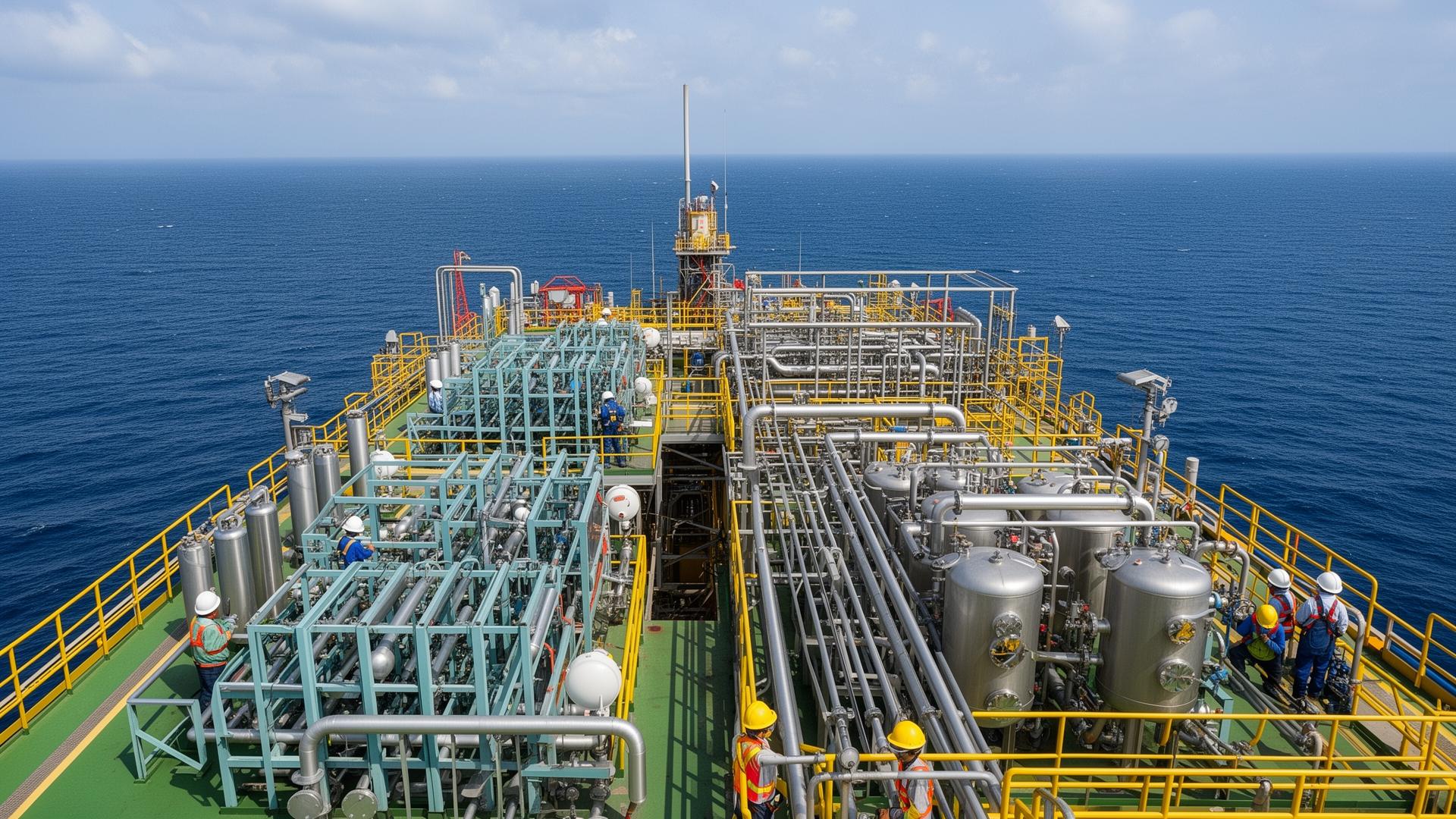
Upstream
Onshore & offshore production, SAGD, EOR, frac flowback and produced-water treatment & reinjection.
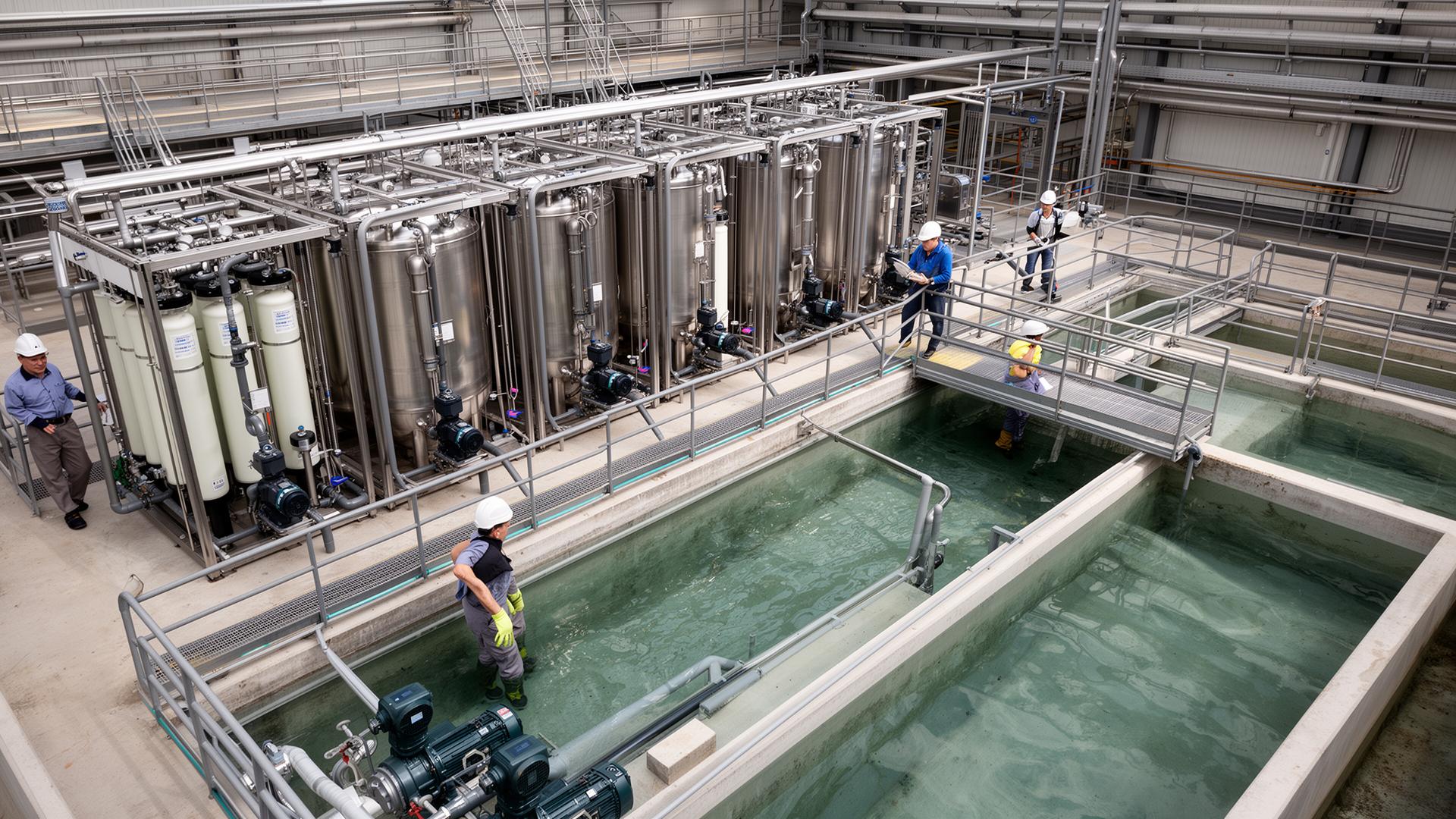
Midstream
Pipelines, terminals and tank farms — hydrostatic test water, drainage and tank-cleaning effluent.
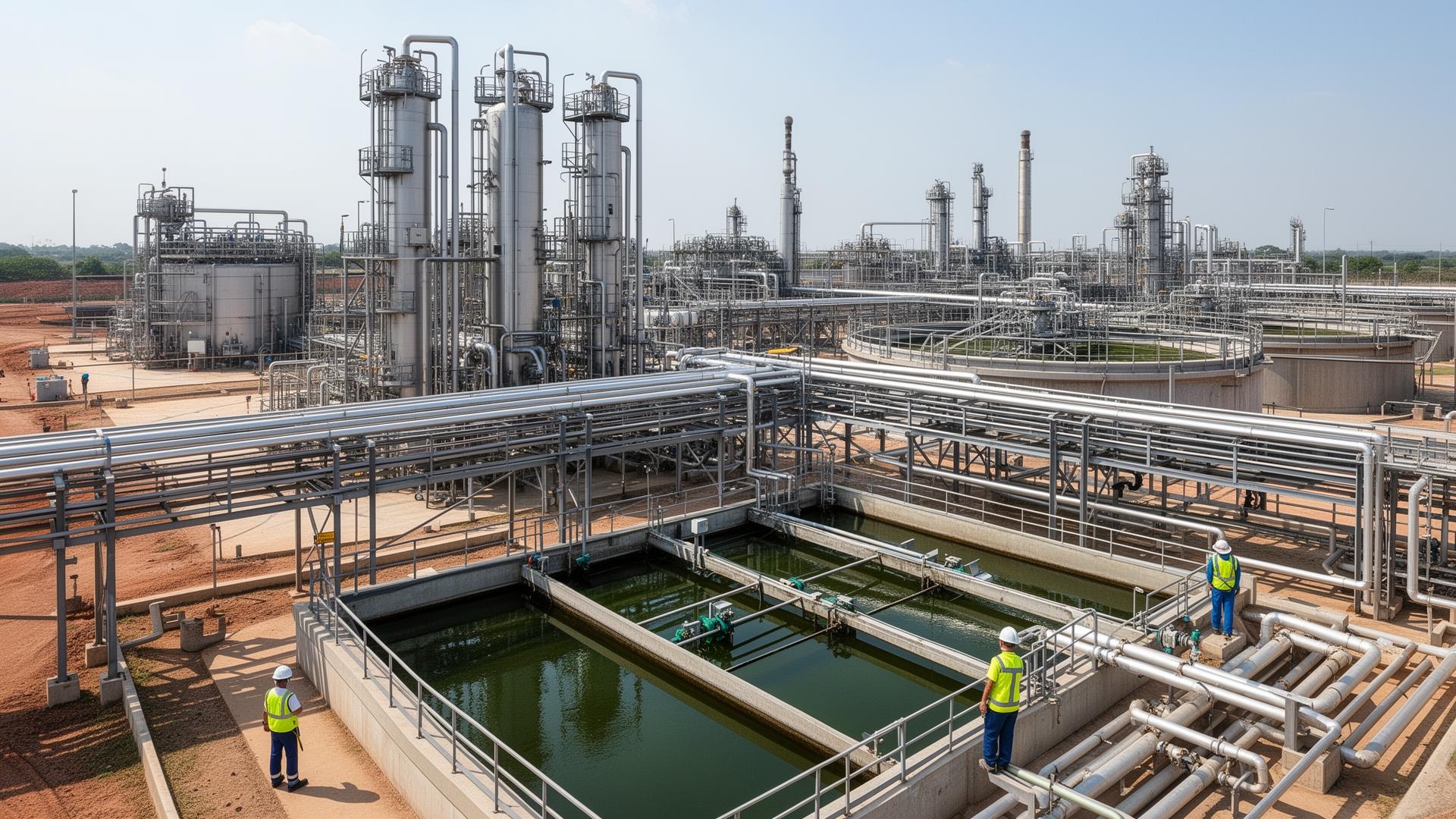
Downstream
Refineries & petrochemicals — ETP, spent caustic, sour water, process & boiler-feed water, desalination & ZLD.
Share your stream data and target specification
WFS will characterize the water and propose a custom train — stand-alone, complete plant, or retrofit to your existing system.