
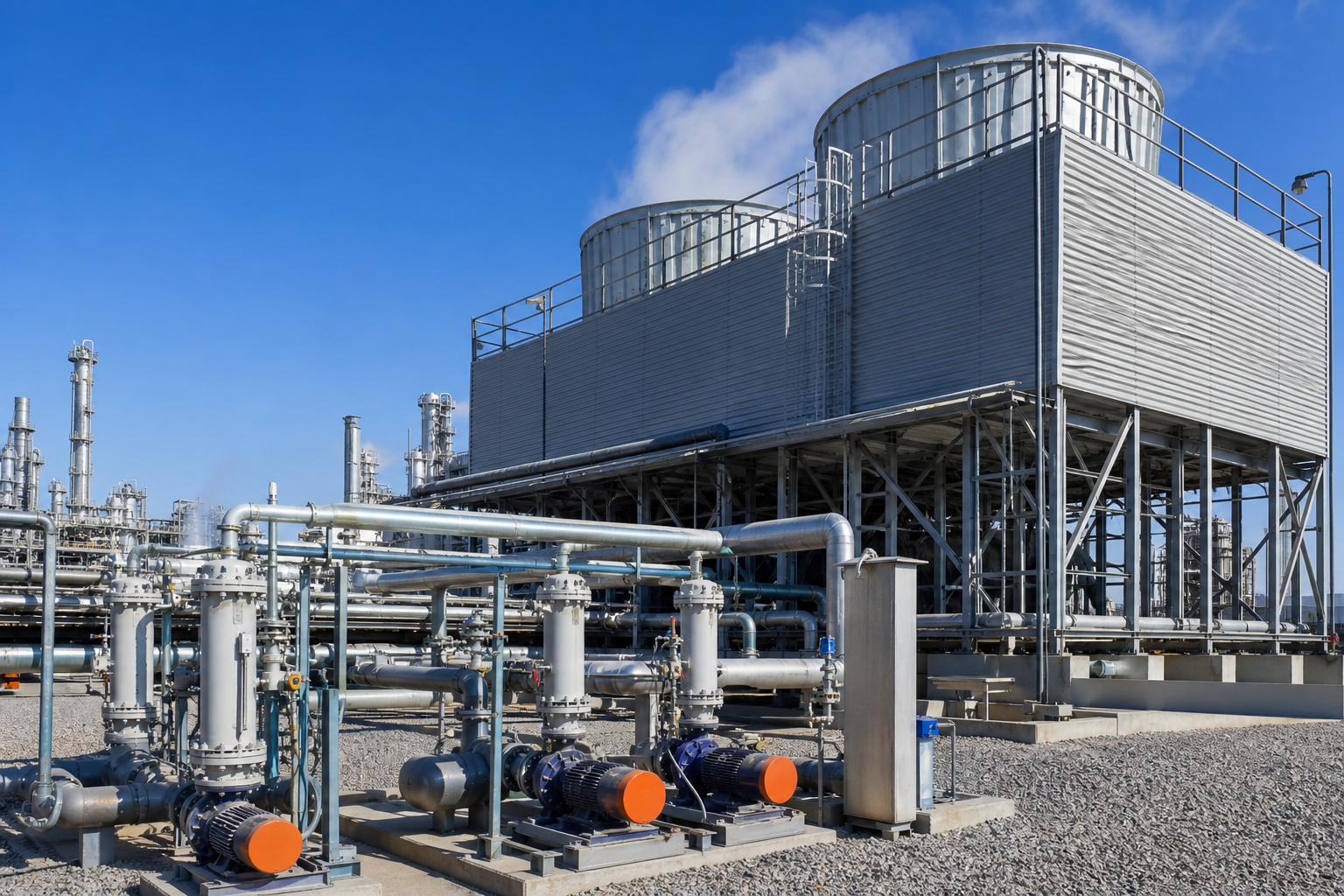
Cooling Water Treatment
Clean, reliable cooling water with maximized cycles of concentration
What this application solves
Open recirculating cooling systems concentrate dissolved and suspended solids as water evaporates, driving scaling, corrosion, biofouling and microbiologically-influenced corrosion. WFS combines make-up treatment, continuous side-stream filtration and tailored chemical dosing to keep exchangers and towers efficient.
The objective is to run at the highest safe cycles of concentration — saving water and chemicals — while protecting metallurgy and heat-transfer surfaces.
Typical influent characteristics
| Parameter | Typical range |
|---|---|
| Make-up TDS | 200 – 3,000 mg/L |
| Hardness | 100 – 600 mg/L CaCO₃ |
| Suspended Solids | 10 – 200 mg/L |
| Cycles of conc. | 3 – 8 |
| Microbial count | control to < 10⁴ CFU/mL |
These ranges frame the design basis. WFS confirms the exact values for your site through laboratory characterization and 24-hour composite sampling, capturing variability across normal, upset and turnaround operation before any equipment is sized.
The problems — and how WFS solves them
- Scaling (calcium carbonate, silica) on hot surfaces
- Corrosion of mixed metallurgy
- Biofouling, biofilm & Legionella risk
- Suspended-solids and process-leak fouling
- Maximizing cycles while staying within limits
- Make-up softening / RO to lower scaling potential
- Side-stream multimedia or disc/screen filtration
- Scale & corrosion inhibitor dosing programs
- Oxidizing & non-oxidizing biocide regime
- Automated blowdown & dosing control
Targets the system is designed to meet
| Performance parameter | Design target |
|---|---|
| Side-stream SS | < 5 – 10 mg/L |
| Corrosion rate (CS) | < 3 mpy |
| Scaling | controlled (LSI managed) |
| Microbial | within target CFU/mL |
Guaranteed, tested performance
Every WFS system is commissioned against a documented performance test. We design to the discharge consent, reuse specification or zero-liquid-discharge target — and verify it on site before handover, then sustain it through O&M.
Filtration approach & system required
Filtration is continuous and partial — a side-stream loop (typically 1–5% of circulation) keeps the whole system clean without filtering the full flow. Make-up treatment lowers the scaling/corrosion driving force so chemistry can do the rest.
Dosing and blowdown are automated on conductivity and ORP so cycles of concentration are pushed safely to the limit.
- Make-up softener / RO skid
- Side-stream filtration package
- Chemical dosing & storage system
- Automated blowdown / analyzer panel
- Biocide & dispersant feed units
Modular process-train schematic
- 1Make-up TreatmentSoftening / RO
Reduce hardness & TDS
- 2Side-stream FiltrationMultimedia / disc / screen
Remove circulating solids
- 3Chemical DosingInhibitors + biocides
Scale, corrosion & microbial control
- 4ControlConductivity / ORP automation
Auto blowdown & dosing
Indicative system specification
Layout & general arrangement
The side-stream filter and dosing skid are located at the cooling tower basin with a short take-off and return. Analyzers and the control panel are mounted nearby for easy calibration.
Chemical day tanks are bunded with safe access; the layout suits both new towers and retrofits to existing systems.
- 01Make-up Treatment
- 02Side-stream Filtration
- 03Chemical Dosing
- 04Control
What WFS delivers
- 1Cooling system survey & water balance
- 2Make-up & side-stream treatment design
- 3Chemical treatment program
- 4Equipment supply & installation
- 5Automation, analyzers & blowdown control
- 6Commissioning & performance monitoring
- 7Ongoing O&M & chemical service
From study to continuous O&M
- 01Study & Assess
- 02Characterize Water
- 03Custom Design
- 04Pilot & Trial
- 05Detailed Engineering
- 06Equipment Design
- 07Fabricate
- 08Deliver to Site
- 09Construct
- 10Electrical & Automation
- 11Continuous O&M
Discuss your cooling water treatment project
Share your stream data and target specification — WFS will characterize the water and propose a custom train.