
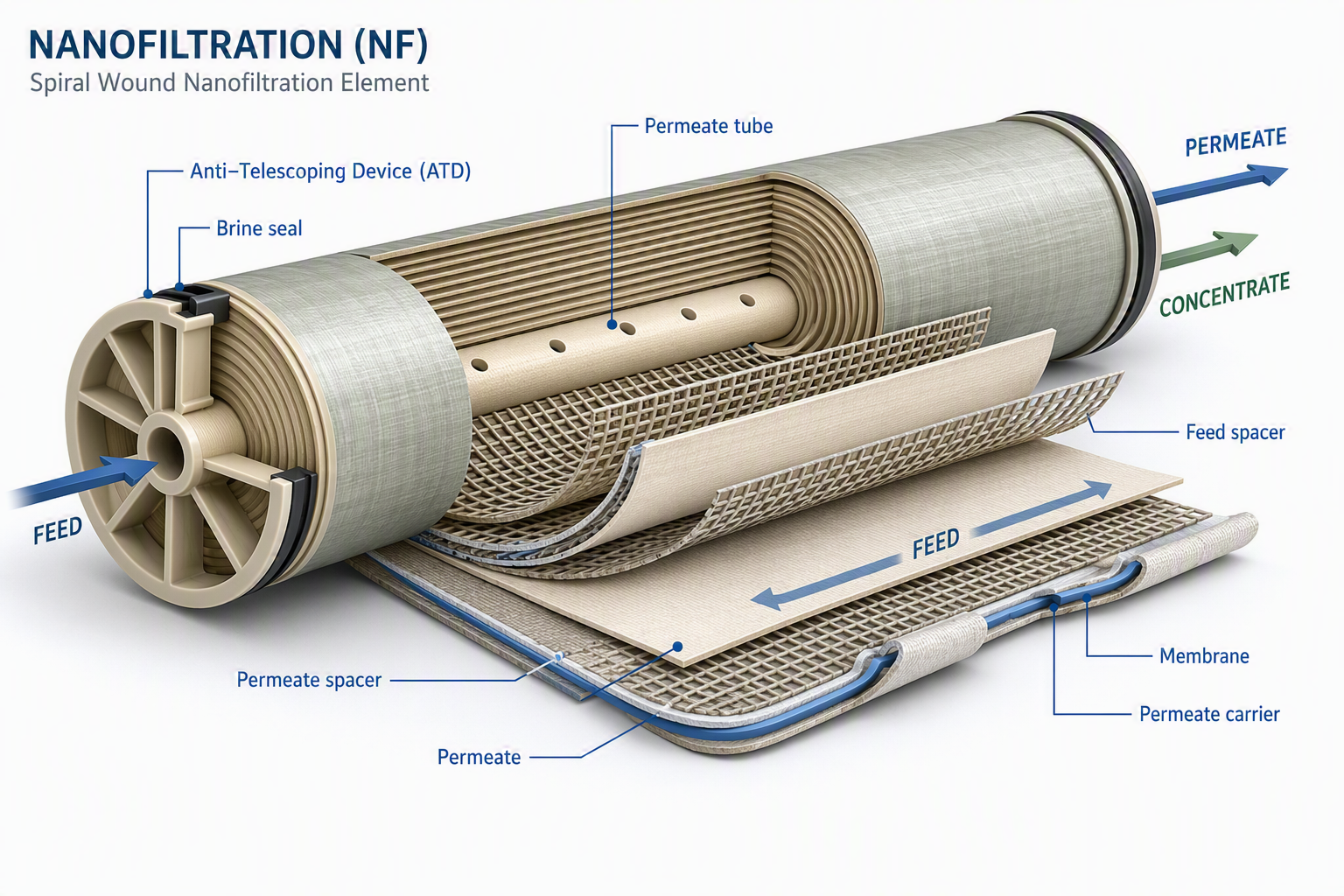
Nanofiltration NF
Selective membrane softening & micro-pollutant removal. Loose membranes (0.001–0.01 µm) that selectively reject divalent ions, hardness, colour and micro-pollutants while passing much of the monovalent salt.
System Schematic
Representative process-flow — configured to your streamUnderlying Technology & Scientific Principle
Nanofiltration sits between UF and RO: charged, loose membranes reject multivalent ions (Ca²⁺, Mg²⁺, SO₄²⁻), organics >200 Da, colour and many micro-pollutants by size and Donnan (charge) exclusion, while allowing a large fraction of monovalent salt and water through at lower pressure than RO.
Working Mechanism
Feed is pressurised across spiral-wound NF membranes; selective rejection concentrates hardness, sulphate and organics in the reject while producing a softened, partially desalted permeate. Antiscalant controls sparingly soluble salts.
Separation / Removal Efficiency
Rejects 90–98% of divalent ions and colour/COD-causing organics and 10–50% of monovalent salts — ideal for selective softening, sulphate removal and organics reduction.
Operating Principle & Parameters
Pressure 5–20 bar; flux 15–30 LMH; recovery 75–85%. Scaling from CaSO₄/CaCO₃ managed by antiscalant and recovery limits.
Flow Rates & Volumetric Capacities
Spiral trains from 5 to thousands of m³/h in pressure-vessel arrays; staged for recovery.
Fluid Media Compatibility
Thin-film composite spiral elements in FRP/SS vessels. Lower pressure than RO; pre-treatment (UF/cartridge) required.
System Schematic & Process Integration
Used for selective softening, sulphate removal (e.g. seawater injection), colour/organics reduction and as RO pre-concentration; downstream of UF and cartridge guards.
Options / Variations Available
Sulphate-removal vs. softening membranes; single- or two-stage arrays; energy-recovery on high-pressure reject.
System Complexity & Automation Level
High — automated pressure, flux, recovery, antiscalant dosing and CIP with permeate-quality trending.
Applications & Performance Delivered
Sulphate removal for injection
Prevents reservoir souring and scaling in seawater flooding.
Selective softening
Removes hardness while retaining wanted monovalent ions.
Colour & organics reduction
Cuts COD-causing organics ahead of discharge or reuse.
Contaminant Removal Profile
Continue exploring the train
 Tertiary
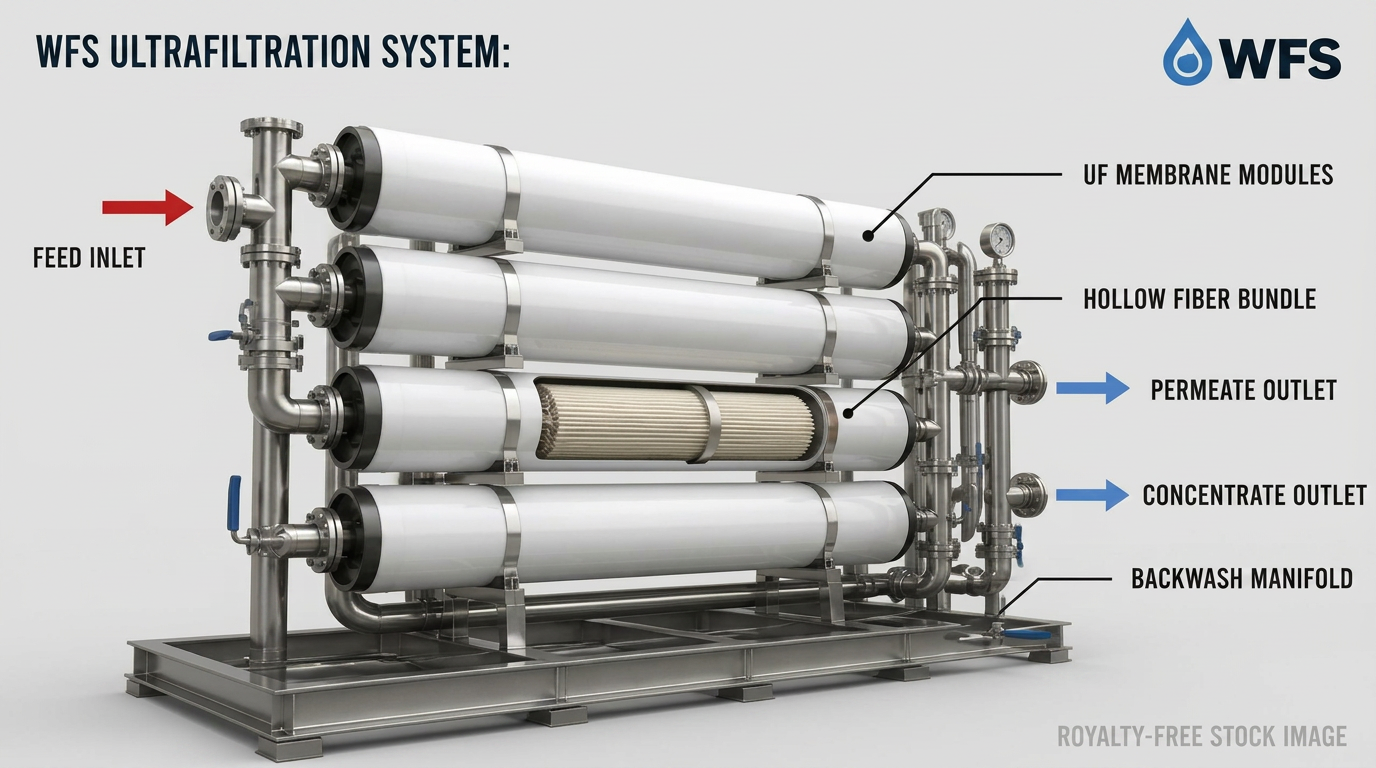
Ultrafiltration
UFPressure-driven membranes (0.01–0.1 µm) that deliver an absolute barrier to suspended solids, oil, bacteria and viruses — the modern RO pre-treatment standard.
Explore technology →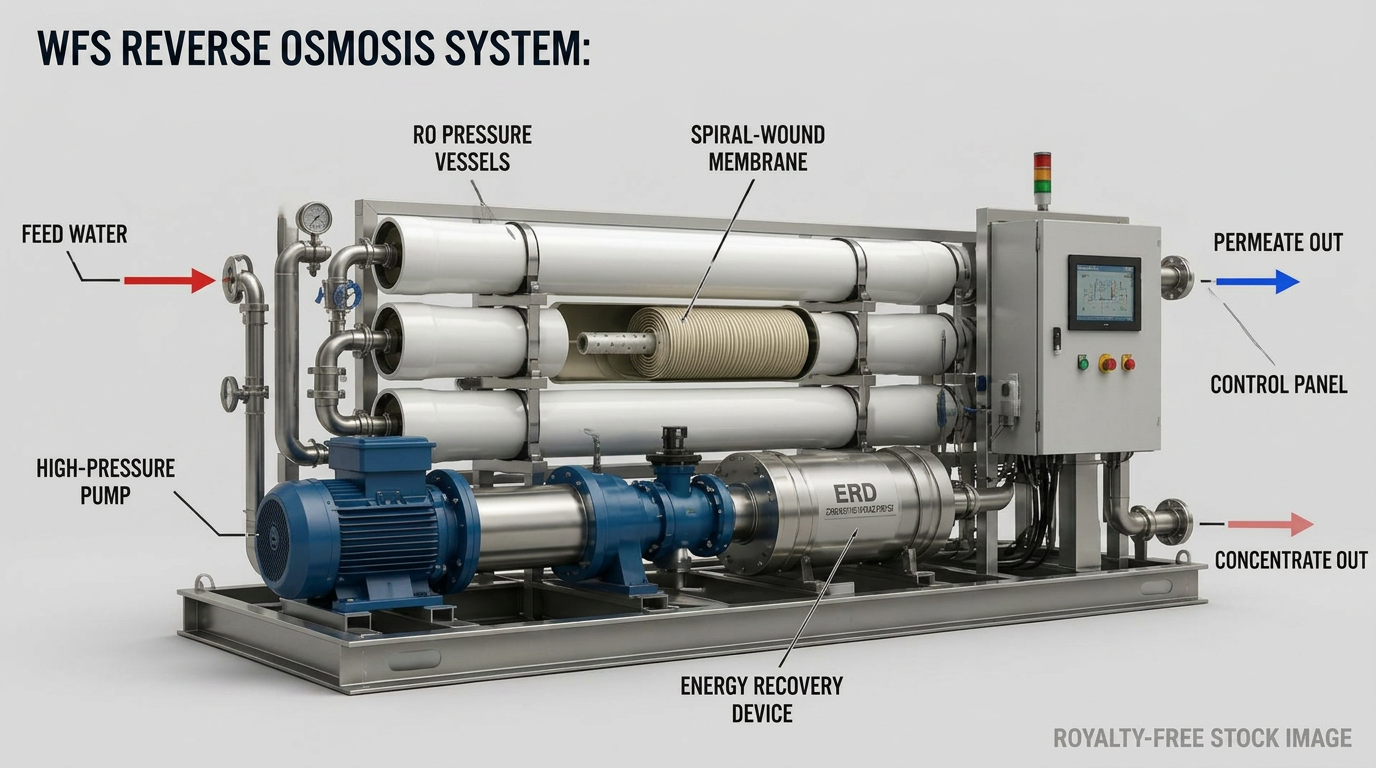 Tertiary
Reverse Osmosis
ROHigh-pressure semi-permeable membranes that reject dissolved salts and organics to produce near-pure permeate — the backbone of desalination, reuse and ZLD.
Explore technology →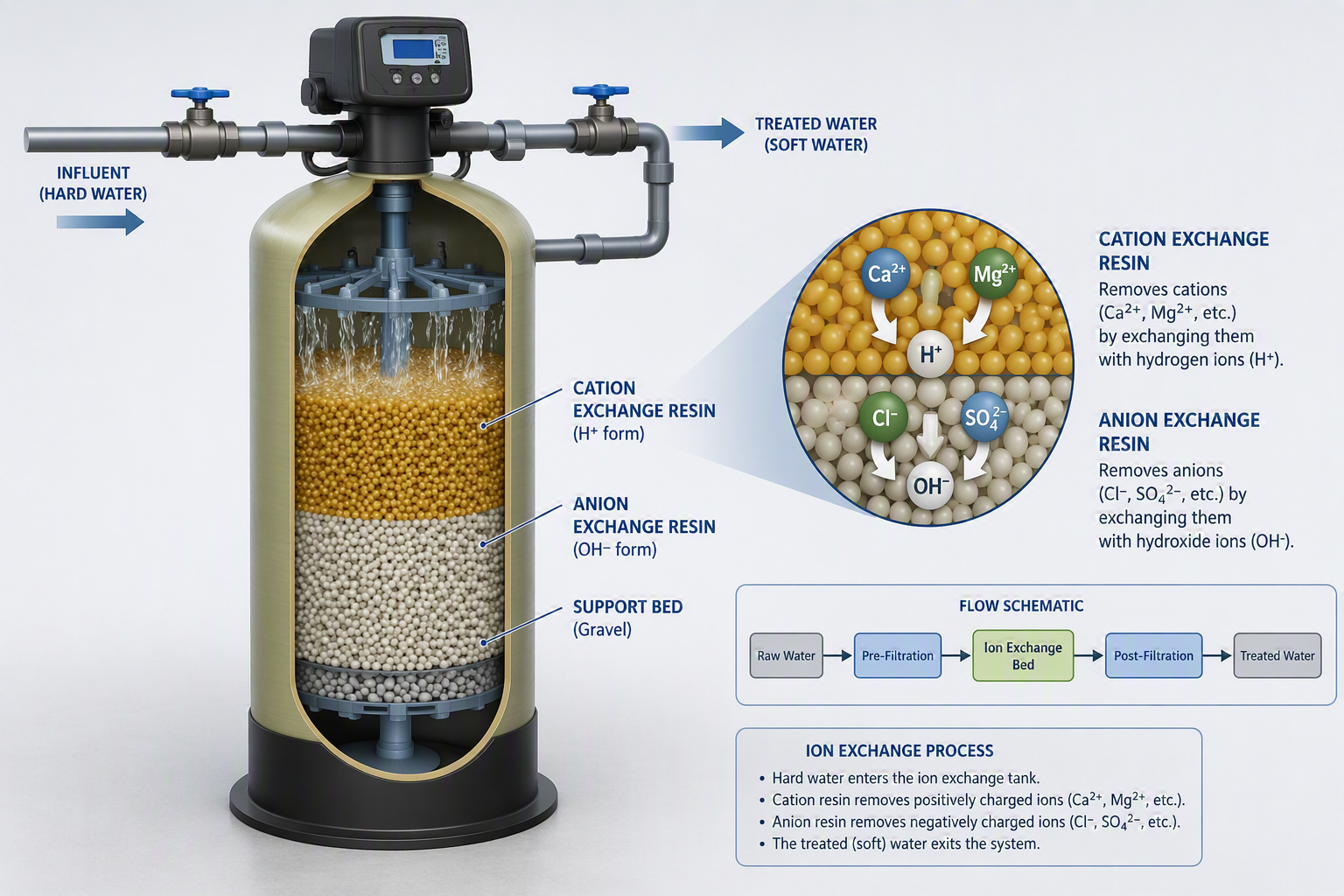 Tertiary
Ion Exchange
IXSelective resin beds that swap unwanted ions for benign ones — delivering softening, demineralisation and trace heavy-metal capture to ultra-low levels.
Explore technology →