Ammonia Removal
Nitrogen removal to consistently meet ammonia discharge limits
What this application solves
Ammonia arises in refineries and petrochemical plants from sour water, hydrotreating, FCC and fertilizer-linked units, and in contaminated groundwater. It is toxic to aquatic life, exerts oxygen demand and is tightly regulated. WFS selects the right removal route based on concentration, flow and discharge target.
High concentrations favor air or steam stripping with recovery; low-to-moderate concentrations favor biological nitrification/denitrification; trace polishing uses selective ion exchange.
Typical influent characteristics
| Parameter | Typical range |
|---|---|
| Ammonia-N | 20 – 5,000 mg/L |
| pH | 6 – 9 |
| Temperature | 20 – 45 °C |
| Flow | 5 – 500 m³/h |
| TDS | 500 – 20,000 mg/L |
These ranges frame the design basis. WFS confirms the exact values for your site through laboratory characterization and 24-hour composite sampling, capturing variability across normal, upset and turnaround operation before any equipment is sized.
The problems — and how WFS solves them
- Wide range of inlet concentrations and flows
- pH and temperature sensitivity of stripping & biology
- Toxicity / inhibition of nitrifying bacteria
- Scaling and fouling in stripping towers
- Very low residual limits for sensitive receiving waters
- Air / steam stripping with pH elevation for high loads
- Acid scrubbing or recovery of stripped ammonia
- Biological nitrification–denitrification (MBBR / MBR)
- Selective ion exchange / zeolite for trace polishing
- Breakpoint chlorination where appropriate
Targets the system is designed to meet
| Performance parameter | Design target |
|---|---|
| Ammonia-N (discharge) | < 1 – 10 mg/L |
| Stripping removal | 90 – 98% |
| Total-N (with deN) | < 10 – 15 mg/L |
| Ammonia recovery | as salt / solution |
Guaranteed, tested performance
Every WFS system is commissioned against a documented performance test. We design to the discharge consent, reuse specification or zero-liquid-discharge target — and verify it on site before handover, then sustain it through O&M.
Filtration approach & system required
Concentration sets the technology: stripping recovers ammonia economically from strong streams; biology removes nitrogen from dilute streams; ion exchange polishes to trace levels. Often two are combined — strip then biologically polish.
Pretreatment removes oil and solids first so stripping packing and biological media stay clean and effective.
- Packed stripping tower with blower / steam supply
- pH adjustment & acid scrubbing package
- Biological nitrification/denitrification reactor
- Ion exchange / zeolite polishing skid
- Instrumentation for ammonia, pH & temperature
Modular process-train schematic
- 1PretreatmentOil/solids removal + pH adjust
Protect downstream, raise pH
- 2StrippingAir / steam stripping tower
Remove high ammonia load
- 3RecoveryAcid scrubber / condenser
Capture ammonia as salt/solution
- 4BiologicalNitrification – denitrification
Convert residual N to N₂
- 5PolishingSelective ion exchange / zeolite
Trace ammonia removal
Indicative system specification
Layout & general arrangement
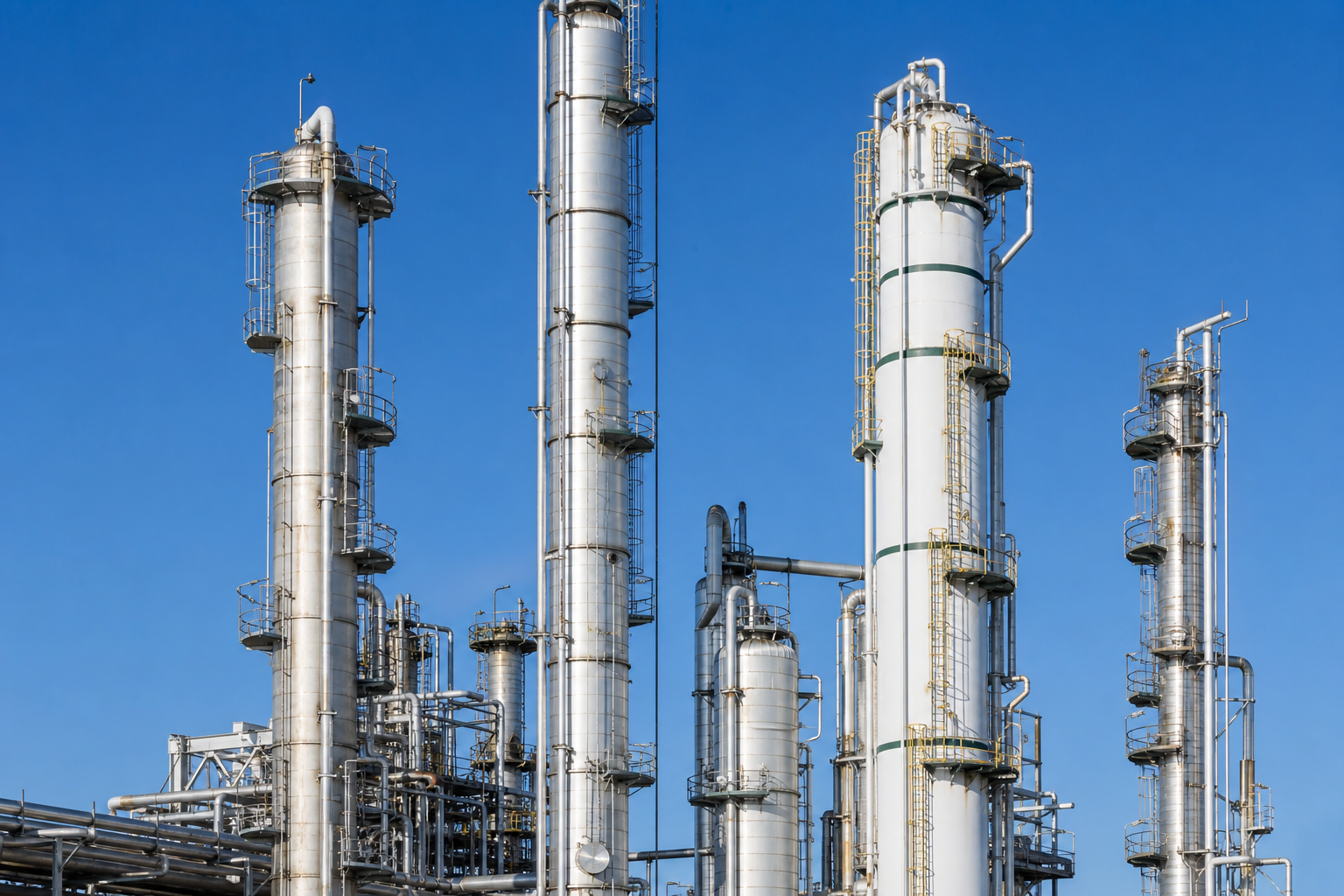
The stripping tower is the tallest element and is placed for prevailing-wind dispersion and access; blowers, scrubber and pumps cluster at its base. Biological and ion-exchange units sit downstream in a compact skid line.
Chemical storage (acid/caustic) is bunded and segregated, with safety showers and gas detection per EHS standards.
- 01Pretreatment
- 02Stripping
- 03Recovery
- 04Biological
- 05Polishing
What WFS delivers
- 1Nitrogen speciation analysis & design basis
- 2Technology selection & treatability study
- 3Stripping / biological / IX system design
- 4Fabrication, delivery & installation
- 5Recovery system & chemical handling
- 6Automation, commissioning & performance test
- 7O&M manuals & operator training
From study to continuous O&M
- 01Study & Assess
- 02Characterize Water
- 03Custom Design
- 04Pilot & Trial
- 05Detailed Engineering
- 06Equipment Design
- 07Fabricate
- 08Deliver to Site
- 09Construct
- 10Electrical & Automation
- 11Continuous O&M
Discuss your ammonia removal project
Share your stream data and target specification — WFS will characterize the water and propose a custom train.