Conventional Produced Water Treatment — Onshore
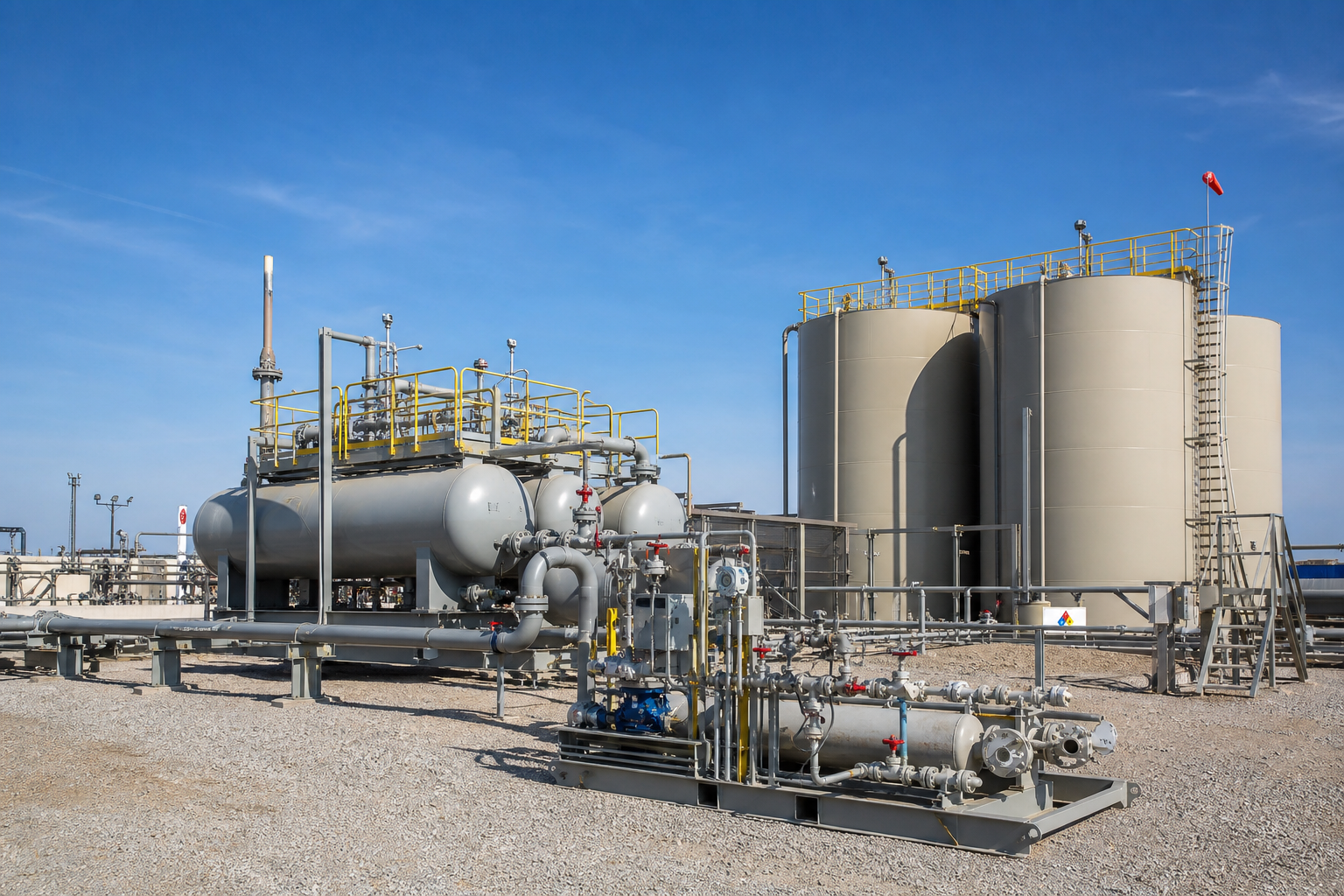
De-oiling, suspended-solids and iron removal for land-based fields, tank batteries and central processing facilities.
Sector overview
As onshore conventional fields mature, water cut climbs to 70–95%+ and produced-water volumes can dwarf oil production. Water leaving the bulk-separation train (free-water knockout, gun barrels, heater treaters) still carries free and emulsified oil, suspended solids, iron sulfide and scale fines, dissolved gases and production chemicals.
WFS designs compact, automated de-oiling and filtration trains that take this water to the required disposal-well injectivity, re-injection, or surface-discharge specification — with the buffering and dosing controls needed to ride through the slugging and variable water cut typical of land operations.
Process overview and application parameters
Process steps
- 1Inlet equalization & skimBuffer slugs, recover free oil, stabilize flow and chemistry.
- 2Primary de-oilingAPI/CPI separator, induced gas flotation (IGF) or hydrocyclone removes bulk dispersed oil and coarse solids.
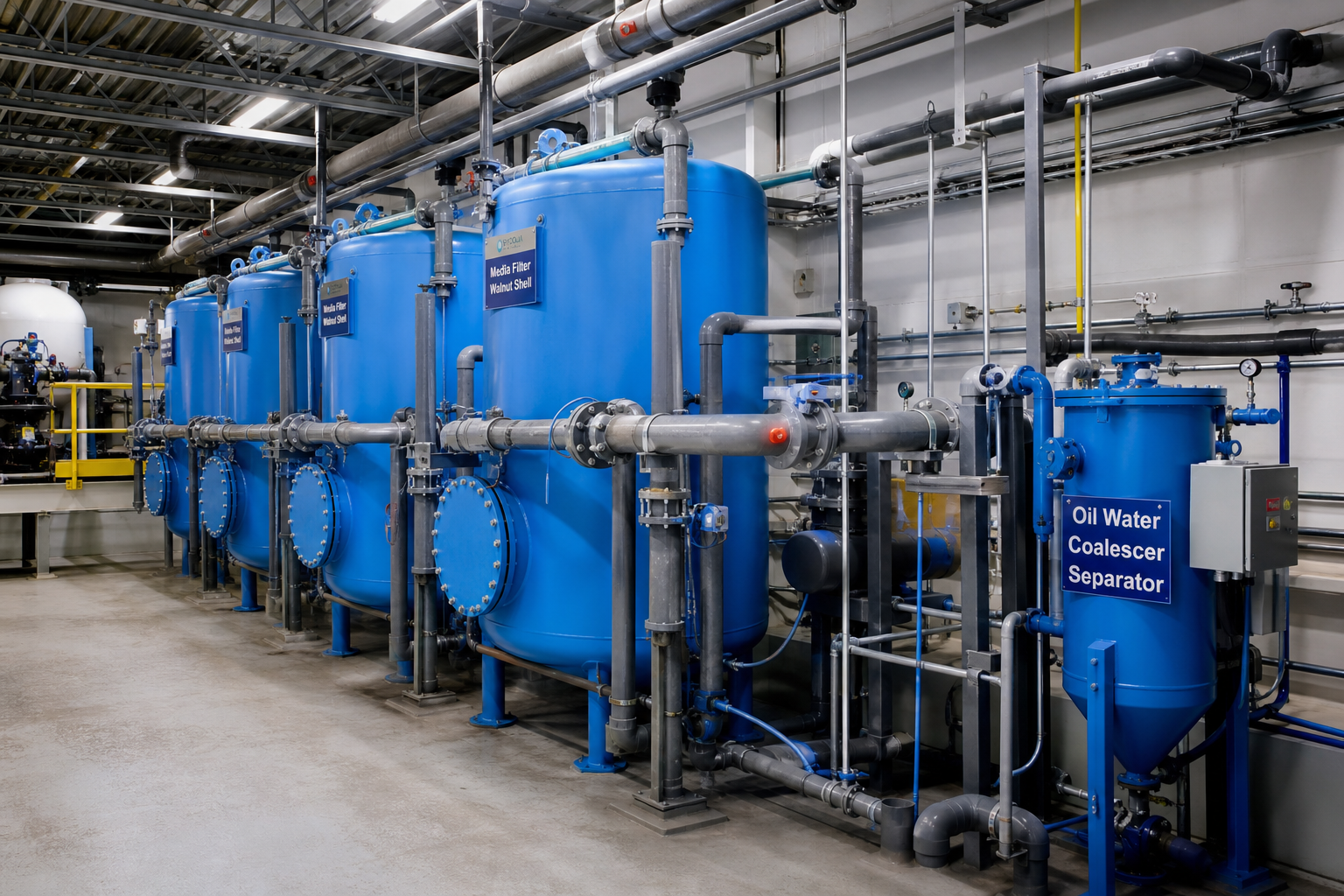
- 3Media coalescenceWalnut-shell / oleophilic media grow sub-30 µm droplets for downstream capture.
- 4Media filtrationDual/multimedia pressure filters remove residual oil and suspended solids.
- 5PolishingCartridge or ultrafiltration where re-injection or reuse demands low turbidity / fine particle cut.
- 6Chemical conditioningDe-oiler, coagulant, oxygen scavenger, scale inhibitor and biocide dosing.
Application parameters (feed water)
| Oil & grease (inlet to plant) | 100 – 2,000 mg/L |
| Dispersed oil droplet size | 10 – 250 µm |
| Total suspended solids (TSS) | 50 – 500 mg/L |
| Total dissolved solids (TDS) | 5,000 – 200,000 mg/L |
| Iron (Fe) | 1 – 50 mg/L |
| H₂S / sulfides | 0 – 500 mg/L |
| Temperature | 30 – 70 °C |
| pH | 6.0 – 7.5 |
Modular treatment train
Modular Process-Train Schematic · Block flow
What makes this water hard — and how we solve it
Emulsified / dispersed oil below the hydrocyclone cut point.
Oleophilic media coalescence grows droplets, followed by walnut-shell filtration to capture <30 µm oil.
Variable water cut and inlet slugging.
Equalization / skim buffering with automated level and dosing control for stable downstream performance.
Iron sulfide and solids plugging the disposal / injection well.
Multimedia plus cartridge or UF polishing to meet injectivity (typ. <2 NTU, particle <2–5 µm).
H₂S, scaling tendency and souring bacteria (SRB).
Oxygen scavenger, scale inhibitor and biocide programs with corrosion-resistant materials of construction.
Filtration approach & system required
Approach
A multi-barrier sequence: enhanced primary separation, media coalescing to grow oil droplets, then deep-bed media and cartridge / UF polishing matched to the disposal specification.
Walnut-shell (nutshell) media is favored for high oil-loading tolerance and backwashable, regenerable operation.
Filtration system / unit operations
- API / CPI separator or compact induced gas flotation (IGF)
- Walnut-shell coalescing media filters with automatic backwash
- Dual / multimedia pressure filters
- Cartridge / bag final filters
- Ultrafiltration skid (reuse / high-spec re-injection)
- Chemical dosing skids and backwash-water recovery
System specification, performance & layout
Indicative system specification
| Capacity (modular) | 1,000 – 50,000 BWPD per train |
| Configuration | Skid-mounted, modular, expandable |
| Materials | Coated CS shells; SS316 / duplex wetted; FRP filter vessels |
| Automation | PLC / SCADA, auto-backwash, dosing control |
| Area classification | ATEX / IECEx where classified |
Performance parameters (guaranteed, tested)
| Oil in water (discharge / re-inj.) | < 10 – 30 mg/L |
| TSS | < 5 – 20 mg/L |
| Turbidity | < 2 NTU |
| Particle size (re-injection) | < 2 – 5 µm |
| Availability | > 95 % |
Plant layout & general arrangement
- •Skid-mounted modular trains with accessible filter banks for media change-out.
- •Dedicated chemical dosing room, instrument-air and control shelter, and sample points at each stage.
- •Classified-area compliant layout with bunding and spill containment.
Project deliverables
- 1Water characterization & treatability study (design basis)
- 2Process selection, mass balance, P&ID and treatment-train design
- 3Pilot / trial skid where required to de-risk performance
- 4Detailed mechanical, civil, structural and E&I engineering
- 5Equipment design, fabrication and Factory Acceptance Test (FAT)
- 6Delivery, site construction and mechanical installation
- 7Electrical installation, instrumentation, controls & SCADA integration
- 8Commissioning, performance test to guaranteed spec & operator training
- 9Continuous Operations & Maintenance (O&M) and remote monitoring
Have a produced-water stream to characterize?
Water Filtration Solutions studies your water, custom-designs the treatment train, pilots it where needed, then fabricates, installs, automates and operates the plant — from characterization through continuous O&M.