Conventional Produced Water Treatment — Offshore
Compact, high-rate, motion-tolerant de-oiling for platforms and FPSOs to meet overboard-discharge limits.
Sector overview
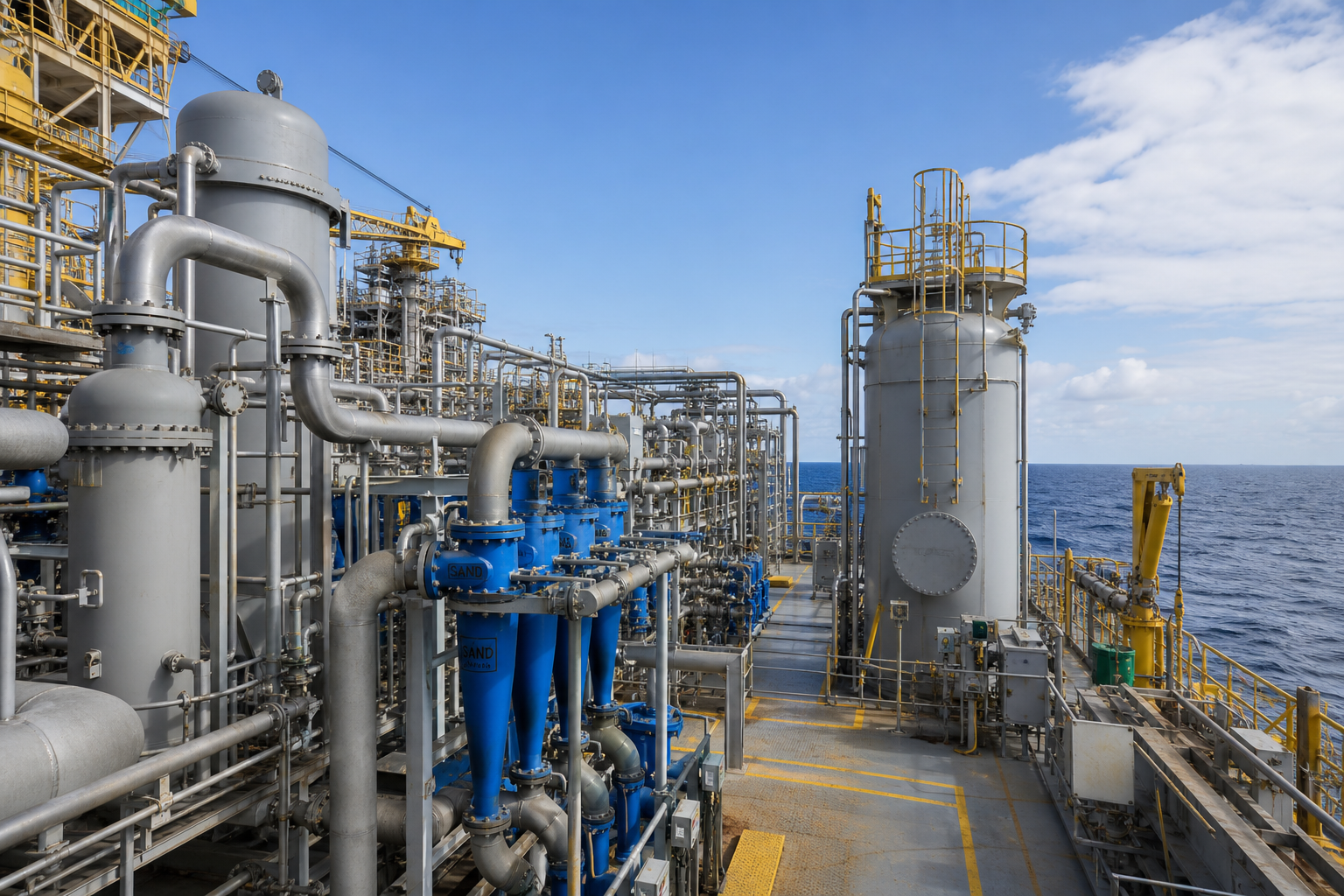
Offshore platforms and FPSOs must treat produced water to overboard-discharge limits — OSPAR's 30 mg/L monthly oil-in-water average is the regional benchmark, and many operators target <15–20 mg/L — all within severe deck weight, footprint and vessel-motion constraints.
WFS trains pair deoiling hydrocyclones with compact flotation units (CFU/IGF) that are insensitive to motion, and add polishing for produced-water re-injection (PWRI) where reservoir pressure support or zero-discharge is the objective.
Process overview and application parameters
Process steps
- 1Inlet degassing & desandingRemove gas break-out and produced sand ahead of separation.
- 2Deoiling hydrocyclonesHigh-rate, motion-tolerant centrifugal removal of dispersed oil.
- 3Compact flotation unit (CFU/IGF)Gas flotation polishes oil-in-water to overboard spec.
- 4Produced-water degasserRemoves flotation gas and stabilizes the treated stream.
- 5PWRI polishingWalnut-shell / fine-media or membrane filtration where re-injection is required.
Application parameters (feed water)
| Oil in water (inlet) | 100 – 1,000 mg/L |
| Dispersed oil droplet size | 5 – 100 µm |
| TSS | 10 – 200 mg/L |
| Dissolved aromatics (BTEX / PAH) | Present — not removed by physical separation |
| TDS (seawater-influenced) | 30,000 – 250,000 mg/L |
| Temperature | 40 – 90 °C |
| Other | Sand / scale fines, production-chemical carryover |
Modular treatment train
Modular Process-Train Schematic · Block flow
What makes this water hard — and how we solve it
Vessel motion degrades gravity separation.
Hydrocyclones and compact flotation are motion-insensitive, high-rate and compact.
Severe deck weight and footprint limits.
High-throughput, low-inventory skids with integrated degassing replace large vessels.
Dissolved aromatics not removed by physical separation.
Macro-porous polymer extraction (MPPE) or adsorption added where dissolved-HC limits apply.
Re-injection plugging and sand / scale.
Desanders, fine filtration, flotation and scale-inhibitor dosing protect injectivity.
Filtration approach & system required
Approach
Hydrocyclone-led primary de-oiling followed by compact gas flotation — the offshore standard for overboard compliance.
Nutshell or membrane polishing for PWRI; optional MPPE for dissolved hydrocarbons.
Filtration system / unit operations
- Deoiling hydrocyclone packages
- Compact flotation unit (CFU) / induced gas flotation
- Produced-water degasser
- Walnut-shell filters and fine media / UF for PWRI
- Desanders and produced-sand handling
- Chemical injection (deoiler, scale & corrosion inhibitor)
System specification, performance & layout
Indicative system specification
| Capacity | 5,000 – 150,000 BWPD |
| Configuration | Deck-integrated, compact, high-turndown skids |
| Materials | SS316L / duplex / 6Mo for seawater service |
| Ratings | Motion-rated; zone-rated (Zone 1 / 2) |
| Venting | Flotation / degasser gas routed to flare / vent |
Performance parameters (guaranteed, tested)
| Oil in water (overboard) | < 15 – 30 mg/L |
| PWRI oil / solids | Per reservoir injectivity spec |
| Turndown | High — handles production decline |
| Reliability | Designed for unmanned / minimal-attendance |
Plant layout & general arrangement
- •Deck-integrated modules engineered for minimum weight and footprint.
- •Hazardous-area compliant with gas venting to flare and slops routing for recovered oil.
- •Arranged for safe access, lifting and module replacement offshore.
Project deliverables
- 1Water characterization & treatability study (design basis)
- 2Process selection, mass balance, P&ID and treatment-train design
- 3Pilot / trial skid where required to de-risk performance
- 4Detailed mechanical, civil, structural and E&I engineering
- 5Equipment design, fabrication and Factory Acceptance Test (FAT)
- 6Delivery, site construction and mechanical installation
- 7Electrical installation, instrumentation, controls & SCADA integration
- 8Commissioning, performance test to guaranteed spec & operator training
- 9Continuous Operations & Maintenance (O&M) and remote monitoring
Have a produced-water stream to characterize?
Water Filtration Solutions studies your water, custom-designs the treatment train, pilots it where needed, then fabricates, installs, automates and operates the plant — from characterization through continuous O&M.