Frack Flowback & Produced Water Treatment
Mobile and central treatment of flowback and produced water for recycle into frac fluid — the Permian recycle model.
Sector overview
Hydraulic fracturing returns flowback in the first weeks — high in frac chemicals, friction reducers and suspended solids — transitioning to produced water with rising TDS, scale-forming ions (Ba, Sr, Ca) and possible NORM.
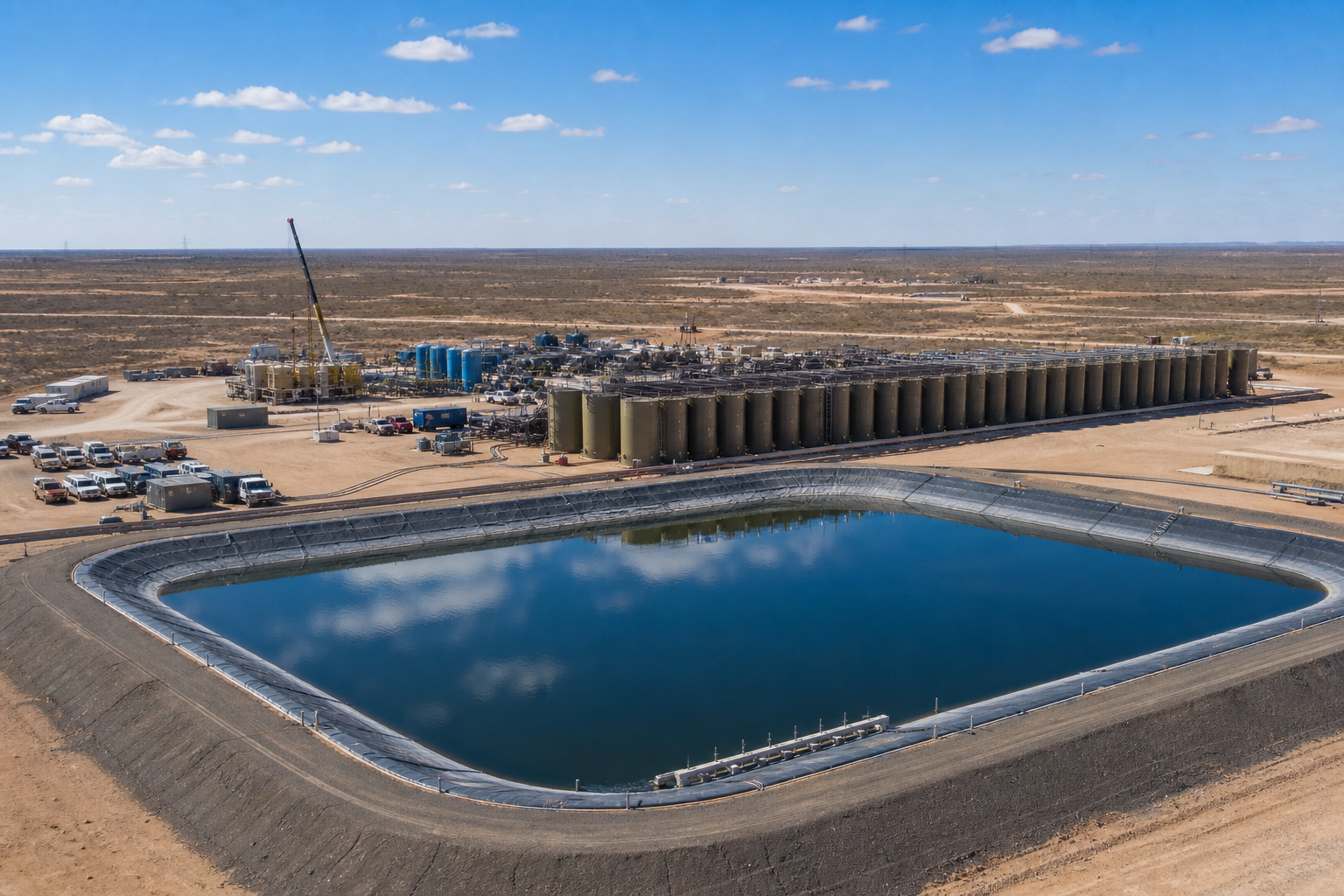
The Permian recycle model treats this water to a reuse-for-frac specification — removing TSS, oil, iron and bacteria and stabilizing scaling tendency — so it can be blended into new frac fluid. That cuts freshwater demand, reduces saltwater-disposal (SWD) volumes and cost, and lowers induced-seismicity risk.
Process overview and application parameters
Process steps
- 1EqualizationPonds or tanks buffer variable pad flowback and blend streams.
- 2Oxidation / aerationOxidize iron and H₂S and knock back bacteria.
- 3Coagulation & flocculationChemistry conditions fine solids and emulsified oil for clarification.
- 4Clarification (DAF / settler)Dissolved air flotation or tube-settler clarifier removes bulk solids and oil.
- 5Media filtrationMultimedia and walnut-shell filters polish to reuse spec.
- 6Disinfection & scale controlBiocide / oxidant and scale inhibitor stabilize the recycle water.
Application parameters (feed water)
| TSS | 100 – 3,000 mg/L |
| Oil & grease | 20 – 500 mg/L |
| TDS (rising over time) | 30,000 – 250,000 mg/L |
| Iron (Fe) | 10 – 150 mg/L |
| Scale ions (Ba / Sr / Ca) | Elevated |
| H₂S / bacteria (SRB, APB) | Present |
| Friction reducers / polymers | Present |
| pH | 5.5 – 7.0 |
Modular treatment train
Modular Process-Train Schematic · Block flow
What makes this water hard — and how we solve it
High and highly variable suspended solids.
DAF / clarifier with automated coagulation–flocculation chemistry.
Iron, H₂S and bacterial souring.
Oxidation / aeration plus a biocide / oxidant program (e.g. ClO₂).
Scaling tendency from Ba / Sr / Ca.
Scale-inhibitor dosing; softening only where low-TDS reuse is targeted.
Throughput, mobility and fast pad turnaround.
Modular / mobile high-rate skids that deploy quickly at the pad or a central facility.
Filtration approach & system required
Approach
Clarify-then-filter at high rate, with oxidation for iron and bacteria — engineered to a robust reuse spec rather than potable quality.
Keep the train simple, rugged and mobile so it can follow the frac spread.
Filtration system / unit operations
- Rapid-mix / aeration and oxidation
- Dissolved air flotation (DAF) or tube-settler clarifier
- Multimedia and walnut-shell filters with auto-backwash
- Cartridge / UF (optional, for tighter reuse)
- Chemical dosing (oxidant, coagulant, flocculant, scale inhibitor, biocide)
- Filter press / centrifuge for solids dewatering
System specification, performance & layout
Indicative system specification
| Capacity | 10,000 – 100,000 BWPD (mobile / modular) |
| Configuration | Trailer / skid; rapid deploy and relocation |
| Automation | Automated chemistry, flow-paced dosing, remote monitoring |
| Materials | Corrosion-resistant for high-TDS brine |
| Solids | Integrated dewatering and NORM handling |
Performance parameters (guaranteed, tested)
| TSS (reuse) | < 10 – 50 mg/L |
| Oil & grease | < 10 – 25 mg/L |
| Iron | < 5 – 10 mg/L |
| Bacteria | Controlled (souring prevention) |
| Scaling | Stabilized to operator reuse spec |
Plant layout & general arrangement
- •Central recycling facility (lined ponds plus treatment) or a mobile spread at the well pad.
- •Pond liners, transfer pumps and tankage sized for pad logistics.
- •Solids-handling area for dewatering and NORM management.
Project deliverables
- 1Water characterization & treatability study (design basis)
- 2Process selection, mass balance, P&ID and treatment-train design
- 3Pilot / trial skid where required to de-risk performance
- 4Detailed mechanical, civil, structural and E&I engineering
- 5Equipment design, fabrication and Factory Acceptance Test (FAT)
- 6Delivery, site construction and mechanical installation
- 7Electrical installation, instrumentation, controls & SCADA integration
- 8Commissioning, performance test to guaranteed spec & operator training
- 9Continuous Operations & Maintenance (O&M) and remote monitoring
Explore other treatment trains
Have a produced-water stream to characterize?
Water Filtration Solutions studies your water, custom-designs the treatment train, pilots it where needed, then fabricates, installs, automates and operates the plant — from characterization through continuous O&M.