Process Water Treatment
Reliable, specification-grade water for every process duty
What this application solves
Process water feeds catalysts, reactors, washing, quench and dilution duties where hardness, silica, chlorides, organics and microbes can cause scaling, fouling and product contamination. WFS designs treatment that converts variable raw-water sources into a consistent, on-spec supply.
Trains are matched to the source — surface water, groundwater, municipal or recycled effluent — and to the target purity, from softened water through to demineralized and ultrapure grades.
Typical influent characteristics
| Parameter | Typical range |
|---|---|
| Turbidity | 1 – 50 NTU |
| TDS | 200 – 3,000 mg/L |
| Total Hardness | 100 – 600 mg/L CaCO₃ |
| Silica | 5 – 50 mg/L |
| TOC | 1 – 10 mg/L |
| Chloride | 50 – 1,000 mg/L |
These ranges frame the design basis. WFS confirms the exact values for your site through laboratory characterization and 24-hour composite sampling, capturing variability across normal, upset and turnaround operation before any equipment is sized.
The problems — and how WFS solves them
- Seasonal variation in raw water quality and turbidity
- Scaling and fouling of downstream equipment
- Silica and organic fouling of membranes
- Microbiological growth and biofilm
- Meeting tight process specs at stable flow and pressure
- Clarification / coagulation for turbidity and organics
- Multimedia and ultrafiltration pretreatment
- Softening or antiscalant-dosed reverse osmosis
- Two-pass RO / EDI for demineralized and ultrapure grades
- UV / chlorination for microbiological control
Targets the system is designed to meet
| Performance parameter | Design target |
|---|---|
| Turbidity | < 0.2 NTU |
| SDI₁₅ | < 3 |
| TDS (RO permeate) | < 50 mg/L |
| Conductivity (DM) | < 1 – 0.1 µS/cm |
| Silica | < 0.02 mg/L |
Guaranteed, tested performance
Every WFS system is commissioned against a documented performance test. We design to the discharge consent, reuse specification or zero-liquid-discharge target — and verify it on site before handover, then sustain it through O&M.
Filtration approach & system required
Pretreatment is sized to deliver a low, stable Silt Density Index to the membranes — the single biggest driver of RO reliability. Ultrafiltration is used as an absolute barrier where raw water is variable.
Polishing (EDI or mixed-bed) is added only where the process genuinely needs demineralized or ultrapure water, keeping operating cost proportionate to spec.
- Clarifier / coagulation package
- Multimedia & ultrafiltration skids
- Reverse osmosis trains (single/two-pass)
- EDI or ion-exchange demineralizers
- UV / dosing & CIP systems
Modular process-train schematic
- 1ClarificationCoagulation / lamella clarifier
Remove turbidity & organics
- 2Media FiltrationMultimedia / dual-media
Reduce SS & turbidity
- 3UltrafiltrationUF membranes
Absolute barrier, low SDI
- 4DesalinationReverse osmosis
Remove dissolved salts
- 5PolishingEDI / mixed-bed ion exchange
Demineralize to ultrapure
- 6DisinfectionUV / chlorination
Microbiological control
Indicative system specification
Layout & general arrangement
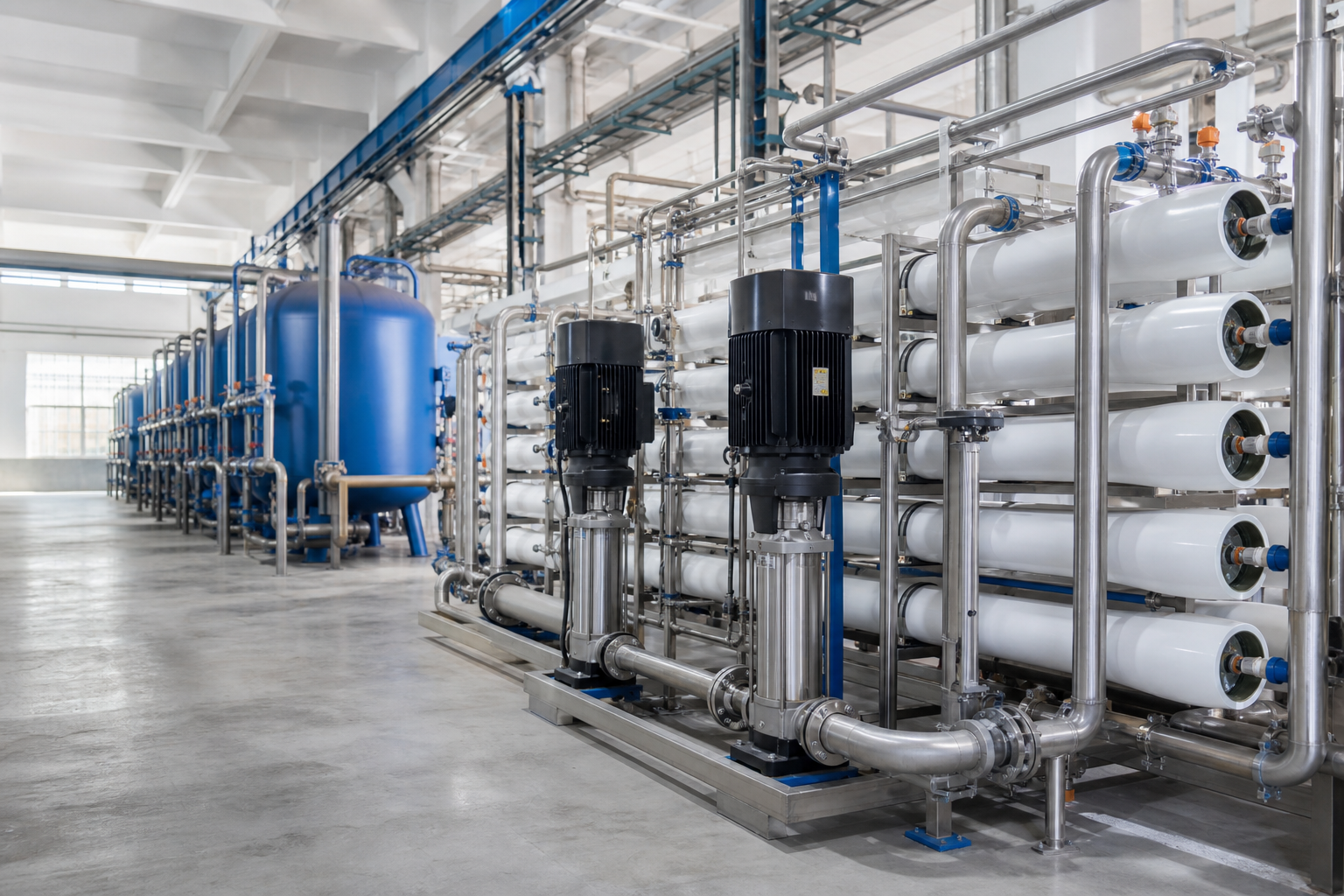
Compact, skid-mounted layout with pretreatment, RO and polishing arranged in a logical flow line inside a utility building or container. Break tanks buffer supply; CIP and dosing are centralized.
Footprint is minimized through vertical vessel arrangement and shared pump galleries, with full maintenance access to membranes and resin vessels.
- 01Clarification
- 02Media Filtration
- 03Ultrafiltration
- 04Desalination
- 05Polishing
- 06Disinfection
What WFS delivers
- 1Raw water analysis & process design basis
- 2Pilot verification of membrane flux & recovery (if required)
- 3PFDs, P&IDs & skid GA drawings
- 4Fabricated, factory-tested treatment skids
- 5Site installation, tie-ins & commissioning
- 6PLC automation, CIP protocols & training
- 7O&M support and membrane/resin management
From study to continuous O&M
- 01Study & Assess
- 02Characterize Water
- 03Custom Design
- 04Pilot & Trial
- 05Detailed Engineering
- 06Equipment Design
- 07Fabricate
- 08Deliver to Site
- 09Construct
- 10Electrical & Automation
- 11Continuous O&M
Discuss your process water treatment project
Share your stream data and target specification — WFS will characterize the water and propose a custom train.