
Dissolved Air Flotation DAF
Micro-bubble flotation of emulsified oil & solids. Micro-bubble flotation that lifts emulsified oil, light solids and chemical floc to the surface — the workhorse secondary de-oiler for emulsified streams.
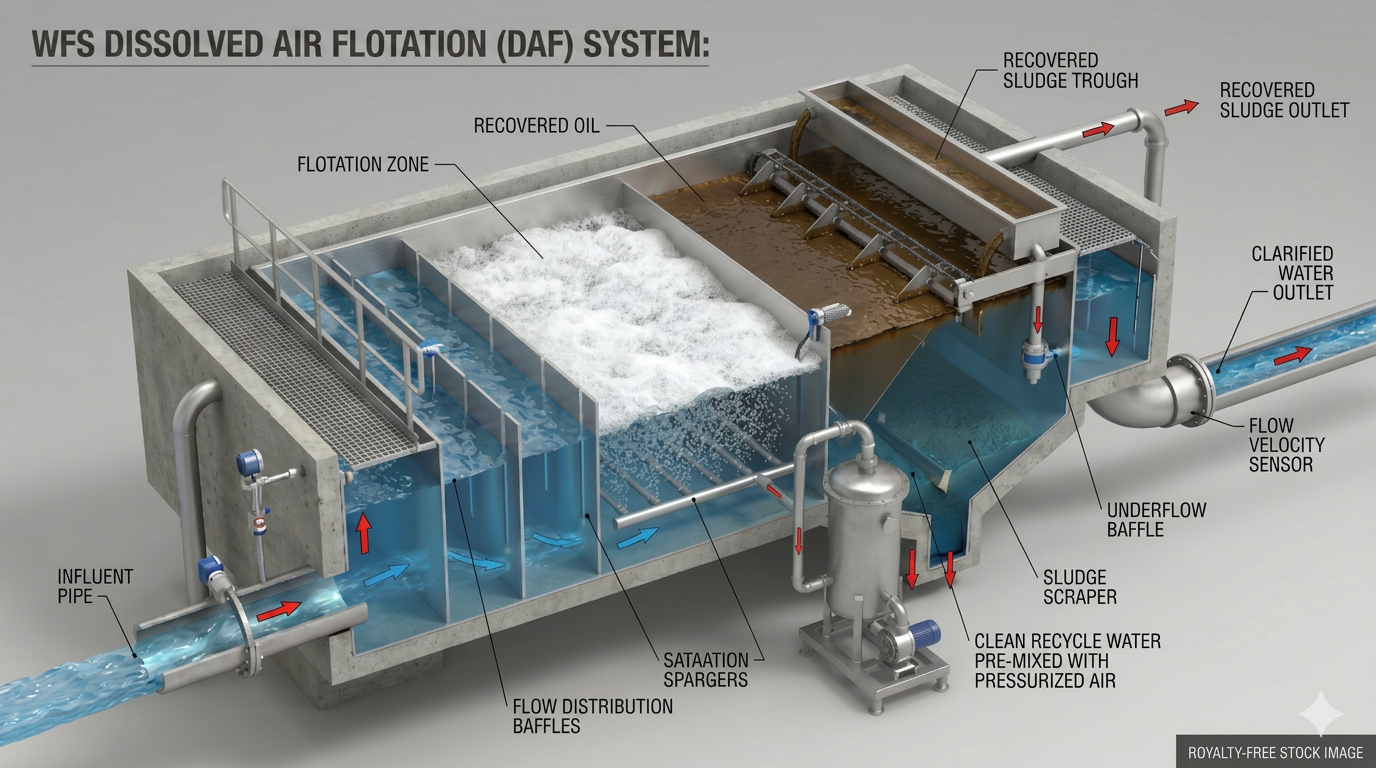
System Schematic
Representative process-flow — configured to your streamUnderlying Technology & Scientific Principle
DAF dissolves air into water under pressure, then releases it at atmospheric pressure to nucleate clouds of 20–50 µm micro-bubbles. The bubbles attach to coagulated oil droplets and suspended particles, lowering their effective density so they float to the surface for skimming.
Working Mechanism
Coagulant and polymer destabilise and flocculate the emulsion; a recycle stream saturated with air in a pressure vessel is injected and flashed across the flotation cell. Rising bubble-floc aggregates form a float blanket removed by surface skimmers, while clarified water is drawn from below.
Separation / Removal Efficiency
With proper chemistry, removes 90–99% of emulsified/free oil and TSS, taking oil-in-water to 5–25 mg/L and removing fine colloids and some metals as hydroxide floc.
Operating Principle & Parameters
Saturation pressure 4–6 bar, recycle 10–30%, air-to-solids ratio 0.005–0.06. Surface loading 5–15 m/h in conventional, up to 40 m/h in high-rate packed DAF.
Flow Rates & Volumetric Capacities
Packages from 5 m³/h skids to >1,000 m³/h basins. Compact high-rate and induced-gas (IGF) variants suit offshore and modular deployment.
Fluid Media Compatibility
CS/SS or FRP cells with lamella packs in high-rate units. Handles saline, warm, surfactant-laden refinery and produced water.
System Schematic & Process Integration
Sits after primary separation and chemical conditioning, ahead of biological treatment, media or membrane polishing.
Options / Variations Available
Dissolved-air (DAF) vs. induced-gas (IGF/CFU); rectangular vs. circular; lamella high-rate packs; nitrogen blanketing for sour service.
System Complexity & Automation Level
Moderate–high — automated coagulant/polymer dosing on streaming-current or turbidity feedback, recycle and skimmer control via PLC.
Applications & Performance Delivered
Refinery ETP secondary de-oiling
Removes emulsified oil and TSS ahead of biological treatment.
Produced-water polishing (IGF/CFU)
Compact gas-flotation for offshore oil-in-water compliance.
Petrochemical & tank-cleaning effluent
Clarifies surfactant-stabilised emulsions with tuned chemistry.
Contaminant Removal Profile
Continue exploring the train
 Secondary
Multimedia Filtration
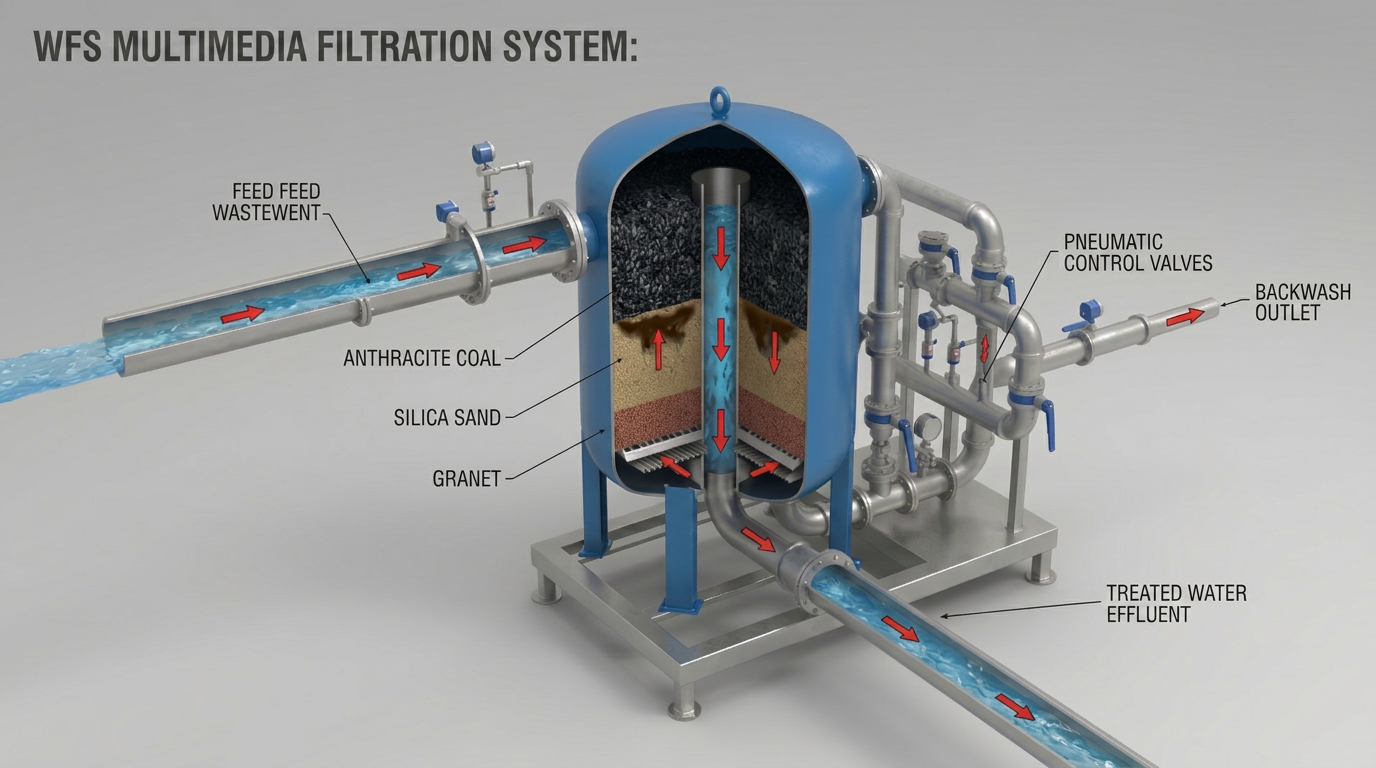
MMFLayered anthracite–sand–garnet beds that strain residual suspended solids and oil to protect membranes and ion exchange downstream.
Explore technology →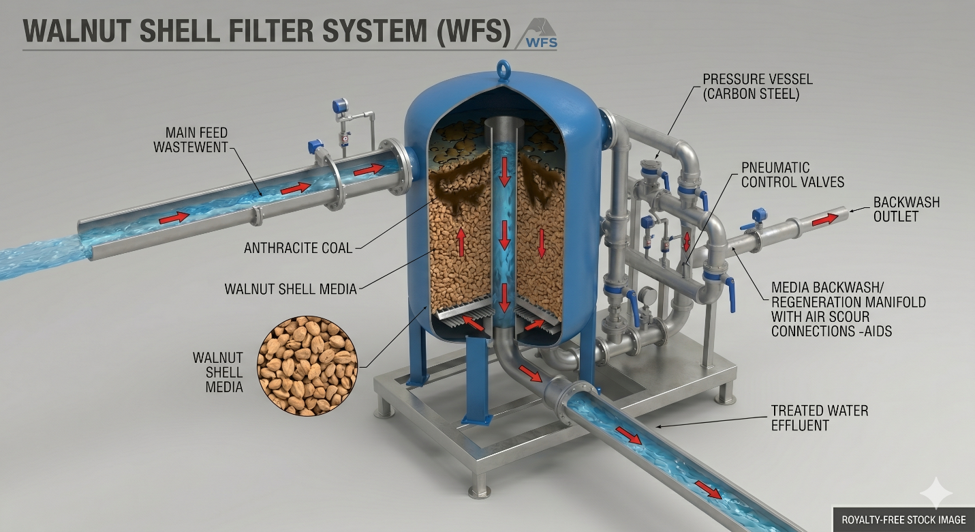 Secondary
Walnut Shell Filters
WSFDeep-bed crushed-walnut-shell media with a natural affinity for oil — the produced-water polishing filter that scrubs clean and recovers full capacity.
Explore technology →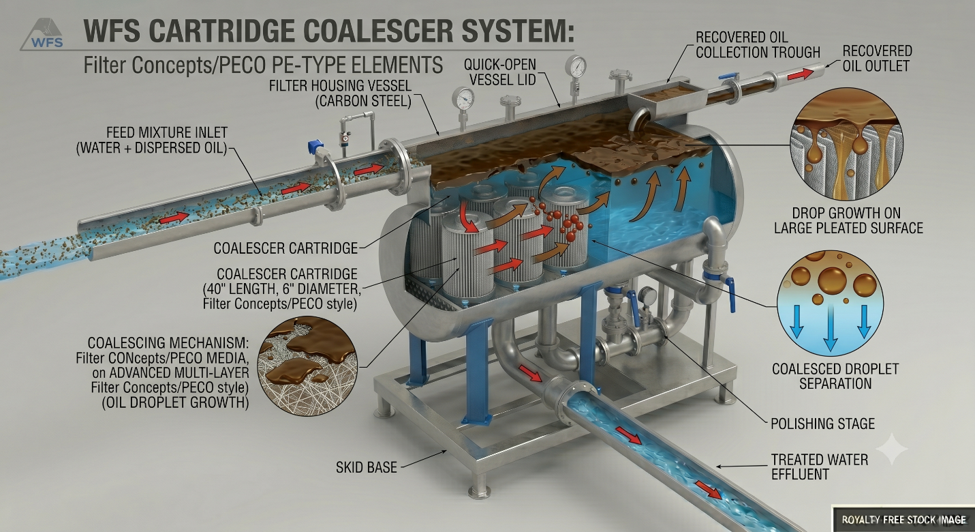 Secondary
Coalescers
COALHigh-surface-area media that merge fine dispersed oil droplets into large, easily separated drops — a low-pressure-drop enhancer for gravity de-oiling.
Explore technology →