Walnut Shell Filters WSF
Deep-bed oleophilic media for produced-water polishing. Deep-bed crushed-walnut-shell media with a natural affinity for oil — the produced-water polishing filter that scrubs clean and recovers full capacity.
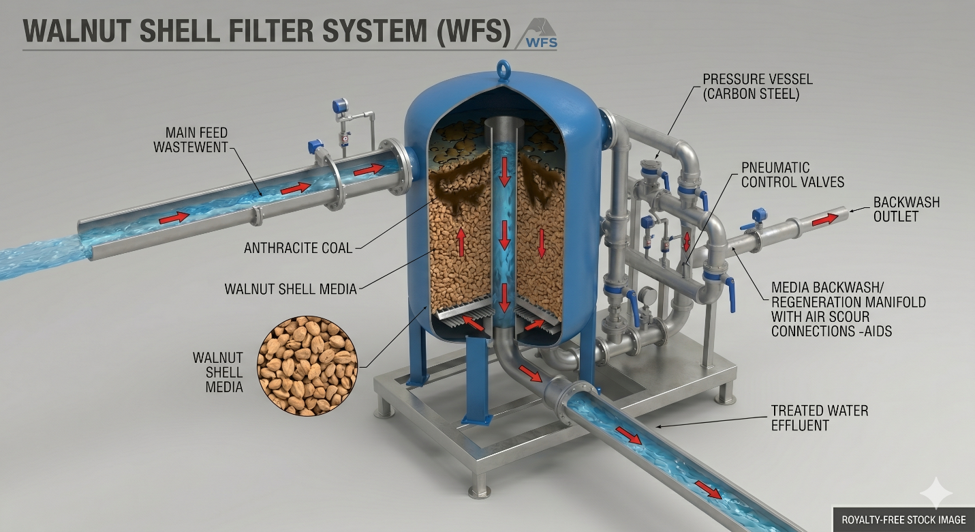
System Schematic
Representative process-flow — configured to your streamUnderlying Technology & Scientific Principle
Crushed walnut shells are naturally oleophilic and slightly hydrophilic, so dispersed oil droplets preferentially wet and adhere to the media grain surface. The deep bed captures oil and solids by a combination of adsorption, interception and depth straining without permanently blinding, because the oil-wet media can be scrubbed and regenerated.
Working Mechanism
Oily water flows downward (or upward in fluidised designs) through a 0.6–1.2 m bed of graded nutshell media. Oil films coat the grains while solids lodge in the inter-grain voids. When differential pressure or run time reaches a setpoint, the bed is fluidised and mechanically agitated with a recycle pump or eductor to scour oil off the grains, and a backwash flush carries the released oil and solids to a recovery tank.
Separation / Removal Efficiency
Removes dispersed oil and suspended solids down to ~2–5 µm, typically delivering outlet oil-in-water of 2–10 mg/L and TSS <5 mg/L from feeds of 50–200 mg/L OiW.
Operating Principle & Parameters
Service flux 20–35 m/h; backwash/scrub cycle every 4–24 h depending on load. Scrub recycle 20–40% of forward flow for 5–10 min; backwash water reused via a slop tank.
Flow Rates & Volumetric Capacities
Single vessels handle 30–250 m³/h; multi-vessel skids serve 1,000+ m³/h with one vessel always in scrub. Common on offshore deck packages and onshore produced-water plants.
Fluid Media Compatibility
Graded crushed walnut shell (0.6–1.4 mm) in coded CS or duplex pressure vessels with internal scrub mixers or eductors. Handles hot, saline, sour produced water.
System Schematic & Process Integration
Final polishing stage after hydrocyclones, IGF/CFU or DAF to meet overboard or re-injection oil-in-water limits; protects downstream injection pumps and absolute filters.
Options / Variations Available
Conventional downflow with mechanical agitator vs. upflow fluidised scrub; single vs. multi-vessel; nitrogen-blanketed sour-service designs.
System Complexity & Automation Level
Moderate — automated scrub/backwash on differential pressure, time or online OiW; PLC-sequenced valve nests and recycle pump start/stop.
Applications & Performance Delivered
Produced-water polishing for re-injection
Meets sub-10 mg/L OiW targets to protect injection wells and downhole formations.
Offshore overboard compliance
Final de-oiling stage downstream of hydrocyclones / CFU to hit discharge limits.
Refinery oily-water reuse
Polishes API/CPI/DAF effluent ahead of cooling-water or boiler-feed reuse trains.
Contaminant Removal Profile
Continue exploring the train
 Secondary
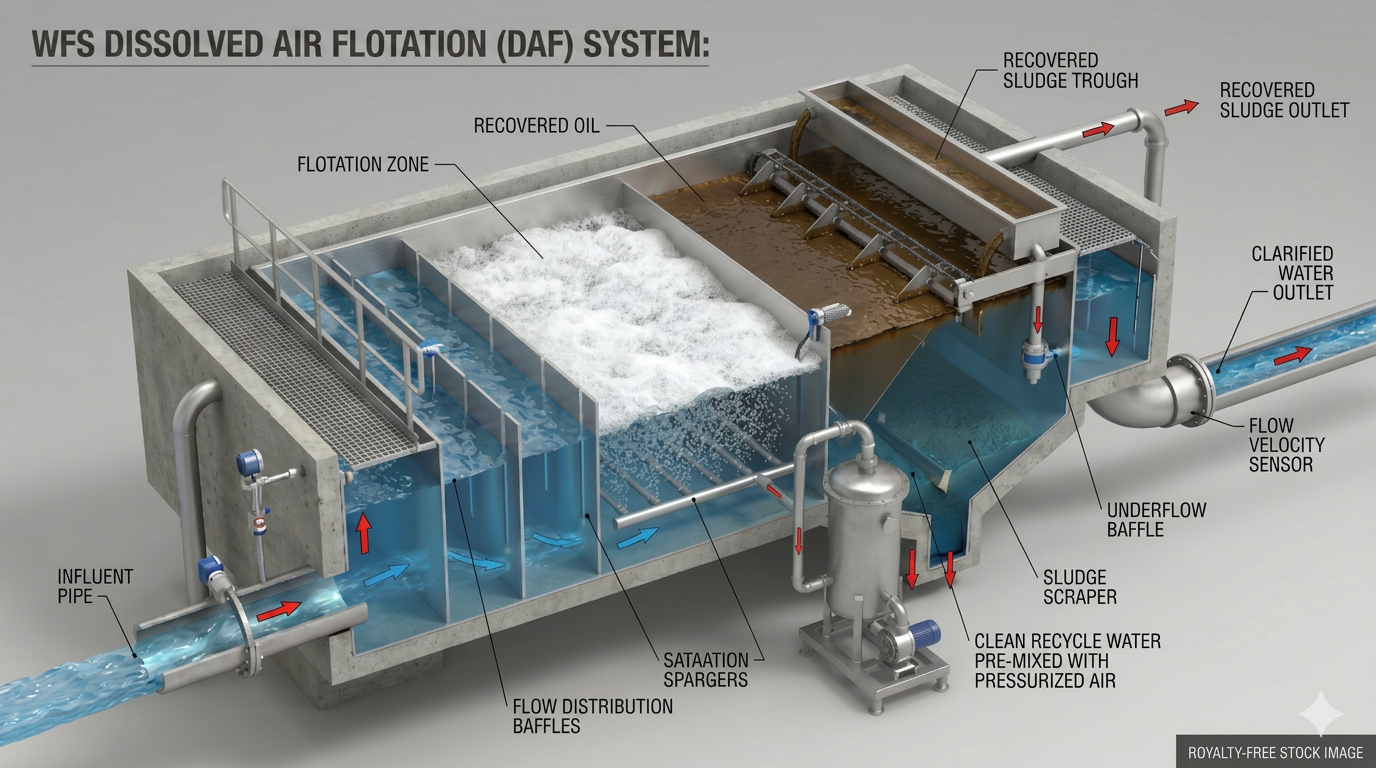
Dissolved Air Flotation
DAFMicro-bubble flotation that lifts emulsified oil, light solids and chemical floc to the surface — the workhorse secondary de-oiler for emulsified streams.
Explore technology →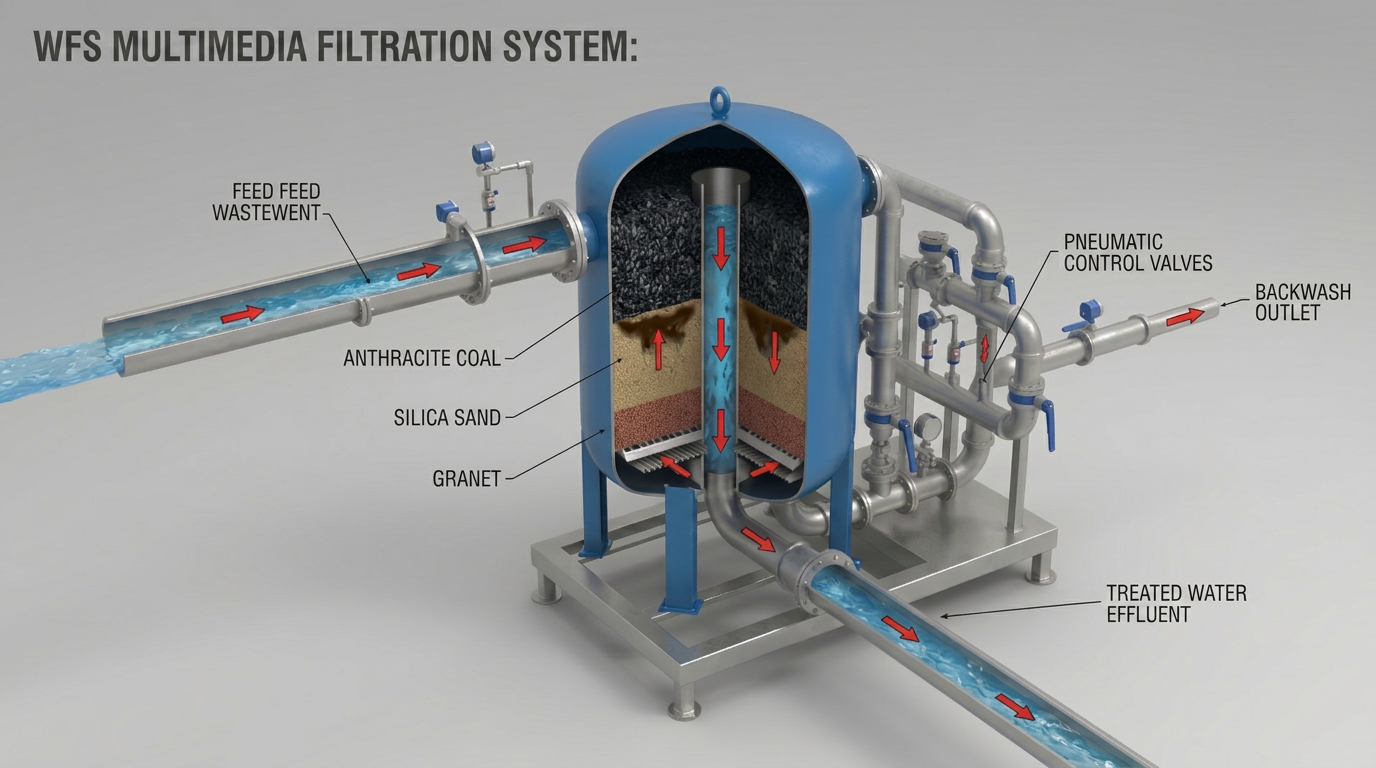 Secondary
Multimedia Filtration
MMFLayered anthracite–sand–garnet beds that strain residual suspended solids and oil to protect membranes and ion exchange downstream.
Explore technology → Secondary
Coalescers
COALHigh-surface-area media that merge fine dispersed oil droplets into large, easily separated drops — a low-pressure-drop enhancer for gravity de-oiling.
Explore technology →