
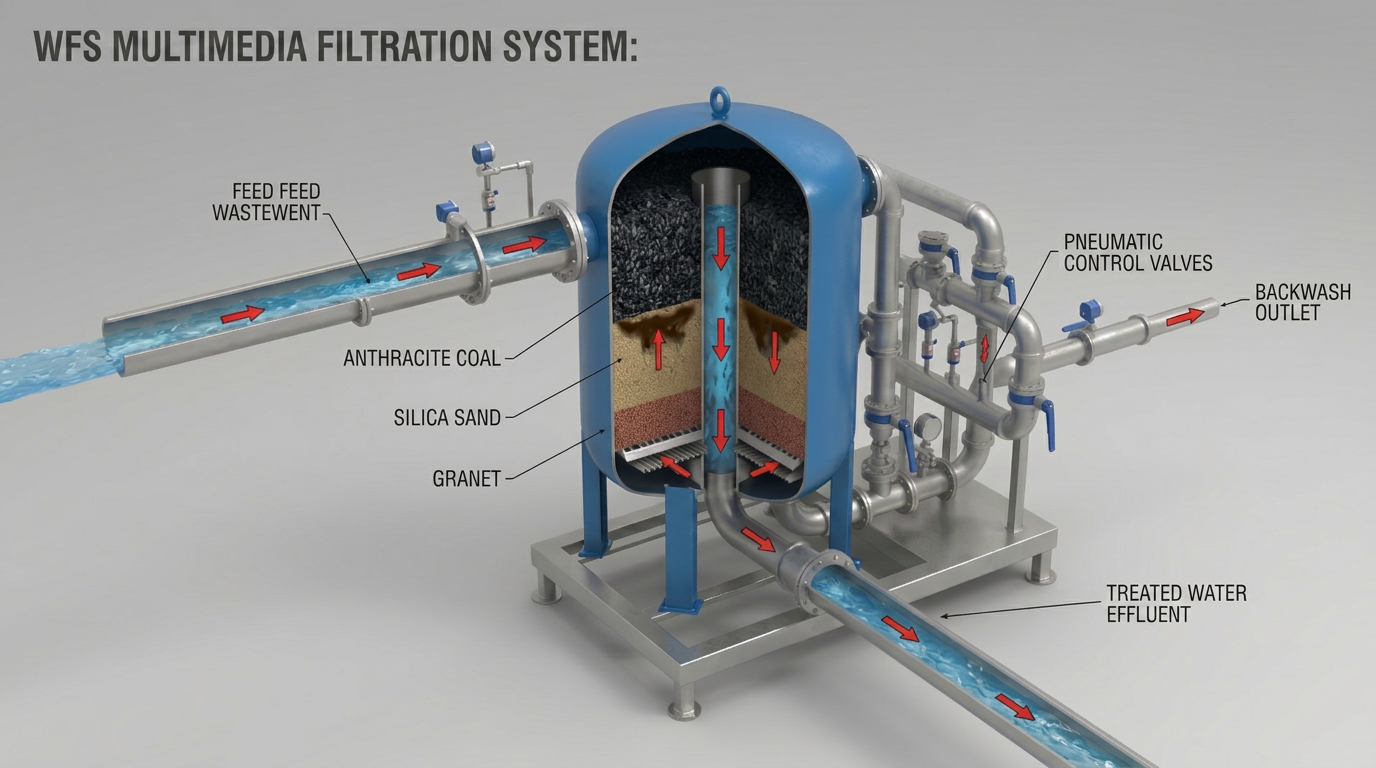
Multimedia Filtration MMF
Multi-layer depth filtration of suspended solids. Layered anthracite–sand–garnet beds that strain residual suspended solids and oil to protect membranes and ion exchange downstream.
System Schematic
Representative process-flow — configured to your streamUnderlying Technology & Scientific Principle
Multimedia (or dual-media) filtration uses a graded bed of materials of decreasing size and increasing density — anthracite over sand over garnet/gravel — so particles are captured in depth: large solids high in the coarse anthracite, fine particles deeper, maximising dirt-holding capacity versus a single-media filter.
Working Mechanism
Water passes down through the bed where solids are removed by straining, interception, sedimentation and adsorption onto media grains. As head-loss rises with captured solids, the bed is periodically backwashed (often with air scour) to fluidise the media, release the trapped solids and re-stratify the layers.
Separation / Removal Efficiency
Removes suspended solids to 5–10 µm nominal, typically achieving effluent TSS <5 mg/L and turbidity <1 NTU; with coagulant addition, fine colloids and residual oil are further reduced.
Operating Principle & Parameters
Filtration rate 10–30 m/h; backwash 30–50 m/h with air scour. Bed depth 0.8–1.5 m. Cycle length set by influent solids load and terminal head-loss.
Flow Rates & Volumetric Capacities
Vertical or horizontal pressure vessels from 5 to several hundred m³/h; multiple vessels in parallel for continuous service during backwash.
Fluid Media Compatibility
Anthracite, silica sand, garnet and support gravel in CS-lined or FRP vessels. Tolerant of saline and warm water; oil fouling must be controlled upstream.
System Schematic & Process Integration
Classic pre-treatment ahead of UF/RO and ion exchange, downstream of clarification or flotation; also tertiary polishing of biologically treated effluent.
Options / Variations Available
Pressure vs. gravity; dual- or tri-media; coagulant-assisted (in-line) filtration; automatic vs. manual backwash valving.
System Complexity & Automation Level
Moderate — automatic backwash on differential pressure, time or turbidity; valve nests sequenced by PLC. Robust and low-skill operation.
Applications & Performance Delivered
RO / UF pre-treatment
Reduces SDI and TSS to protect membranes and extend life.
Cooling-water side-stream filtration
Controls suspended solids and fouling in recirculating systems.
Tertiary effluent polishing
Clarifies biologically treated water before discharge or reuse.
Contaminant Removal Profile
Continue exploring the train
 Secondary
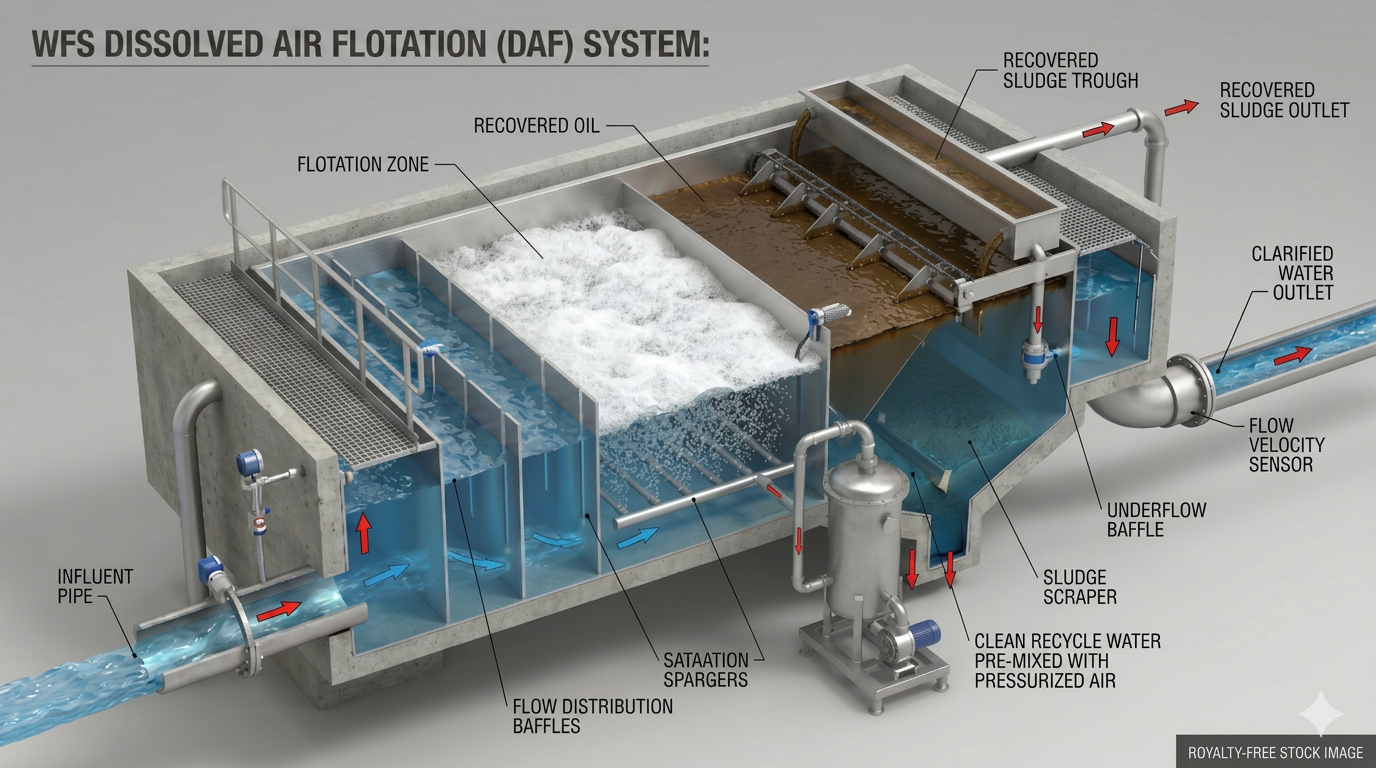
Dissolved Air Flotation
DAFMicro-bubble flotation that lifts emulsified oil, light solids and chemical floc to the surface — the workhorse secondary de-oiler for emulsified streams.
Explore technology →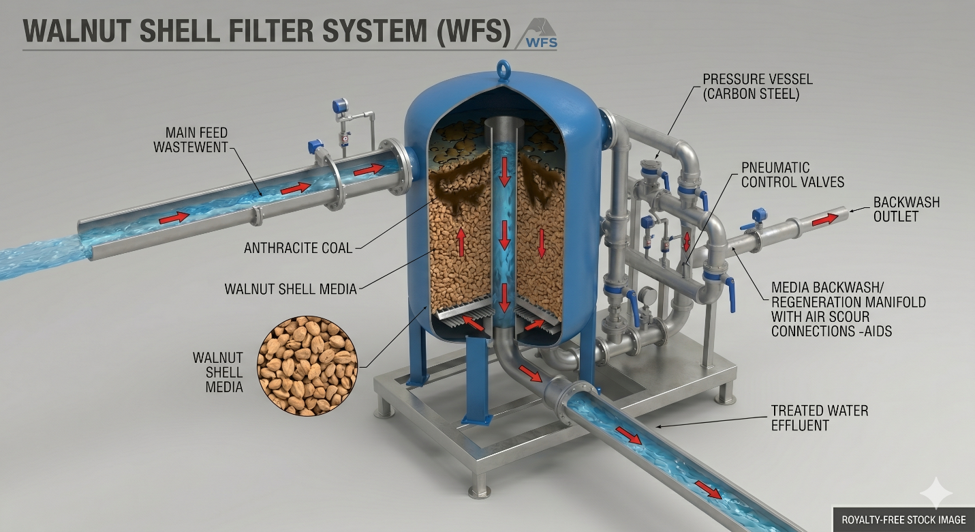 Secondary
Walnut Shell Filters
WSFDeep-bed crushed-walnut-shell media with a natural affinity for oil — the produced-water polishing filter that scrubs clean and recovers full capacity.
Explore technology →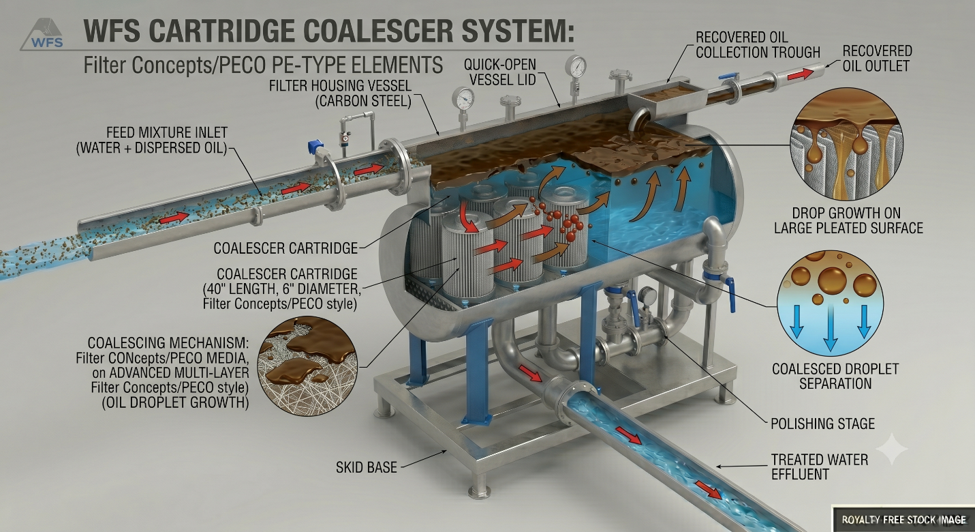 Secondary
Coalescers
COALHigh-surface-area media that merge fine dispersed oil droplets into large, easily separated drops — a low-pressure-drop enhancer for gravity de-oiling.
Explore technology →