
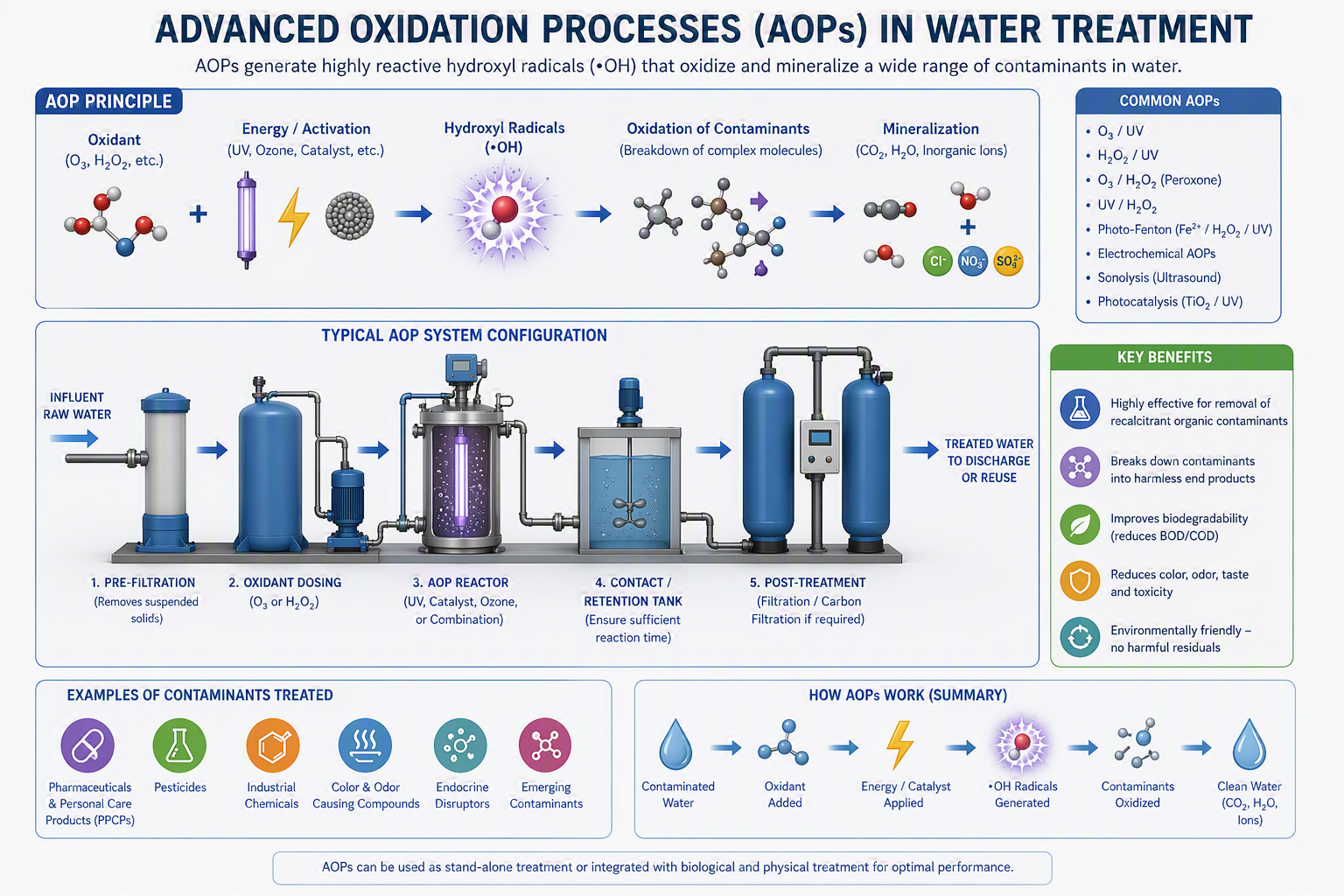
Advanced Oxidation Processes AOP
Hydroxyl-radical destruction of refractory organics. Hydroxyl-radical generation (UV/ozone/peroxide/Fenton) that destroys the most persistent organics outright — mineralising what other processes only transfer.
System Schematic
Representative process-flow — configured to your streamUnderlying Technology & Scientific Principle
Advanced Oxidation Processes (AOPs) generate hydroxyl radicals (•OH) — the second-strongest oxidant known after fluorine — in situ from combinations of UV, ozone, hydrogen peroxide and Fe²⁺ catalysts. The •OH radical attacks C–H and C=C bonds non-selectively, mineralising refractory organics to CO₂ and water.
Working Mechanism
Common AOP routes include UV/H₂O₂ (peroxide photolysis), O₃/H₂O₂ (peroxone), UV/O₃, and Fenton (Fe²⁺ + H₂O₂). The generated •OH radicals destroy organics that resist biological treatment, adsorption and conventional oxidation — including pesticides, pharmaceuticals, BTEX, phenols, 1,4-dioxane and PFAS precursors.
Separation / Removal Efficiency
Refractory COD reduction 60–95%; specific micropollutants >99%; full mineralisation possible with sufficient oxidant dose. 4–6 log disinfection as a co-benefit on UV-based systems.
Operating Principle & Parameters
H₂O₂ dose 5–100 mg/L; O₃ dose 2–20 mg/L; UV fluence 500–3000 mJ/cm²; pH 3 (Fenton) or 6–8 (UV/H₂O₂, peroxone); contact 1–30 min depending on route.
Flow Rates & Volumetric Capacities
Skid-mounted units from 1 m³/h sidestreams to >1000 m³/h reuse trains; modular reactor banks scale linearly with flow and target dose.
Fluid Media Compatibility
UV reactors with medium- or low-pressure lamps, ozone generators with venturi or fine-bubble contactors, H₂O₂ dosing skids, Fenton mix tanks with Fe²⁺ feed and pH control.
System Schematic & Process Integration
Polishing after biological treatment, RO concentrate destruction, micropollutant removal in water reuse, refinery wastewater detox upstream of discharge.
Options / Variations Available
UV/H₂O₂, O₃/H₂O₂ (peroxone), UV/O₃, Fenton, photo-Fenton, catalytic ozonation — selection driven by target contaminant, matrix and energy cost.
System Complexity & Automation Level
High — UV-intensity feedback, online H₂O₂/O₃ residual trim, ORP control, lamp-hour and quartz-sleeve monitoring, with full SCADA integration.
Applications & Performance Delivered
Refinery wastewater polishing
Destroys phenols, BTEX and refractory COD ahead of discharge.
Reuse micropollutant removal
Targets 1,4-dioxane, NDMA, pharmaceuticals and pesticides for potable reuse.
RO concentrate detox
Mineralises concentrated organics in brine before disposal or ZLD.
Contaminant Removal Profile
Continue exploring the train
 Polishing
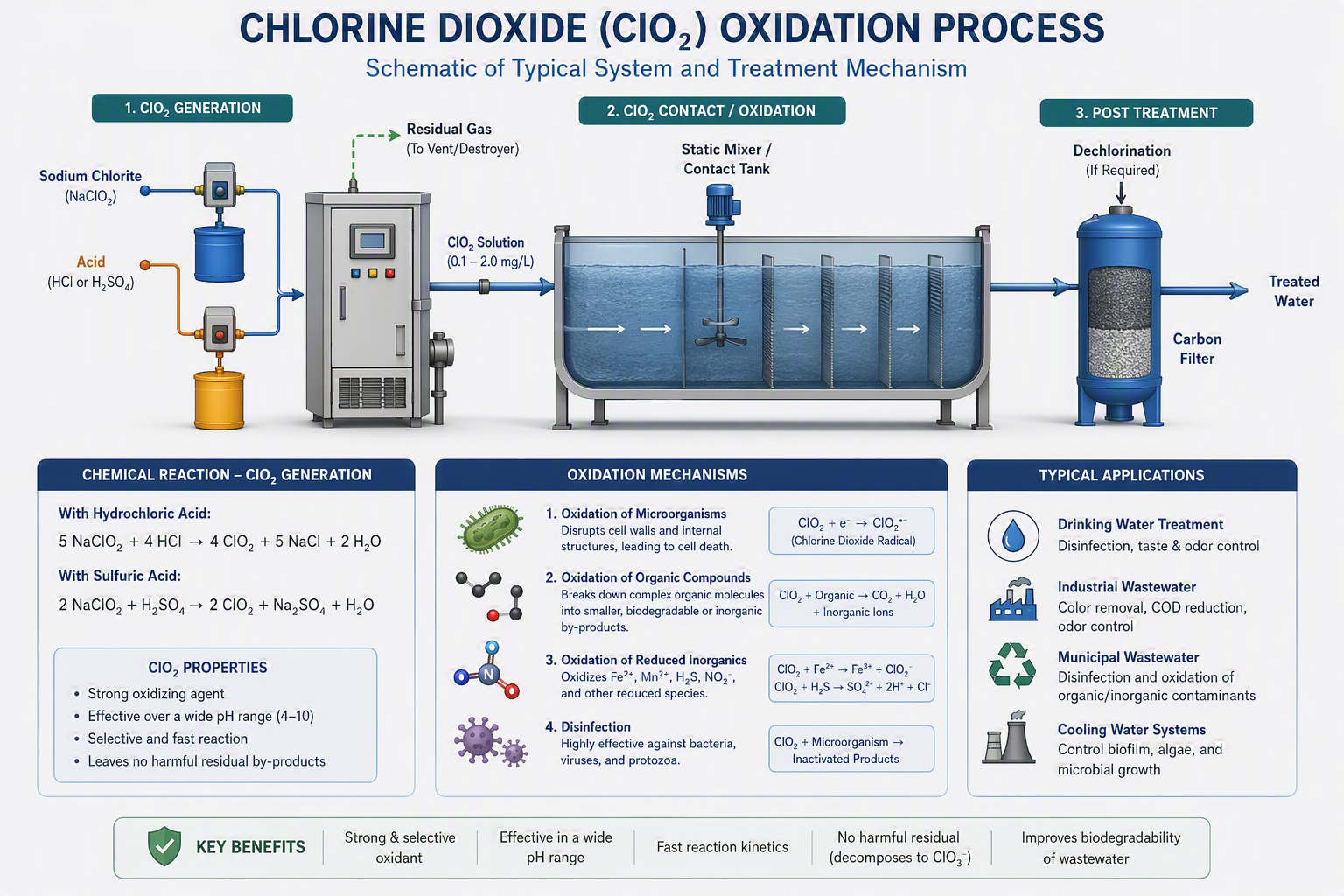
Chlorine Dioxide (ClO₂) Treatment
ClO₂A powerful selective oxidant and biocide dosed on-site — controls biofouling and oxidises sulphides without forming chlorinated by-products.
Explore technology →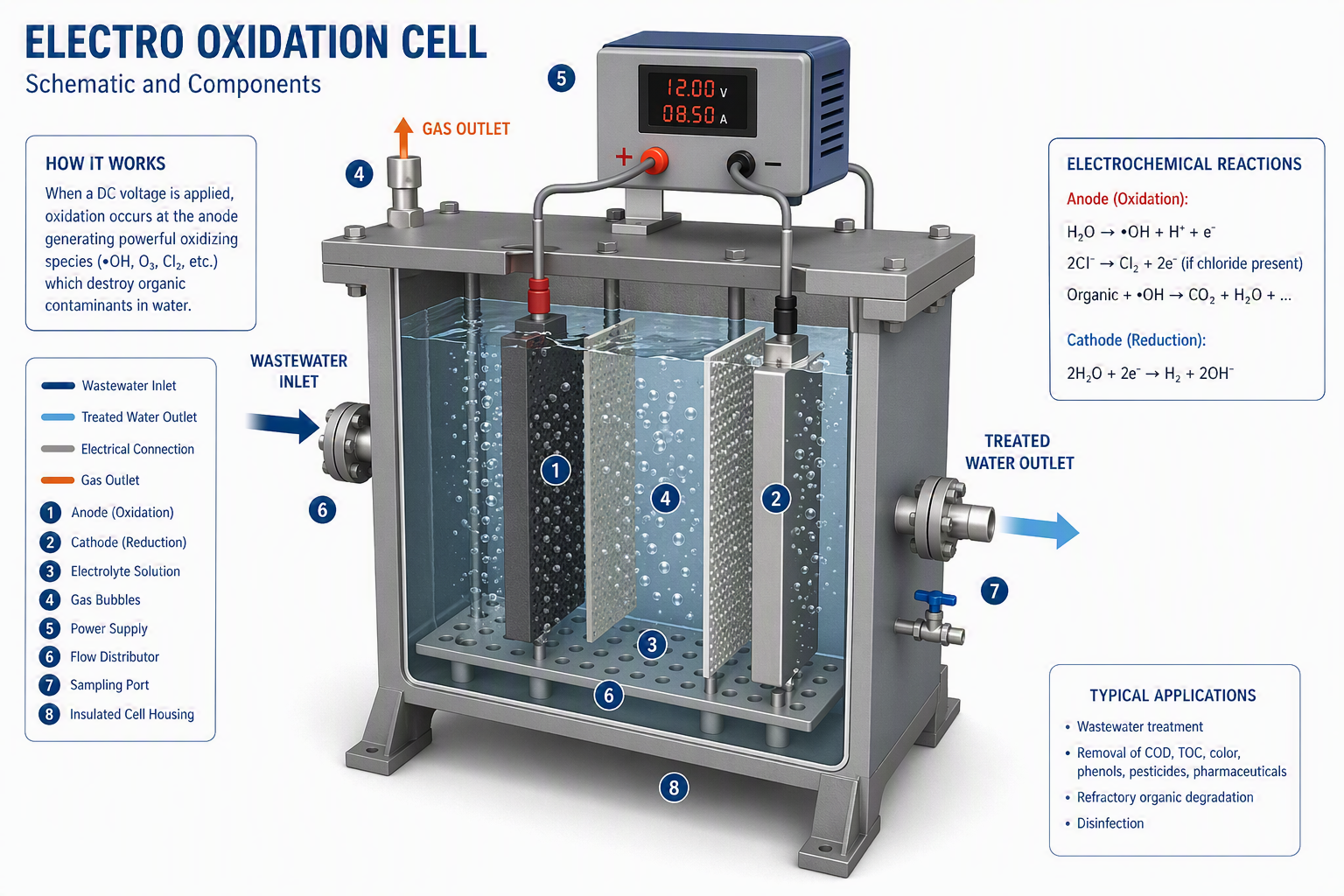 Polishing
Electro-oxidation
EODirect anodic oxidation at dimensionally stable electrodes that destroys refractory organics and ammonia in high-salinity brines — chemical-free advanced oxidation.
Explore technology →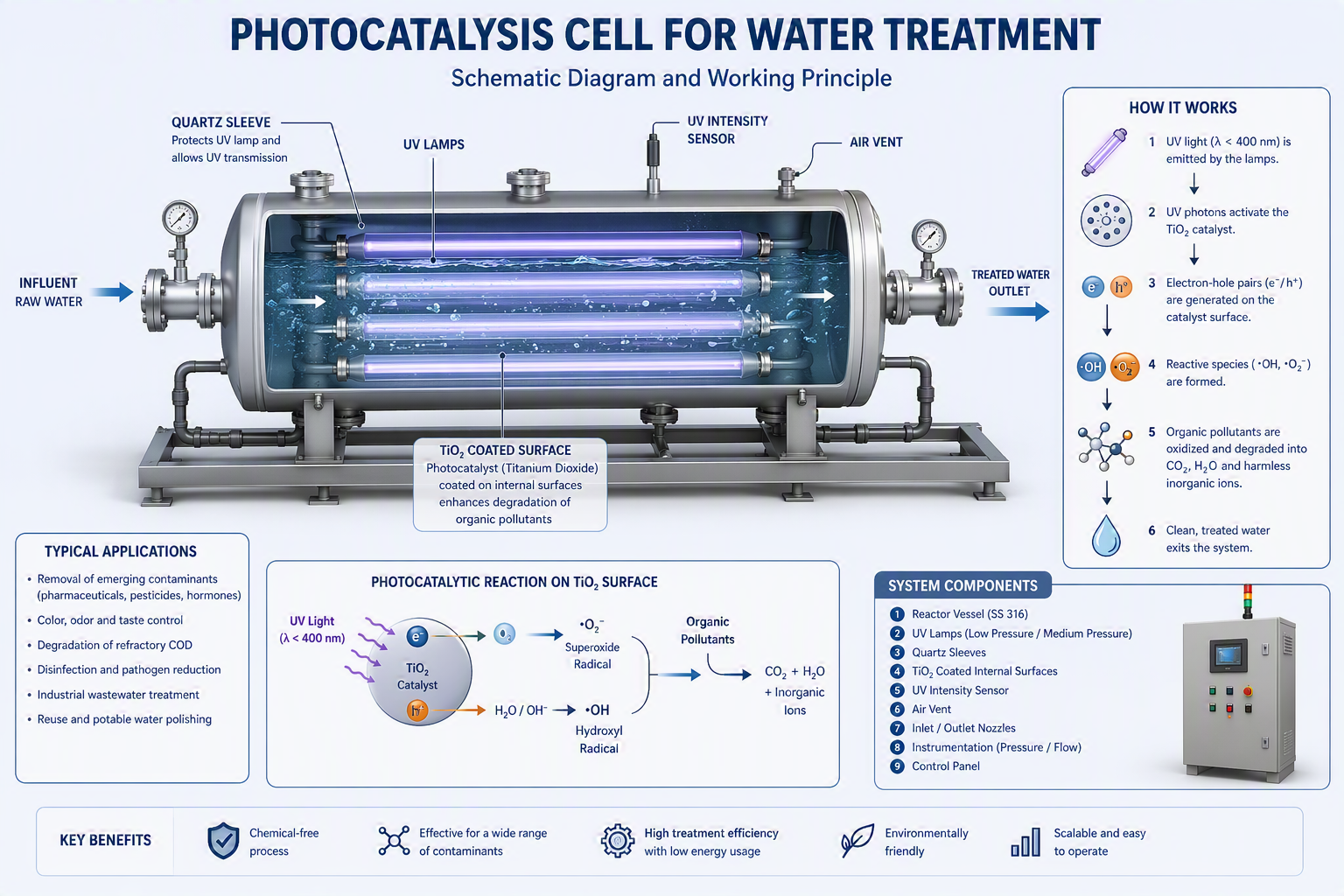 Polishing
Photocatalysis
PCUV-activated semiconductor catalysts (TiO₂) that generate reactive radicals from light — a green advanced-oxidation route that breaks down complex organics.
Explore technology →