
Chlorine Dioxide (ClO₂) Treatment ClO₂
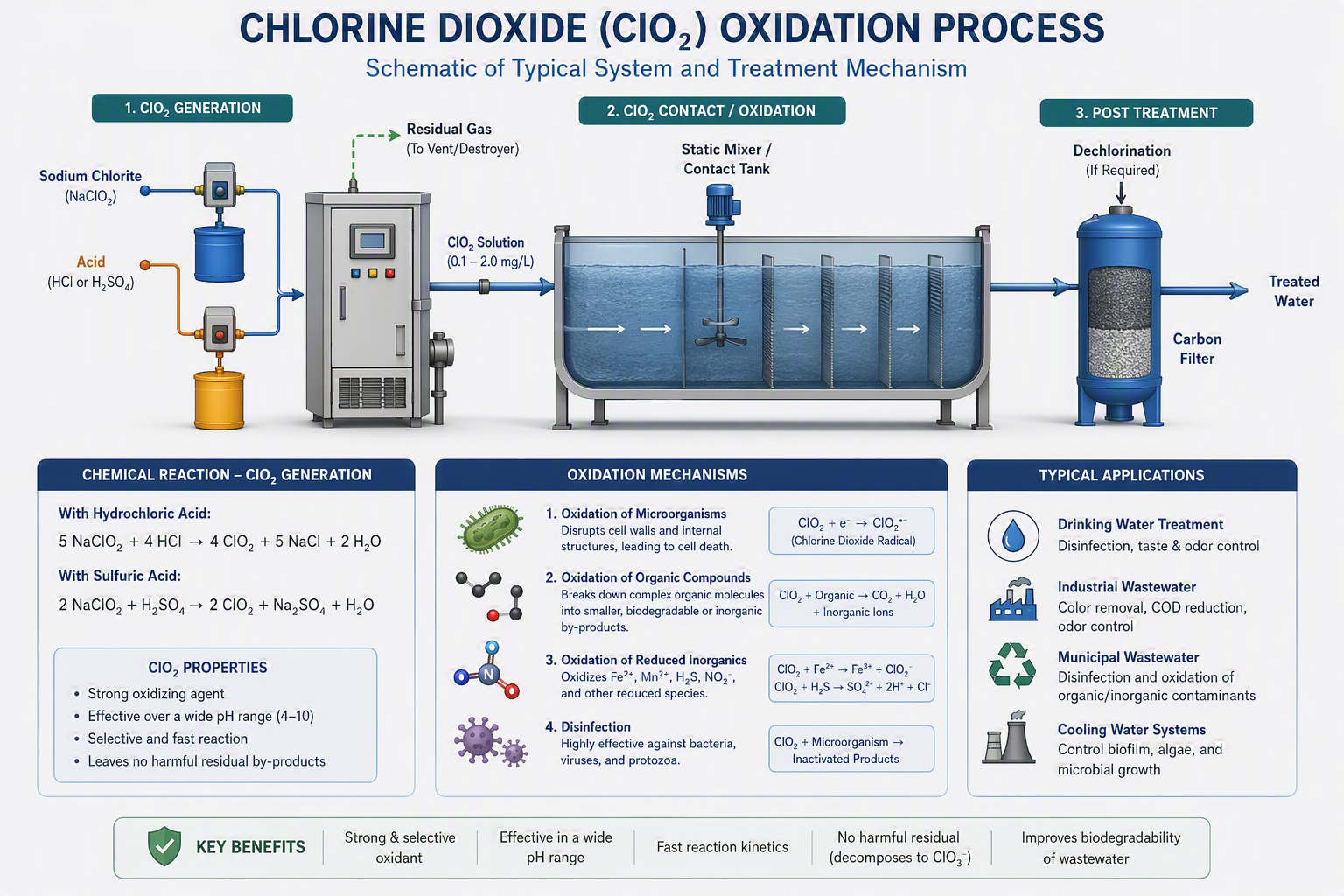
Selective biocide & sulphide oxidant. A powerful selective oxidant and biocide dosed on-site — controls biofouling and oxidises sulphides without forming chlorinated by-products.
System Schematic
Representative process-flow — configured to your streamUnderlying Technology & Scientific Principle
Chlorine dioxide is generated on-site from sodium chlorite and an activator (acid, chlorine or hypochlorite). As a true dissolved gas, it acts as a selective one-electron oxidant — it does not chlorinate organics and so avoids THM/HAA formation, while remaining biocidal across a wide pH range.
Working Mechanism
ClO₂ is produced in a small reactor skid and dosed in-line into the water stream. It oxidises sulphides, iron and manganese, disrupts biofilm and inactivates planktonic and sessile bacteria. Residual ClO₂ and chlorite are monitored downstream.
Separation / Removal Efficiency
Sulphide oxidation >99%; planktonic bacteria 4–6 log reduction at 0.1–0.5 mg/L residual; effective biofilm penetration with no THM/HAA formation.
Operating Principle & Parameters
Dose 0.1–2 mg/L (continuous) or 1–5 mg/L (shock); contact time 5–30 min; effective pH 4–10; generator efficiency >95% with <2% excess chlorite.
Flow Rates & Volumetric Capacities
Generator capacities from grams/h to tens of kg/h ClO₂; scalable to any plant size from cooling-water side-streams to full produced-water disinfection.
Fluid Media Compatibility
Skid-mounted generator with sodium chlorite and activator dosing, reaction chamber, in-line injection quill and residual analyser.
System Schematic & Process Integration
Cooling-water biocide, produced-water injection-system biocide, RO pre-treatment for biofouling control, sulphide control upstream of biological treatment.
Options / Variations Available
Three-chemical (NaClO₂ + HCl + NaOCl), two-chemical (NaClO₂ + HCl) or electrochemical generation; continuous or shock dosing.
System Complexity & Automation Level
High — flow-paced or residual-trim dosing with ClO₂/chlorite analysers, leak detection and full safety interlocks on the generator skid.
Applications & Performance Delivered
Injection-water biocide
Controls SRB and biofouling in waterflood and disposal wells.
Cooling-water treatment
Penetrates biofilm at low residuals without chlorinated by-products.
Sulphide control
Oxidises dissolved H₂S/sulphides upstream of biological or membrane treatment.
Contaminant Removal Profile
Continue exploring the train
 Polishing
Advanced Oxidation Processes
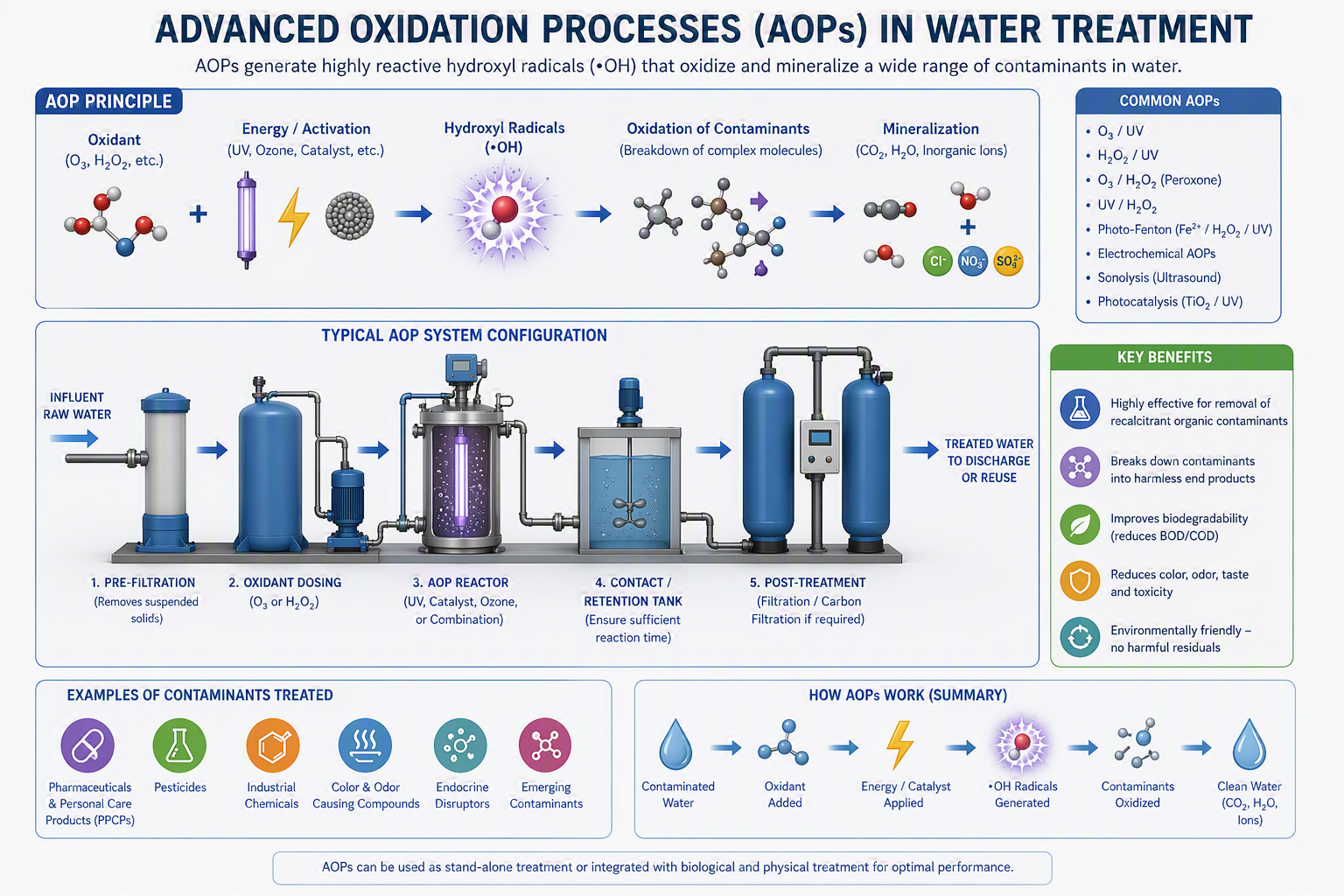
AOPHydroxyl-radical generation (UV/ozone/peroxide/Fenton) that destroys the most persistent organics outright — mineralising what other processes only transfer.
Explore technology →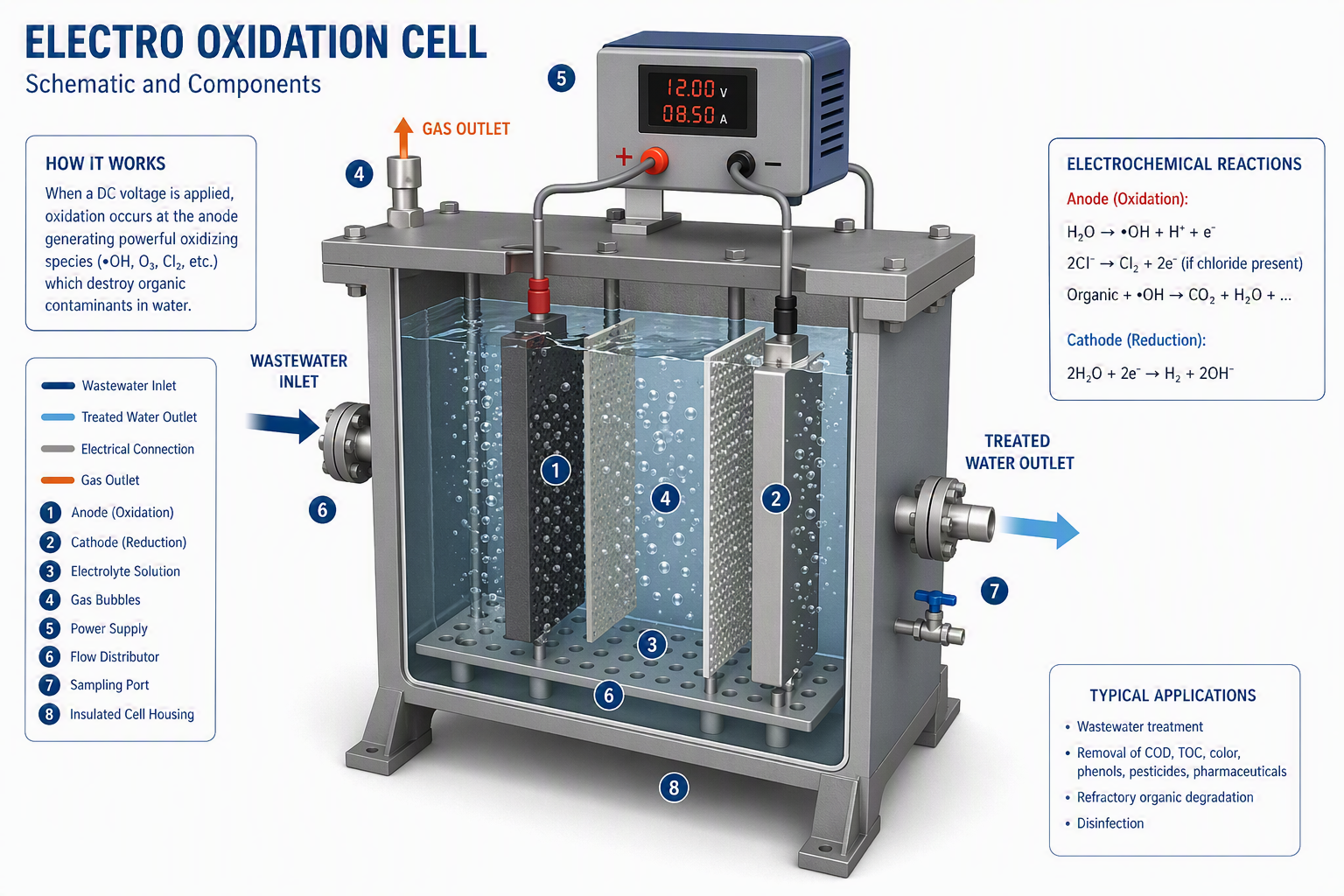 Polishing
Electro-oxidation
EODirect anodic oxidation at dimensionally stable electrodes that destroys refractory organics and ammonia in high-salinity brines — chemical-free advanced oxidation.
Explore technology →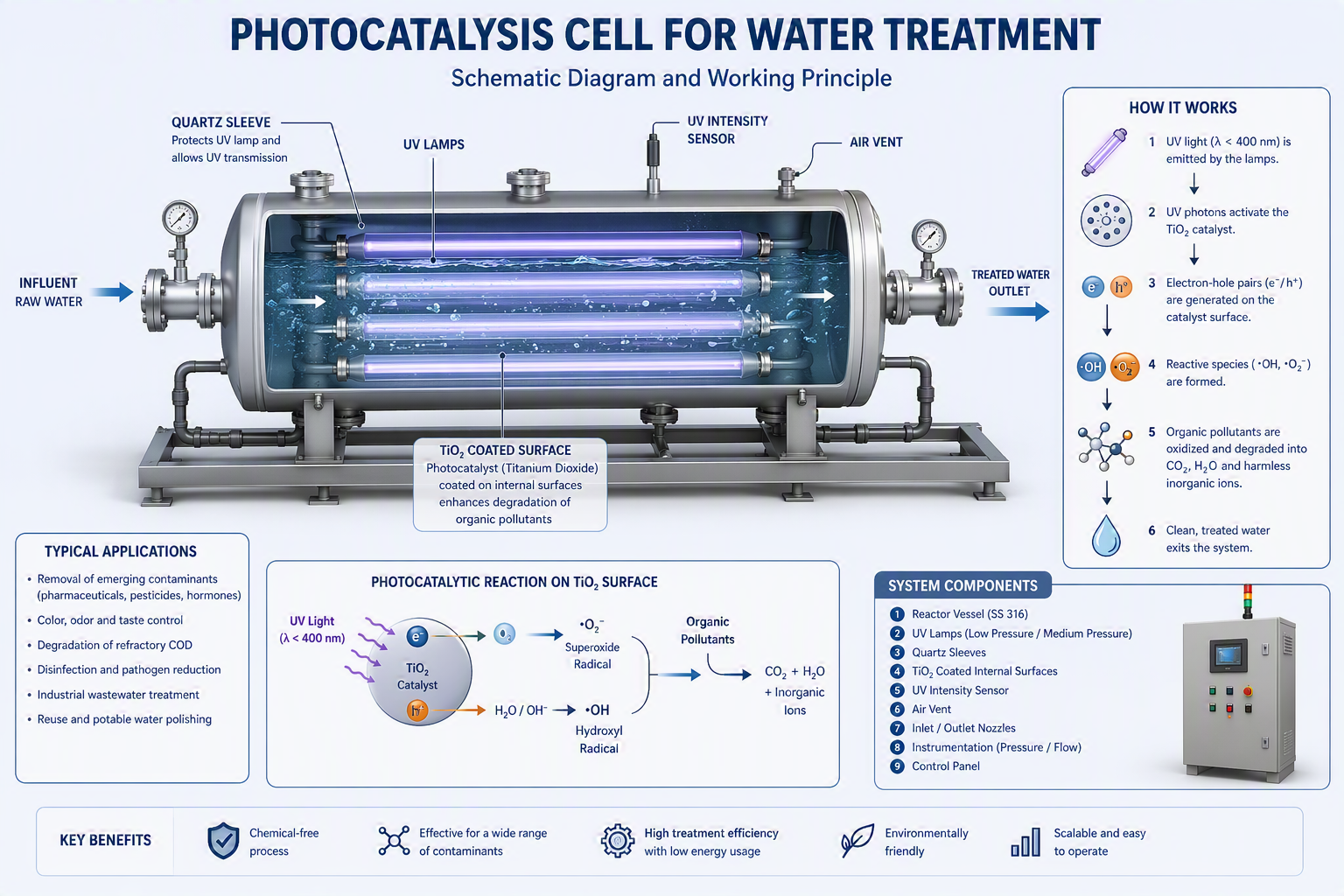 Polishing
Photocatalysis
PCUV-activated semiconductor catalysts (TiO₂) that generate reactive radicals from light — a green advanced-oxidation route that breaks down complex organics.
Explore technology →