Hydrocyclones HC
Centrifugal liquid–liquid separation. Static centrifugal de-oilers that spin produced water at thousands of g — separating dispersed oil with no moving parts in a compact, deck-friendly package.
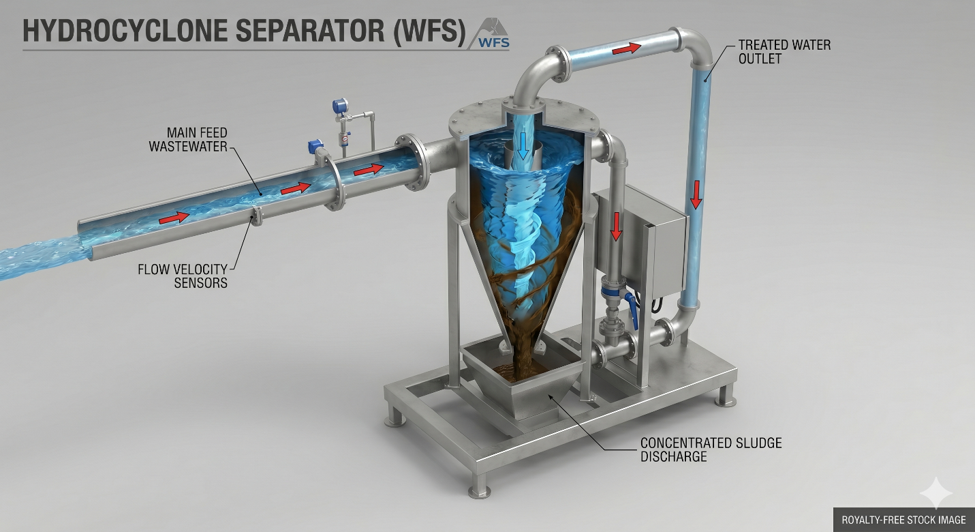
System Schematic
Representative process-flow — configured to your streamUnderlying Technology & Scientific Principle
A deoiling hydrocyclone converts feed pressure into a high-speed vortex. The resulting centrifugal field (up to several thousand g) drives the denser water phase to the wall while lighter oil migrates to the low-pressure core axis, where it is rejected — separation by density without any rotating parts.
Working Mechanism
Pressurised water enters tangentially into a tapering liner, accelerating into a spiral. Water exits as a clean underflow at the apex; the coalesced oil core reverses and discharges through a small reject orifice at the overflow. Performance is set by the pressure-drop ratio (PDR) between overflow and underflow.
Separation / Removal Efficiency
Removes dispersed oil from ~15 µm upward, typically achieving 80–95% oil reduction and outlet oil-in-water of 10–40 mg/L on a well-conditioned feed.
Operating Principle & Parameters
Feed pressure 4–10 bar; PDR 1.4–2.0; high shear sensitivity — upstream valves and pumps must avoid creating tight emulsions. Reject rate 1–3% of feed.
Flow Rates & Volumetric Capacities
Each liner handles 3–12 m³/h; multi-liner vessels scale to 50–1,000+ m³/h. Extremely compact and orientation-tolerant for offshore platforms and FPSOs.
Fluid Media Compatibility
Wear-resistant liners (duplex, ceramic-lined) in coded pressure vessels. Ideal for hot, saline, sour produced water at high pressure.
System Schematic & Process Integration
Core of upstream produced-water packages — downstream of bulk separation, upstream of flotation/compact flotation units (CFU) and polishing.
Options / Variations Available
Deoiling vs. desanding liners; single- or two-stage; static or with reject recovery; combined deoiling/degassing vessels.
System Complexity & Automation Level
Moderate — automatic PDR control via reject and underflow valves, with online oil-in-water monitoring. No mechanical maintenance internally.
Applications & Performance Delivered
Offshore produced-water treatment
Primary dispersed-oil removal on weight- and space-limited platforms.
FPSO & subsea-tieback packages
Orientation-tolerant separation under motion and high pressure.
Desanding duty
Solids removal protecting downstream pumps and membranes.
Contaminant Removal Profile
Continue exploring the train
 Primary
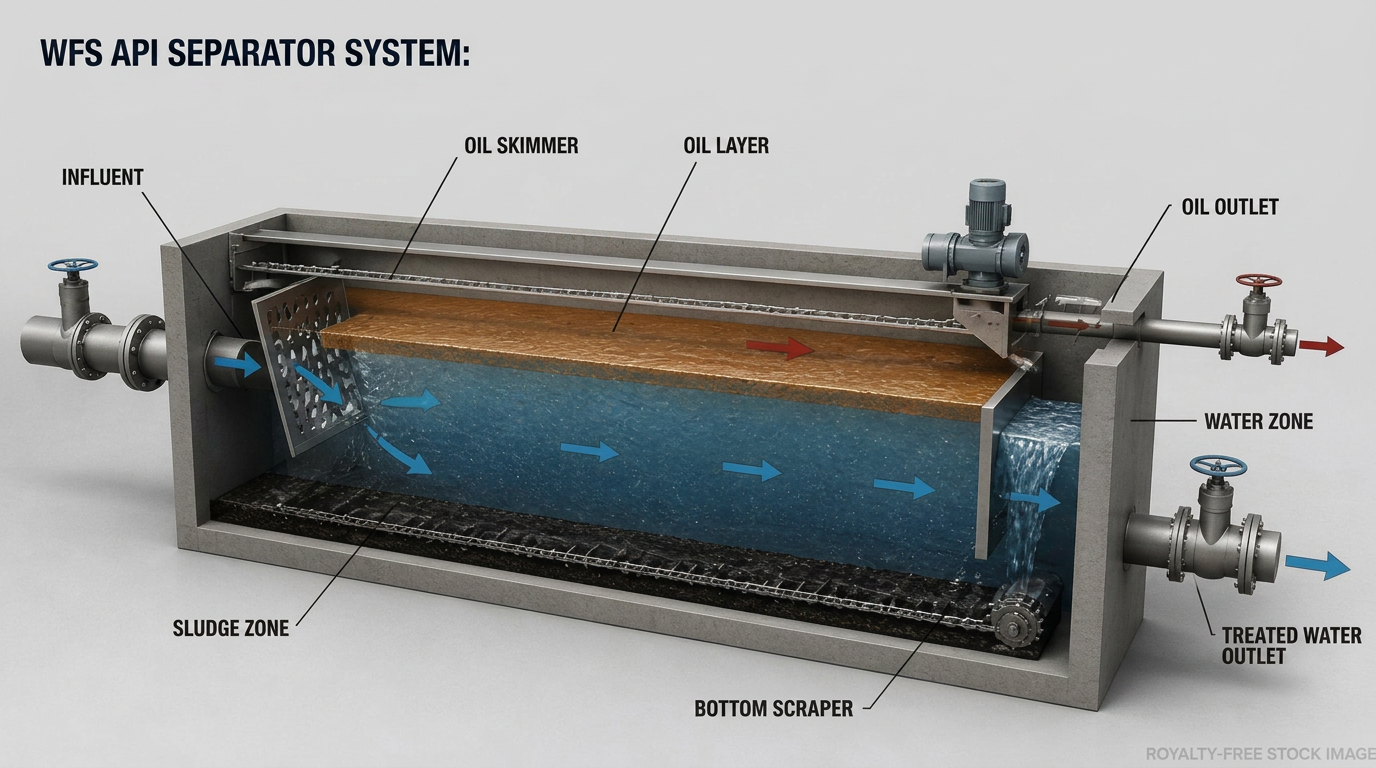
API Separator
APIGravity-based rectangular basin that separates bulk free oil, settleable solids and water by density difference — the robust first stage of nearly every oily-water train.
Explore technology →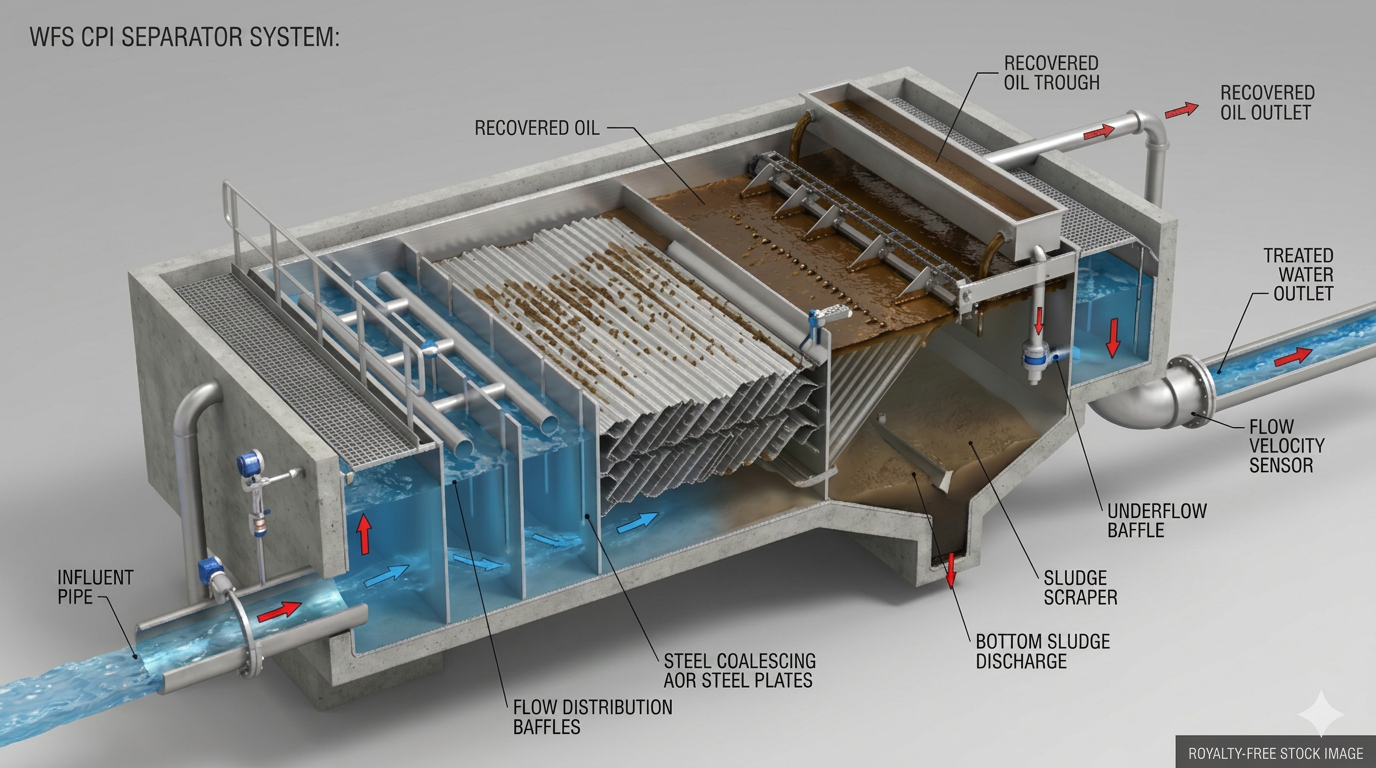 Primary
Corrugated Plate Interceptor
CPIInclined corrugated-plate pack that shortens the distance an oil droplet must rise — delivering API-class separation in a fraction of the footprint.
Explore technology →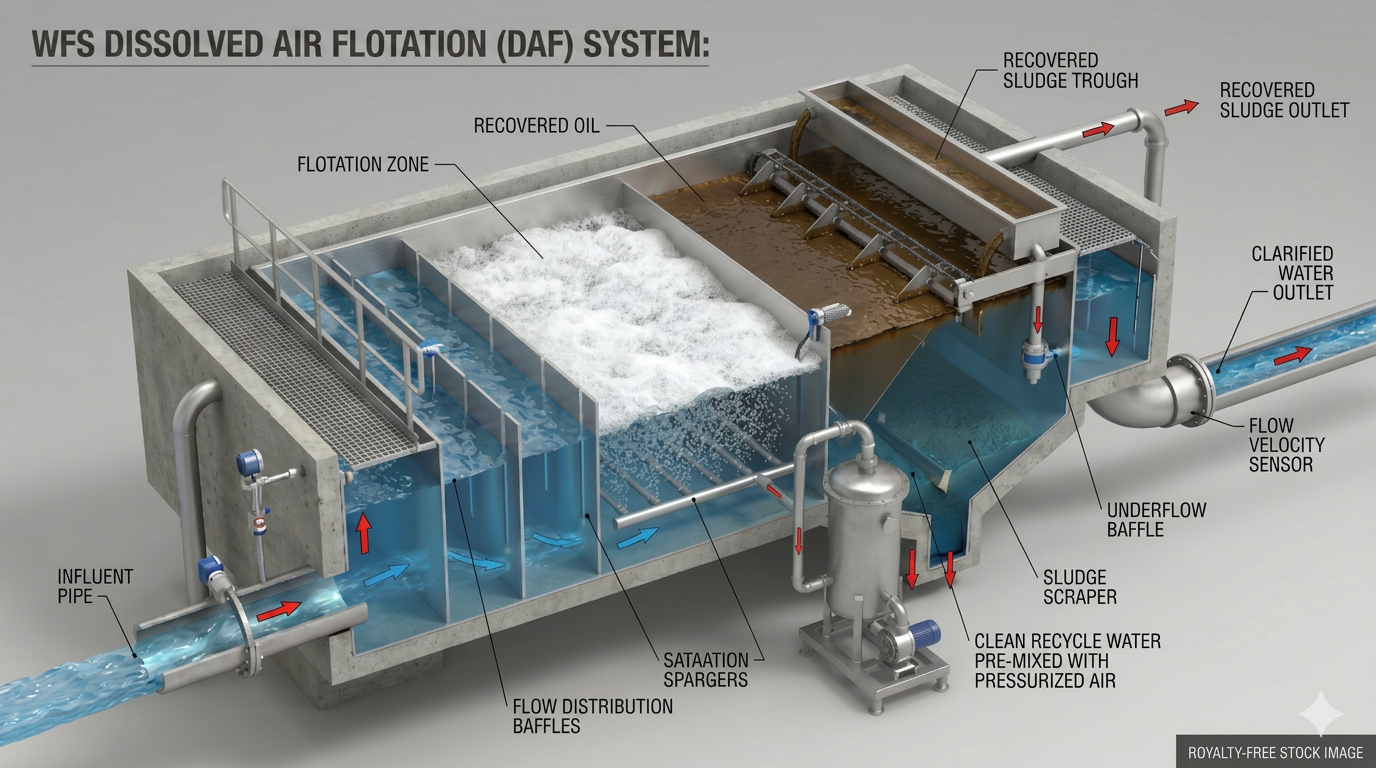 Secondary
Dissolved Air Flotation
DAFMicro-bubble flotation that lifts emulsified oil, light solids and chemical floc to the surface — the workhorse secondary de-oiler for emulsified streams.
Explore technology →