
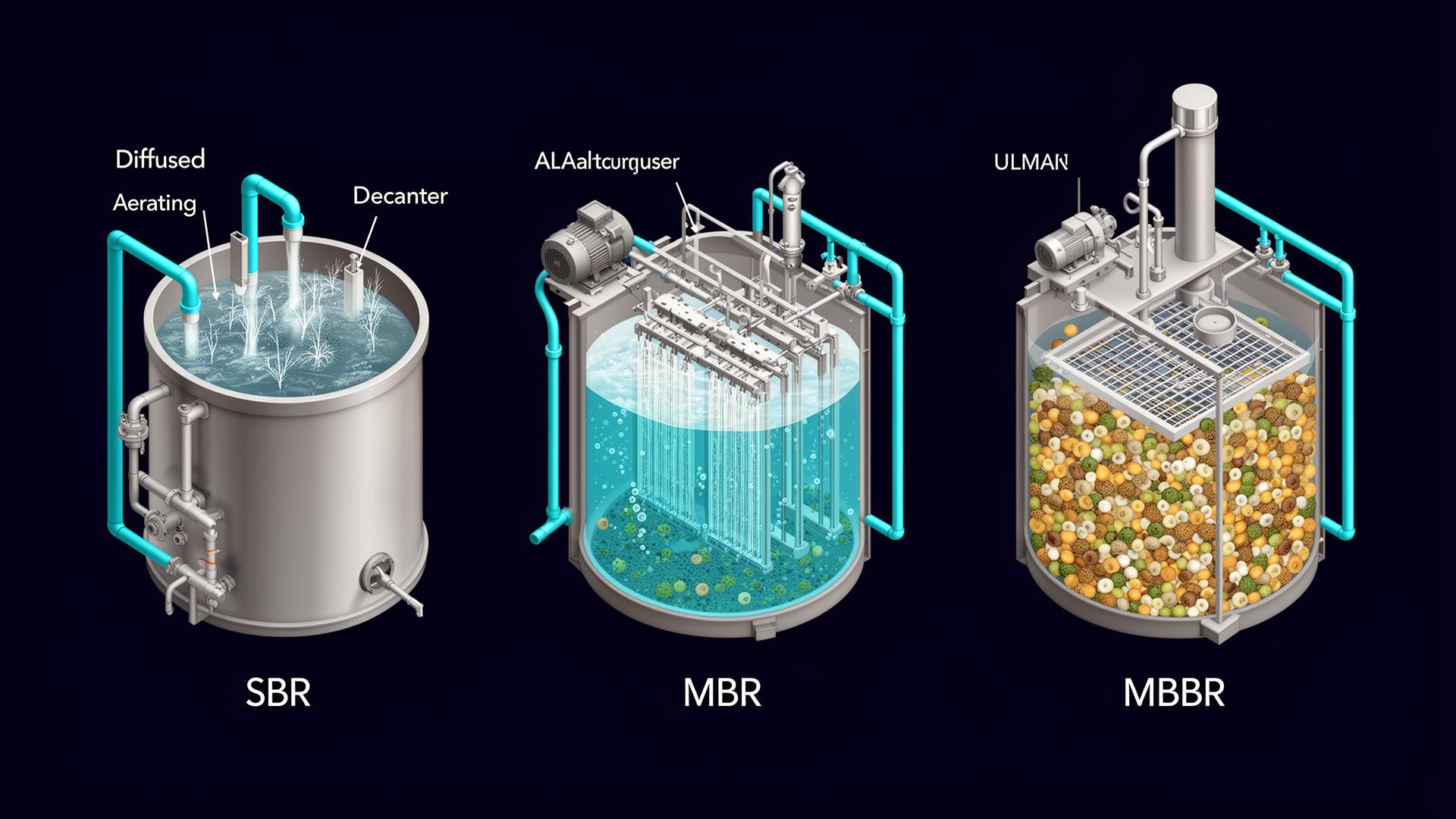
🦠 Biological Reactor System (SBR / MBR / MBBR)
Aerobic Biological Treatment for BOD, COD, Ammonia & Recalcitrant Organics
WFS biological reactors degrade BOD, COD, ammonia, sulfides, phenols, and soluble hydrocarbons using engineered microbial consortia. The same platform supports three reactor architectures: SBR (batch nitrification-denitrification in a single tank), MBR (mixed-liquor + submerged hollow-fiber UF membranes), and MBBR (moving plastic biofilm carriers in an aerated tank).
Each configuration is supplied with a fine-bubble diffused aeration grid, a turn-down blower package, a nutrient (N/P) dosing station as needed, alkalinity correction for nitrification, and SCADA-linked DO/ORP/MLSS instrumentation. Sludge management is sized for the design SRT — wasting to a thickener, dewatering centrifuge, or filter press.
Bioreactors are deployed in series with API/CPI or DAF clarification upstream and GAC / RO polishing downstream to achieve discharge-grade effluent.
Reactor Configurations
Select a configuration to view reaction mechanism, advantages, and target contaminants.
Single-tank batch process cycling through fill, react (aerobic/anoxic), settle, decant, and idle phases. Excellent for variable flow and load — common on smaller installations and remote sites.
- · No external clarifier needed
- · Handles load swings
- · Simple footprint
- · Excellent N removal
Full Specifications
- Flow Range
- 5–500 m³/hr
- BOD Removal
- >95%
- Ammonia Removal
- >98% (with nitrification)
- Footprint
- Up to 70% smaller (MBR vs CAS)
- Aeration
- Fine-bubble diffused, turn-down blower
- MLSS
- 3,000–12,000 mg/L (config dependent)
- SRT
- 10–30 days typical
- DO Set Point
- 1.5–3.0 mg/L (aerobic zones)
- Carriers (MBBR)
- Polyethylene K1/K3/K5, 40–67% fill
- Membranes (MBR)
- PVDF hollow fiber, 0.04 µm
- Controls
- PLC + DO/ORP/MLSS/NH₃ probes
- Sludge Yield
- 0.3–0.6 kg VSS / kg BOD removed
Configure your Biological Reactor System (SBR / MBR / MBBR)
Submit your water chemistry, flow rate, and site conditions — our engineers will return a sized configuration and process datasheet.